

By Donald Kenkela, and Grace Phillips
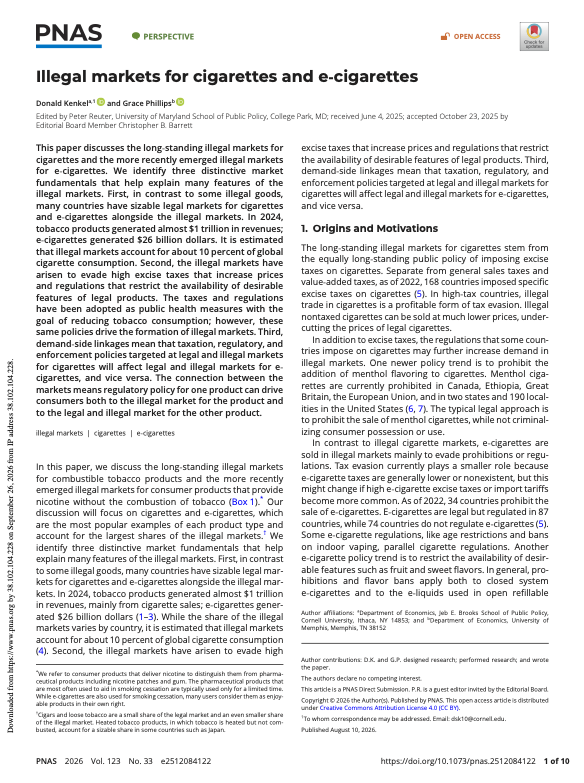
This paper discusses the long- standing illegal markets for cigarettes and the more recently emerged illegal markets for e- cigarettes. We identify three distinctive market fundamentals that help explain many features of the illegal markets. First, in contrast to some illegal goods, many countries have sizable legal markets for cigarettes and e-cigarettes alongside the illegal markets. In 2024, tobacco products generated almost $1 trillion in revenues; e- cigarettes generated $26 billion dollars. It is estimated that illegal markets account for about 10 percent of global cigarette consumption. Second, the illegal markets have arisen to evade high excise taxes that increase prices and regulations that restrict the availability of desirable features of legal products. The taxes and regulations have been adopted as public health measures with the goal of reducing tobacco consumption; however, these same policies drive the formation of illegal markets. Third, demand- side linkages mean that taxation, regulatory, and enforcement policies targeted at legal and illegal markets
for cigarettes will affect legal and illegal markets for e-cigarettes, and vice versa. The connection between the
markets means regulatory policy for one product can drive consumers both to the illegal market for the product and to the legal and illegal market for the other product.
By: Beckner Andersano , Thomas M. Cahill , Michael Grommes , Maxwell C. K. Leung
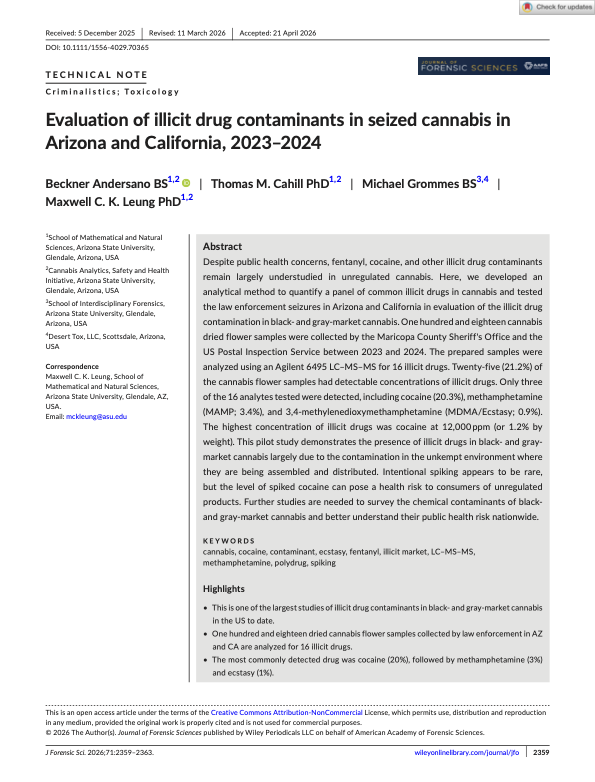
Despite public health concerns, fentanyl, cocaine, and other illicit drug contaminants remain largely understudied in unregulated cannabis. Here, we developed an analytical method to quantify a panel of common illicit drugs in cannabis and tested the law enforcement seizures in Arizona and California in evaluation of the illicit drug contamination in black- and gray-market cannabis. One hundred and eighteen
cannabisdried flower samples were collected by the Maricopa County Sheriff's Office and theUS Postal Inspection Service between 2023 and 2024. The prepared samples wereanalyzed using an Agilent 6495 LC–MS–MS for 16 illicit drugs. Twenty-five (21.2%) of the cannabis flower samples had detectable concentrations of illicit drugs. Only three of the 16 analyses tested were detected, including cocaine (20.3%), methamphetamine(MAMP; 3.4%), and 3,4-methylenedioxymethamphetamine(MDMA/Ecstasy; 0.9%) .The highest concentration of illicit drugs was cocaine at 12,000 ppm (or 1.2% byweight). This pilot study demonstrates the presence of illicit drugs in black- and gray-market cannabis largely due to the contamination in the unkempt environment where they are being assembled and distributed. Intentional spiking appears to be rare, but the level of spiked cocaine can pose a health risk to consumers of unregulated products. Further studies are needed to survey the chemical contaminants of black-and gray-market cannabis and better understand their public health risk nationwide.
By Jay P. Kennedy
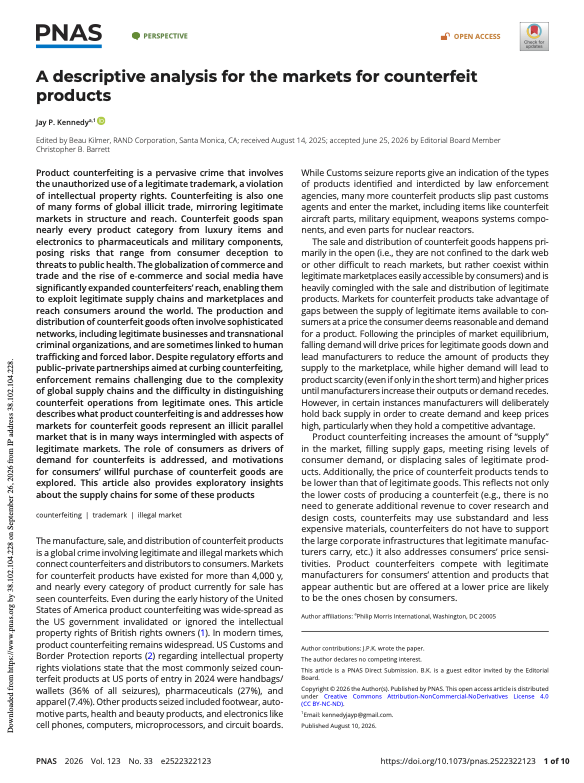
Product counterfeiting is a pervasive crime that involves the unauthorized use of a legitimate trademark, a violation of intellectual property rights. Counterfeiting is also one of many forms of global illicit trade, mirroring legitimate markets in structure and reach. Counterfeit goods span nearly every product category from luxury items and electronics to pharmaceuticals and military components, posing risks that range from consumer deception to threats to public health. The globalization of commerce and trade and the rise of e-commerce and social media have significantly expanded counterfeiters’ reach, enabling them to exploit legitimate supply chains and marketplaces and reach consumers around the world. The production and
distribution of counterfeit goods often involve sophisticated networks, including legitimate businesses and transnational criminal organizations, and are sometimes linked to human trafficking and forced labor. Despite regulatory efforts and public–private partnerships aimed at curbing counterfeiting, enforcement remains challenging due to the complexity of global supply chains and the difficulty in distinguishing counterfeit operations from legitimate ones. This article describes what product counterfeiting is and addresses how
markets for counterfeit goods represent an illicit parallel market that is in many ways intermingled with aspects of legitimate markets. The role of consumers as drivers of demand for counterfeits is addressed, and motivations for consumers’ willful purchase of counterfeit goods are explored. This article also provides exploratory insights about the supply chains for some of these products
By Joras Ferwerda
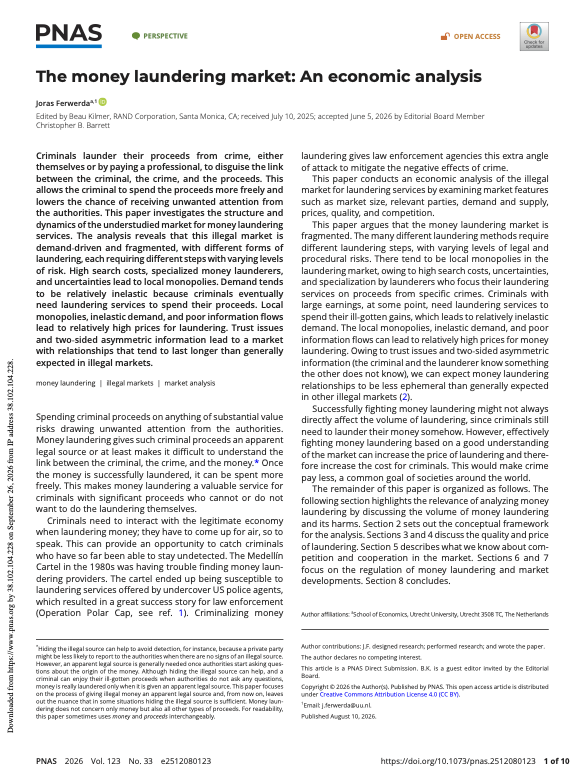
Criminals launder their proceeds from crime, either themselves or by paying a professional, to disguise the link between the criminal, the crime, and the proceeds. This allows the criminal to spend the proceeds more freely and lowers the chance of receiving unwanted attention from the authorities. This paper investigates the structure and dynamics of the understudied market for money laundering services. The analysis reveals that this illegal market is demand-driven and fragmented, with different forms of laundering, each requiring different steps with varying levels of risk. High search costs, specialized money launderers, and uncertainties lead to local monopolies. Demand tends to be relatively inelastic because criminals eventually need laundering services to spend their proceeds. Local monopolies, inelastic demand, and poor information flows
lead to relatively high prices for laundering. Trust issues and two-sided asymmetric information lead to a market with relationships that tend to last longer than generally expected in illegal markets.
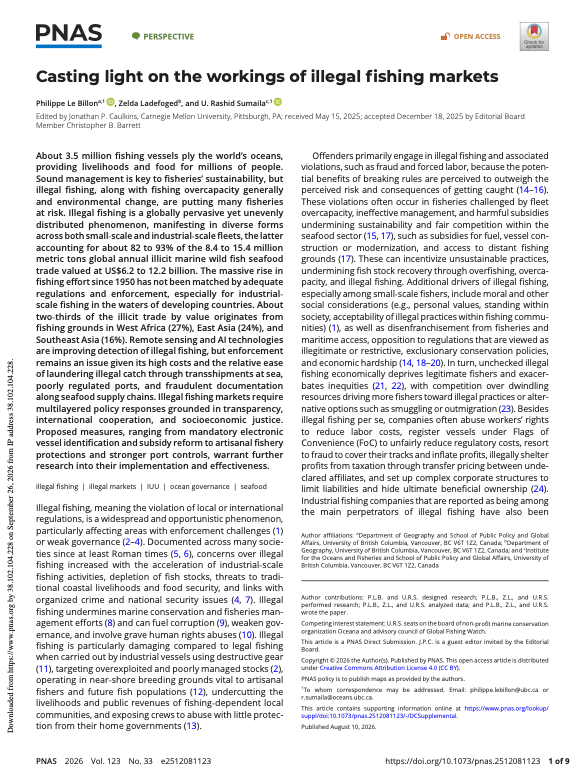
By: Philippe Le Billona, Zelda Ladefoged, and U. Rashid Sumailac
About 3.5 million fishing vessels ply the world’s oceans, providing livelihoods and food for millions of people.
Sound management is key to fisheries’ sustainability, but illegal fishing, along with fishing overcapacity generally and environmental change, are putting many fisheries at risk. Illegal fishing is a globally pervasive yet unevenly distributed phenomenon, manifesting in diverse forms across both small- scale and industrial- scale fleets, the latter accounting for about 82 to 93% of the 8.4 to 15.4 million metric tons global annual illicit marine wild fish seafood trade valued at US$6.2 to 12.2 billion. The massive rise in fishing effort since 1950 has not been matched by adequate regulations and enforcement, especially for industrial scale fishing in the waters of developing countries. About two- thirds of the illicit trade by value originates from fishing grounds in West Africa (27%), East Asia (24%), and Southeast Asia (16%). Remote sensing and AI technologies are improving detection of illegal fishing, but enforcement remains an issue given its high costs and the relative ease of laundering illegal catch through transshipments at sea, poorly regulated ports, and fraudulent documentation along seafood supply chains. Illegal fishing markets require multilayered policy responses grounded in transparency, international cooperation, and socioeconomic justice. Proposed measures, ranging from mandatory electronic vessel identification and subsidy reform to artisanal fishery protections and stronger port controls, warrant further research into their implementation and effectiveness.
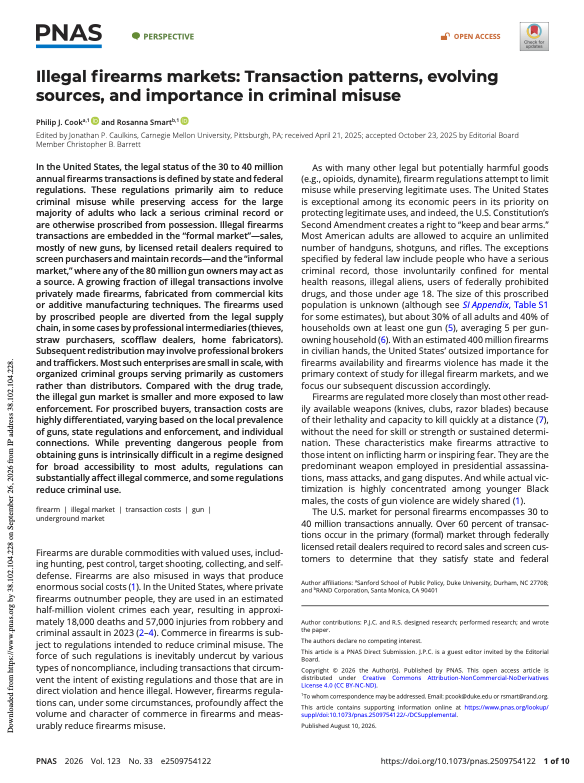
By Philip J. Cook, and Rosanna Smart
In the United States, the legal status of the 30 to 40 million annual firearms transactions is defined by state and federal regulations. These regulations primarily aim to reduce criminal misuse while preserving access for the large majority of adults who lack a serious criminal record or are otherwise proscribed from possession. Illegal firearms transactions are embedded in the “formal market”—sales, mostly of new guns, by licensed retail dealers required to screen purchasers and maintain records—and the “informal market,” where any of the 80 million gun owners may act as a source. A growing fraction of illegal transactions involve privately made firearms, fabricated from commercial kits or additive manufacturing techniques. The
firearms used by proscribed people are diverted from the legal supply chain, in some cases by professional intermediaries (thieves, straw purchasers, scofflaw dealers, home fabricators). Subsequent redistribution may involve professional brokers and traffickers. Most such enterprises are small in scale, with organized criminal groups serving primarily as customers rather than distributors. Compared with the drug trade, the illegal gun market is smaller and more exposed to law enforcement. For proscribed buyers, transaction costs are highly
differentiated, varying based on the local prevalence of guns, state regulations and enforcement, and individual connections. While preventing dangerous people from obtaining guns is intrinsically difficult in a regime designed for broad accessibility to most adults, regulations can substantially affect illegal commerce, and some regulations reduce criminal use.
By United Nations EMLER
In the present report, the International Independent Expert Mechanism to Advance Racial Justice and Equality in Law Enforcement examines how racism is embedded in drug control systems and shapes their impacts on Africans and people of African descent. It begins by exploring the root causes of racial discrimination in drug policy, including the legacies of colonialism, the racialization of drugs, the influence of militarized approaches and the “war on drugs”. The Mechanism then analyses manifestations of racial discrimination across the criminal justice system. Building on this analysis, it examines the intersection of drug policy with other grounds of discrimination, such as gender, highlighting how intersecting forms of discrimination can increase the risk of human rights violations. The Mechanism also identifies factors that exacerbate these harms and concludes by highlighting promising practices and policy approaches aimed at
addressing racial discrimination and advancing more equitable and rights-based drug policies. The present report also includes information on the activities of the Mechanism since its previous report.
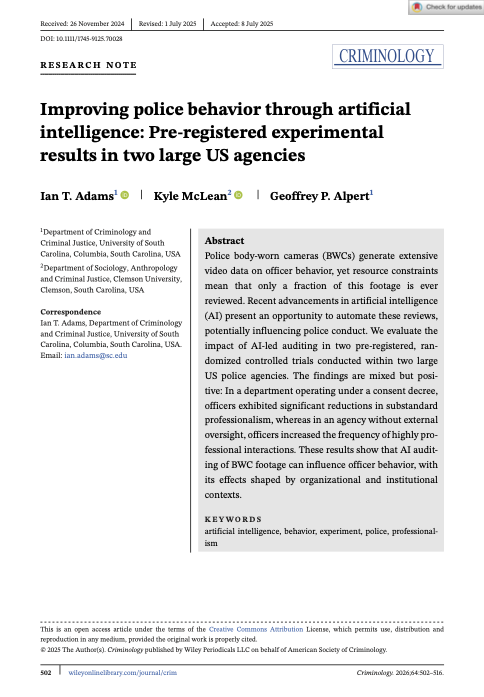
By Ian T. Adams, Kyle McLean, Geoffrey P. Alpert
Police body-worn cameras (BWCs) generate extensive video data on officer behavior, yet resource constraints mean that only a fraction of this footage is ever reviewed. Recent advancements in artificial intelligence (AI) present an opportunity to automate these reviews, potentially influencing police conduct. We evaluate the impact of AI-led auditing in two pre-registered, randomized controlled trials conducted within two large US police agencies. The findings are mixed but positive: In a department operating under a consent decree, officers exhibited significant reductions in substandard professionalism, whereas in an agency without external oversight, officers increased the frequency of highly professional interactions. These results show that AI auditing of BWC footage can influence officer behavior, with its effects shaped by organizational and institutional contexts.