


By Revolving Doors and Newton
The hidden cost of England’s so-called “prolific offenders” the people repeatedly in the headlines for shoplifting and low-level crime – is laid bare in groundbreaking new research by Revolving Doors and
Newton.
The report is the first of its kind, bringing together the insights of people with lived experience of the ‘revolving door’ of reoffending with innovative analysis of real public sector data, including case notes. It reveals new findings about the toll that punishment without rehabilitation and key missed opportunities has on people, public finances and public services.
Revolving Doors is now calling for a joint-departmental Government response across health, justice and housing. They are also requesting a focus on interventions that are known to work to address the root
causes of offending and a joined-up approach that combines shared data, thinking and lived experience.
The joint analysis finds:
● Between 30,000 and 50,000 individuals make up this group, trapped in cycles of repeat offending.
● They are responsible for at least 130,000 crimes a year, from shoplifting and assault to drug offences and criminal damage.
● True costs find that individuals cost more than £100,000 each year, with lifetime costs of over £1.4m.
● They cost the criminal justice system at least £242m annually, with a total socio-economic bill of up to £5.2bn. This figure represents almost a quarter of all reoffending costs and is the first ever measurement of this group’s impact on public services including the NHS, councils and social services.
Those in this group are often referred to as “prolific offenders”. This report identifies them more clearly to show they are in fact the ‘revolving door cohort’: people in crisis who cycle in and out of the justice system because of unmet health and social needs – including mental ill health, addiction, homelessness and histories of trauma.
Crucially, this group is not captured by existing systems like Integrated Offender Management, which was set up to specifically target those identified as most persistently offending.
By Mohammad Fazle Rabbi
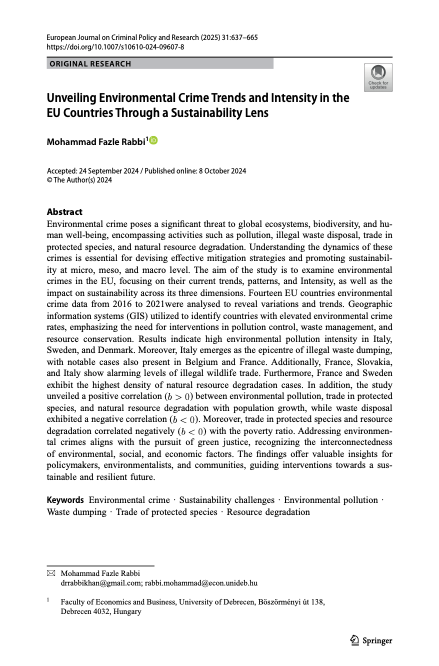
Environmental crime poses a significant threat to global ecosystems, biodiversity, and human well-being, encompassing activities such as pollution, illegal waste disposal, trade in protected species, and natural resource degradation. Understanding the dynamics of these crimes is essential for devising effective mitigation strategies and promoting sustainability at micro, meso, and macro level. The aim of the study is to examine environmental crimes in the EU, focusing on their current trends, patterns, and Intensity, as well as the impact on sustainability across its three dimensions. Fourteen EU countries environmental crime data from 2016 to 2021were analysed to reveal variations and trends. Geographic information systems (GIS) utilized to identify countries with elevated environmental crime rates, emphasizing the need for interventions in pollution control, waste management, and resource conservation. Results indicate high environmental pollution intensity in Italy, Sweden, and Denmark. Moreover, Italy emerges as the epicentre of illegal waste dumping, with notable cases also present in Belgium and France. Additionally, France, Slovakia, and Italy show alarming levels of illegal wildlife trade. Furthermore, France and Sweden exhibit the highest density of natural resource degradation cases. In addition, the study unveiled a positive correlation () between environmental pollution, trade in protected species, and natural resource degradation with population growth, while waste disposal exhibited a negative correlation (). Moreover, trade in protected species and resource degradation correlated negatively () with the poverty ratio. Addressing environmental crimes aligns with the pursuit of green justice, recognizing the interconnectedness of environmental, social, and economic factors. The findings offer valuable insights for policymakers, environmentalists, and communities, guiding interventions towards a sustainable and resilient future.