
Open Access Publisher and Free Library
CRIME+CRIMINOLOGY.jpeg

CRIME

Violent-Non-Violent-Cyber-Global-Organized-Environmental-Policing-Crime Prevention-Victimization

Posts tagged Cultural Ecosystem
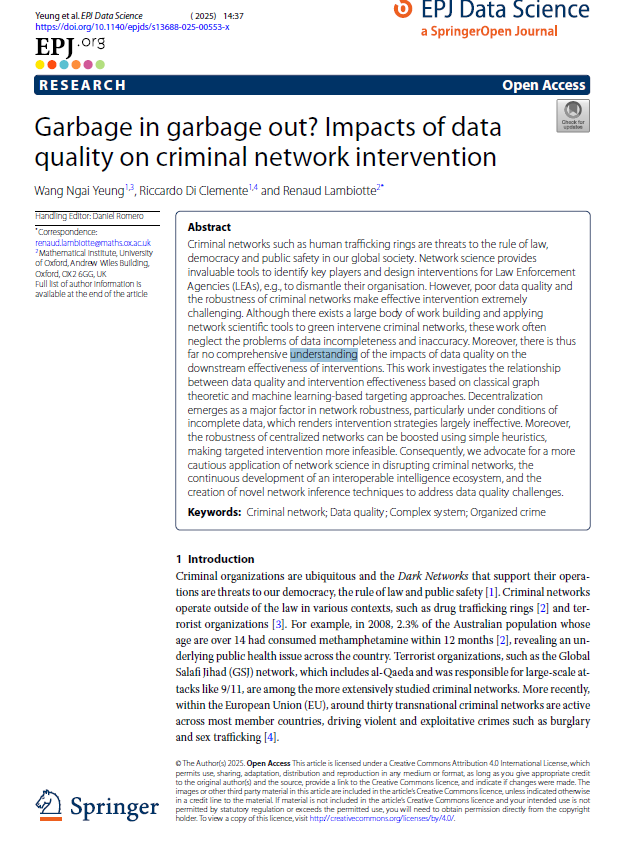
Garbage in garbage out? Impacts of data quality on criminal network intervention

By Wang Ngai Yeung, Riccardo Di Clemente & Renaud Lambiotte

Criminal networks such as human trafficking rings are threats to the rule of law, democracy and public safety in our global society. Network science provides invaluable tools to identify key players and design interventions for Law Enforcement Agencies (LEAs), e.g., to dismantle their organisation. However, poor data quality and the robustness of criminal networks make effective intervention extremely challenging. Although there exists a large body of work building and applying network scientific tools to green intervene criminal networks, these work often neglect the problems of data incompleteness and inaccuracy. Moreover, there is thus far no comprehensive understanding of the impacts of data quality on the downstream effectiveness of interventions. This work investigates the relationship between data quality and intervention effectiveness based on classical graph theoretic and machine learning-based targeting approaches. Decentralization emerges as a major factor in network robustness, particularly under conditions of incomplete data, which renders intervention strategies largely ineffective. Moreover, the robustness of centralized networks can be boosted using simple heuristics, making targeted intervention more infeasible. Consequently, we advocate for a more cautious application of network science in disrupting criminal networks, the continuous development of an interoperable intelligence ecosystem, and the creation of novel network inference techniques to address data quality challenges.

 EPJ Data Sci. 14, 37 (2025)

Spatiotemporal Impacts of Drug Crop and Commodity Agriculture on Cultural Ecosystem Services: The Case of Ischnosiphon in Ticuna Communities of Loreto, Peru

By Juan José Palacios Vega, Manuel Martín Brañas, Sydney Silverstein, Ricardo Zárate Gómez, Nicholas Kawa, Margarita del Águila Villacorta

In recent decades, drug crop eradication and drug trafficking interdiction have pushed drug crop cultivation into new areas of the Amazonian rainforest. The presence of the drug industries in these regions—followed by alternative development programs that aim to substitute illicit drug crops with commodity crops like cacao—has transformed forest ecologies, risking loss to both biodiversity and cultural ecosystem services (CES) for surrounding communities. In the last ten years, forest loss linked to the increase in cultivation of commodity crops—both licit and illicit—has been monitored, generating extensive geospatial data. However, the spatiotemporal impacts on key plant species utilized by indigenous communities who have recently shifted to drug crop and commodity agricultural production remain poorly understood. In this paper, we use geospatial modeling to explore the potential impacts of drug crop cultivation and alternative development programs on the CES of Ticuna indigenous communities of the Peruvian Amazon. We analyze the spatiotemporal impact of drug and commodity crop cultivation on three culturally significant species of the genus Ischnosiphon, known locally as dexpe or huarumá, by generating a model of the potential distribution of the three species. The rate of increase of legal and illegal crops was also calculated and the spatiotemporal impact was measured and represented using spatial analysis techniques. Our analysis finds that, between 2010 and 2020, the increase in both illicit and licit commodity crop cultivation is correlated with changes in the distribution of huarumá species, which in turn affects the cultural ecosystem services of Ticuna communities.

Journal of Illicit Economies and Development, 6(1): pp. 93–111.