

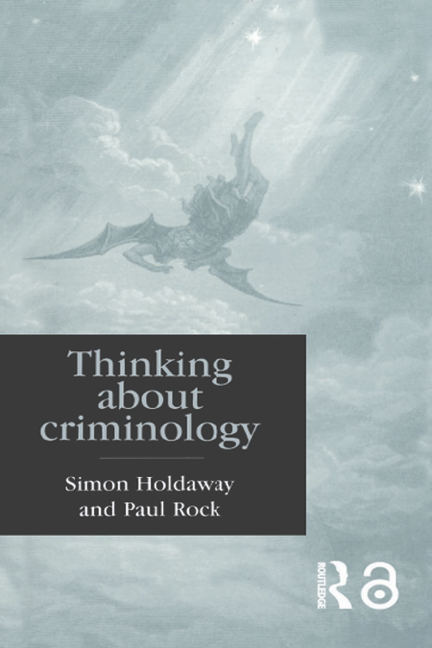
Edited by Simon Holdaway and Paul Rock
First published in 1998. Thinking about criminology draws together the expertise of respected criminologists from the principle contemporary schools of thought. The book aims to provide a clear analysis of the relationship between sociological theory and contemporary empirical criminological research, discussing the ways in which theoretical perspectives have contributed to the understanding of relevant criminal justice institutions, law and policy.
by Graeme Newman (Author), Sheldon Glueck (Author)
When a court asks whether a defendant was too mentally ill to be responsible, whose knowledge should decide it: the judge's, the jury's, or the doctor's? A reader's guide to the 1925 book that first mapped the whole problem.
In 1925, a young Harvard scholar named Sheldon Glueck published Mental Disorder and the Criminal Law, a study of nearly seven hundred pages on how American courts handle the mentally ill accused. It appeared while the country was arguing over Leopold and Loeb, over rising murder rates, and over Chief Justice Taft's charge that criminal justice was a disgrace to civilization. Glueck asked how courts find out that a defendant is mentally ill, how the legal tests of insanity were made, what psychiatry actually says about the main mental disorders, and what becomes of defendants who are acquitted. His answer was that the law had cut the mind into separate compartments of knowing, feeling and willing, and that reform had to begin with the unity of the mind.
The book is long, technical and dense with footnotes. This Reader's Guide makes it accessible without replacing it. It explains the argument in plain language, supplies the legal and medical background a modern reader may lack, and shows where the reasoning is strong and where it is open to question.
INSIDE THIS GUIDE
A reading plan and a chapter-by-chapter map of the original
The pretrial-examination law of Massachusetts and what its first 113 examinations found
How the tests of insanity were made, from Hale and the "wild beast" to M'Naghten and the American courts
The argument that mental processes are a unity, and why it undercuts the old tests
A table of the main mental disorders of 1925 and what each meant for criminal responsibility
What happens to defendants acquitted by reason of insanity, and the fight over release
Glueck's program: neutral experts, a new jury charge, a verdict of partial responsibility, and a commission to decide treatment after conviction
A worked example that applies his 1925 jury charge to three imaginary defendants
What has changed since 1925, from Durham to the Insanity Defense Reform Act, and the eugenics assumptions the book shared with its time
Five common misreadings, a primer of legal terms, a glossary, an annotated reading list, an FAQ, 26 discussion questions and classroom activities
WHO IT'S FOR
Students of law, criminology, psychology, psychiatry and history; teachers and reading groups; and general readers who want to know how the insanity defense came to be the way it is.
PLEASE NOTE
This is an independent guide, not an abridgment or edition of Glueck's book. It does not reproduce the original's text and is not endorsed by the author's heirs or the original publisher. It is meant to be read alongside the original. Download the original book.
Written by Graeme R. Newman with the assistance of Claude, an AI model made by Anthropic. The AI-generated content is disclosed in accordance with Read-Me.Org policy.
Read-Me.Org Inc. New York-Philadelphia-Australia. 2026. p.64.
by Graeme Newman (Author), Sheldon Glueck (Author)
If a man kills because he is certain his victim is plotting against him, and he knows killing is against the law, is he responsible?
In 1962, Sheldon Glueck of the Harvard Law School gave four lectures at Tulane University on one of the hardest questions in criminal law: where to draw the line between the wicked and the ill. Law and Psychiatry: Cold War or Entente Cordiale? reviews the tests of legal insanity, says what is wrong with each, proposes a new one, and argues that lawyers and psychiatrists are quarreling over too small a prize.
This Reader's Guide explains his arguments in plain language, supplies the legal background, and shows what has changed since. Inside are a lecture map, a worked example applying six tests to three imaginary defendants, common misreadings, and discussion questions.
A companion to the original, for students, teachers and curious readers. Download the original book.
Read-Me.Org Inc. New York-Philadelphia-Australia. 2026. p.64.
By Bernard Glueck. Designed and Edited with an Introduction by Graeme R. Newman and Claude.
In 1916, psychiatrist Bernard Glueck made a case that was still radical for its time: that prisons and asylums needed trained psychiatrists on staff, not as outside consultants, but as clinicians embedded in the institution itself. Writing from the criminal department of the Government Hospital for the Insane in Washington, D.C., Glueck laid out five detailed case studies that argued, one patient at a time, for a new way of understanding the criminal mind.
Inside, you'll find:
A clinical study of psychogenic psychosis in prisoners — the theory that mental breakdown behind bars is often a meaningful reaction to arrest, trial, and confinement, not simply organic illness
An extended case-by-case analysis of malingering, and the difficult problem of separating feigned symptoms from genuine mental illness
A study of "litigious paranoia" — the compulsive, self-representing plaintiff who turns the courtroom into an extension of his delusion
A landmark early psychoanalytic case history of kleptomania
Glueck went on to found the first psychiatric clinic ever established inside an American prison, at Sing Sing, and later served as a psychiatric expert in the Leopold and Loeb trial. He was also the elder brother of criminologist Sheldon Glueck — making this book a companion volume to Read-Me.Org's editions of War Criminals and Probation and Criminal Justice.
This new edition includes a substantial original introduction by Graeme R. Newman, assessing Glueck's century-old argument against the present day: what holds up in modern correctional psychiatry, what doesn't, and a hard look at whether American prisons have actually delivered on the promise Glueck was making in 1916 — including current data on the ongoing shortage of psychiatric staffing across U.S. correctional systems.
A Read-Me.Org Classic Reprint. This is a corrected and reformatted edition of the 1916 first edition (Little, Brown, and Company), prepared from a public domain source text under a Creative Commons Attribution 4.0 International License. AI-assisted tools were used in the production of this edition, as disclosed on our website.
Read-Me.Org Inc. New York-Philadelphia-Australia. 2026. p.165.
By D.J. Summers
in the past five years, Colorado’s largest cities have had very different experiences of crime.
Colorado’s violent and property crime rates rose sharply in the early 2020s, prompting varying responses from leaders at state and local levels. Some have been more successful than others, according to the most recently available Colorado Bureau of Investigation data.
CSI analyzed the violent and property crime trends of Colorado’s ten largest cities: Denver, Colorado Springs, Aurora, Fort Collins, Lakewood, Thornton, Arvada, Westminster, Pueblo, and Centennial. These ten cities represent just under half the state’s total population, with a combined population of roughly 2.3 million residents. CSI analyzed the average violent and property crime rates per 100,000 people through the first two quarters of each year between 2016 and 2025. Pueblo’s police data is not current and could not be included in the analysis.
Property and violent crime cost the state $27 billion in economic losses in 2022 between the tangible and intangible effects of reported and unreported crime. It is imperative that public leaders continually examine and understand which policies best address crime rates.
Key Findings
Denver’s violent crime rate is the highest among Colorado’s largest cities, with 235 violent crimes per 100,000 people.
Aurora’s is second highest, with 203 violent crimes per 100,000 people.
Aurora’s violent crime has remained beneath Denver’s for three years, breaking the trend of the late 2010s and early 2020s in which Aurora’s rates were higher.
Only Colorado Springs saw an increase in the violent crime rate between 2022 and 2025.
Among the largest cities, Aurora saw the sharpest decrease in violent crime rate.
Aurora saw the second highest decrease in violent crime rate, with a 36% decrease.
Denver has the highest property crime rate of Colorado’s largest cities, with 1,122 property crimes per 100,000 people.
Lakewood has the second highest rate, with 1,099 per 100,000 people.
Aurora and Centennial had the sharpest decreases in property crime rate since 2021, at 56%, 49%, and 44%, respectively.
By Sarah Ferencz, Alissa Greer, Amanda Butler
This qualitative study examines how frontline police officers in British Columbia experienced and adapted to Canada's first formal drug decriminalization policy 1 year after implementation. Drawing on 30 semi-structured interviews and using thematic analysis with a policy alienation and street-level bureaucracy lens, we analyzed how officers felt alienated from the policy process and coped with this experience as frontline implementers. Key themes show that frontline officers experienced processes of policy alienation in various ways: they felt that the policy was misaligned with their frontline perspectives; the Policy undermined their ability to help people in their communities; and legal ambiguity surrounding the Policy was challenging to navigate. Their coping strategies revealed that officers interpreted and executed decriminalization in divergent ways.
Policy Implications
These findings have important implications for policymakers and police leadership considering drug policy reforms. Officers’ feelings of disempowerment and policy meaninglessness, especially in contexts of legal ambiguity, may lead to inconsistent or inequitable enforcement. Strengthening communication across police ranks is critical. Middle managers may help translate reform goals, identify resource gaps, and support effective coping strategies. Legal clarity should extend beyond policy updates to help officers reconcile overlapping laws and reduce liability concerns. While there are limits to policy consultation with frontline officers within the hierarchical structure of police institutions, reform efforts should still engage with frontline officers’ working logics. Training should address harmful attitudes and misunderstandings of drug use, clarify legal boundaries, and mitigate unintended harms of enforcement. Ultimately, effective drug policy reform in a multi-jurisdictional system requires acknowledging how frontline officers interpret and shape
policy within institutional constraints.
By Ali Malik
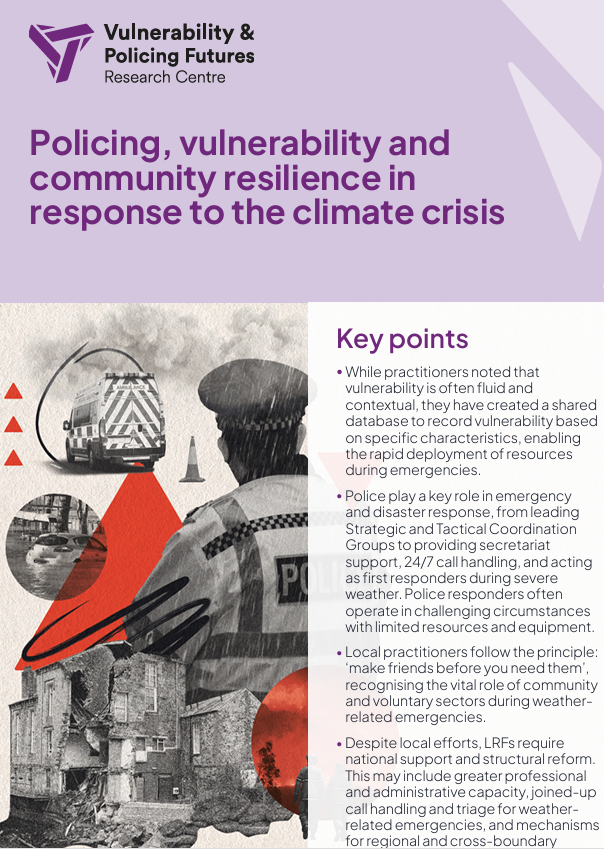
The increasing frequency and severity of extreme weather events in the UK, such as storms, flooding, heatwaves, and severe cold spells, recognised as consequences of the climate crisis, have placed significant operational and organisational pressures on police, emergency responders and local authorities. This research adopts an in-depth qualitative case study design and a temporal analogues approach, which draws on past experiences and events to develop an understanding of the present and inform future learning. Doing this provides insights into the role of the police and Local Resilience Forums (LRFs) in preparing for and responding to extreme weather eventsThe findings highlight that LRFs are essential for locally led emergency planning. However, due to resource constraints, these partnerships often rely on relational capital, negotiated agreement and goodwill. Decisive leadership, situational awareness, experience from past events and routine work were also described as key factors for effective emergency response. LRFs cannot mitigate the impacts of the climate crisis without national support. Local preparedness depends on safe homes, green spaces, reliable transport networks and affordable clean energy. The research also points to the need for greater professional, analytical, and specialist support for LRFs, along with targeted funding to resource localised efforts for preparedness, recovery, and long-term climate adaptation.
By Devon W. Carbado
This Article employs the Law Review’s Discourse symposium on my book, Unreasonable: Black Lives, Police Power, and the Fourth Amendment, as a starting point to foreground and elaborate on an idea that I reference in that text: police power abolition. The Article begins by describing the central insight that motivates Unreasonable—namely, that simply limiting the frequency with which the police interact with Black people could save Black lives. If the police have fewer opportunities to stop and question Black people, they have fewer opportunities to kill us. That observation led me to think about the range of structural forces that facilitate contact between Black people and the police. Fourth Amendment law is one such force. From pedestrian checks, to traffic stops, to stops and frisks, to searches and seizures at the border, Fourth Amendment law permits the police to interact with and enact violence against Black people on the thinnest, most unreasonable of suspicions. The Article does not reprise precisely how Fourth Amendment law performs that racially subordinating work. For that, you will have to read Unreasonable and the broader body of work on which the book is based. Instead, the Article summarizes the core arguments Unreasonable propounds, links them to what I call “police power abolition,” and explains how police power abolition can provide an entry into and render more legible broader discourses about abolition. Throughout the Article, I draw on and react to the generous and generative review essays that participants in this symposium have written about the book. In the context of doing so, I explain why, notwithstanding the limitations of law as space for antiracist interventions, the legal terrain should remain a critical (though not the only or most important) site for advancing
racial justice.
UCLA School of Law, Public Law Research Paper Forthcoming
69 Pages Posted: 20 Nov 2025
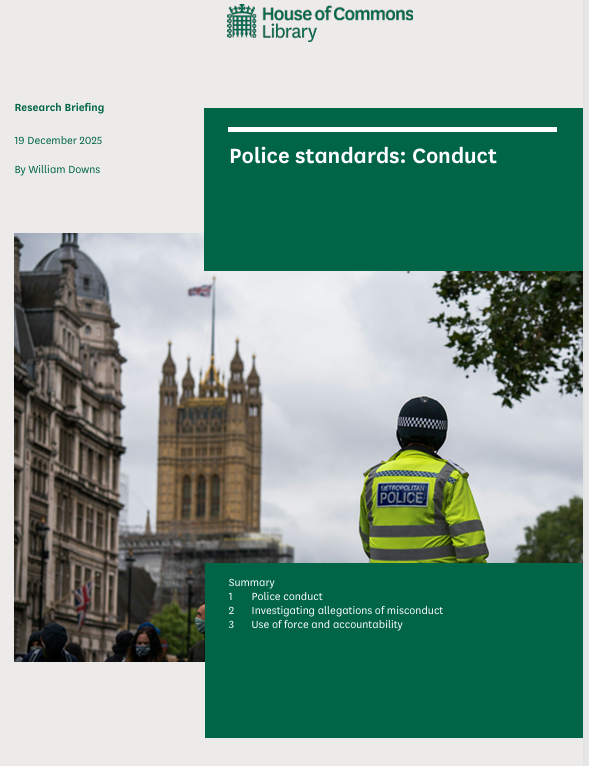
By William Downs
Police misconduct is behaviour by a police officer that falls below the standards of professional behaviour for the police.
Cases of police misconduct can arise from concerns raised by police officers or staff, or following incidents where members of the public have been harmed by the actions of the police.
What are the laws on police misconduct?
Legislation specifies how allegations of police misconduct should be handled, though the framework is complex. In short, most allegations of police misconduct are handled in line with rules set out in the Police Act 1996 and Police (Conduct) Regulations 2020. This legislation is designed to support the police in maintaining a disciplined force. The Home Office provides statutory guidance on implementing this legislation.
London: UK Parliament, House of Commons Library, 2025. 23p.
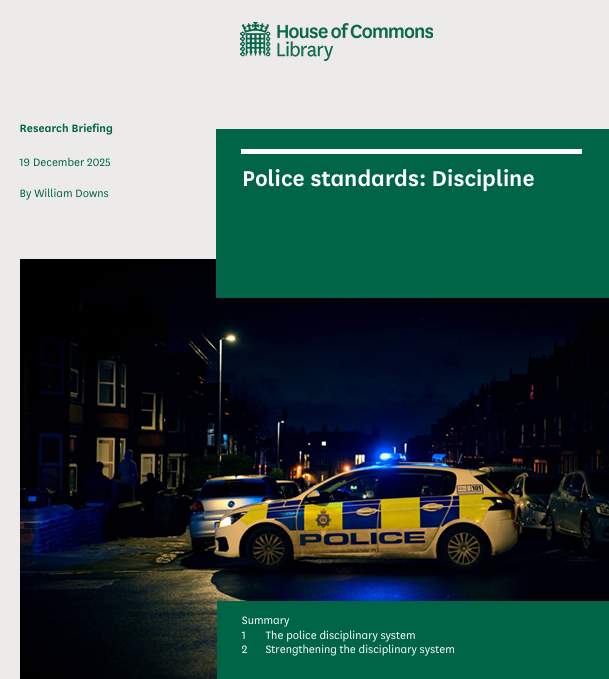
By William Downs
Police disciplinary proceedings are brought in cases where it is agreed, following an investigation, that a police officer has a case to answer for: • misconduct (meaning a breach of the standards of professional behaviour that justifies disciplinary action of at least written), or • gross misconduct (meaning a breach of the standards of professional behaviour that is so serious to justify dismissal) A decision on whether there is a case to answer is based on whether there is sufficient evidence upon which a misconduct panel “could make a finding on the balance of probabilities” that an officer’s behaviour amounted to misconduct or gross misconduct. The Commons Library briefings Police standards: Complaints and Police Standards: Conduct explain in more detail how allegations of police wrongdoing are investigated.
London: UK Parliament. House of commons Library.. 2025. 19p.
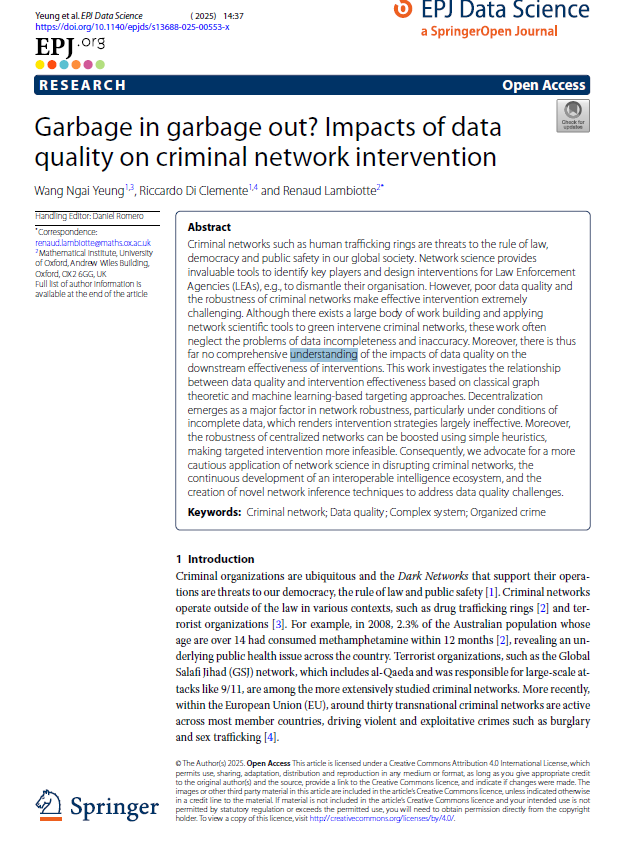
By Wang Ngai Yeung, Riccardo Di Clemente & Renaud Lambiotte
Criminal networks such as human trafficking rings are threats to the rule of law, democracy and public safety in our global society. Network science provides invaluable tools to identify key players and design interventions for Law Enforcement Agencies (LEAs), e.g., to dismantle their organisation. However, poor data quality and the robustness of criminal networks make effective intervention extremely challenging. Although there exists a large body of work building and applying network scientific tools to green intervene criminal networks, these work often neglect the problems of data incompleteness and inaccuracy. Moreover, there is thus far no comprehensive understanding of the impacts of data quality on the downstream effectiveness of interventions. This work investigates the relationship between data quality and intervention effectiveness based on classical graph theoretic and machine learning-based targeting approaches. Decentralization emerges as a major factor in network robustness, particularly under conditions of incomplete data, which renders intervention strategies largely ineffective. Moreover, the robustness of centralized networks can be boosted using simple heuristics, making targeted intervention more infeasible. Consequently, we advocate for a more cautious application of network science in disrupting criminal networks, the continuous development of an interoperable intelligence ecosystem, and the creation of novel network inference techniques to address data quality challenges.
EPJ Data Sci. 14, 37 (2025)
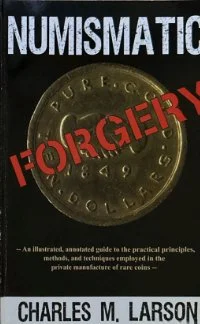
By Charles M. Larson
In "Numismatic Forgery," author Charles M. Larson pulls back the curtain on one of the most secretive and sophisticated threats to the world of coin collecting.1 Far from a simple historical overview, this book serves as a definitive guide to the dark art of the "super-forger," detailing the methods used to deceive even the most seasoned experts.
Larson provides a deep dive into the technical evolution of counterfeiting—from the crude cast copies of the past to the modern, high-precision struck forgeries that haunt the current marketplace. By meticulously explaining the tools of the trade, including centrifugal casting, pressure casting, and the creation of deceptive dies, Larson equips collectors, dealers, and historians with the knowledge necessary to spot the subtle "tells" of a fake.
Key features of this essential numismatic reference include:
The Forger's Toolkit: A step-by-step examination of the physical processes used to create counterfeit currency.
Detection Techniques: Practical advice on identifying "transfer marks," edge filing, and suspicious luster.
Case Studies: Real-world examples of famous forgeries that have infiltrated major collections.
The Ethics of the Hobby: A sobering look at how forgery undermines the historical integrity of numismatics.
Whether you are a casual hobbyist or a professional dealer protecting a million-dollar inventory, "Numismatic Forgery"is an indispensable resource for anyone who wants to ensure that the history they hold in their hands is the real deal.

May Contain Markup
By Donald Powell Wilson
Psychologist's Experience: The author, a psychologist, spent three years at Fort Leavenworth Penitentiary, significantly changing his perspective and approach to his profession.
Research Focus: The book is a personal account of the author's research on drug addiction and criminality, highlighting the human stories of his six convict assistants.
Prison Environment: The narrative provides a vivid description of the penitentiary's environment, including the strict security measures and the daily routines of the inmates.
Challenges and Adaptation: The author faced numerous challenges,including gaining the trust of the inmates and navigating the prison complex social dynamics.
Pocket Books, 1953, 369 pages
By Ben Grunwald and Jeffrey Fagan
In 2000, the Supreme Court held in Illinois v. Wardlow that a suspect’s presence in a “high-crime area” is relevant in determining whether an officer has reasonable suspicion to conduct an investigative stop. Despite the importance of the decision, the Court provided no guidance about what that standard means, and over fifteen years later, we still have no idea how police officers understand and apply it in practice. This Article conducts the first empirical analysis of Wardlow by examining data on over two million investigative stops conducted by the New York Police Department from 2007 to 2012. Our results suggest that Wardlow may have been wrongly decided. Specifically, we find evidence that officers often assess whether areas are high crime using a very broad geographic lens; that they call almost every block in the city high crime; that their assessments of whether an area is high crime are nearly uncorrelated with actual crime rates; that the suspect’s race predicts whether an officer calls an area high crime as well as the actual crime rate; that the racial composition of the area and the identity of the officer are stronger predictors of whether an officer calls an area high crime than the crime rate itself; and that stops are less or as likely to result in the detection of contraband when an officer invokes high-crime area as a basis of a stop. We conclude with several policy proposals for courts, police departments, and scholars to help address these problems in the doctrine.
California Law Review 345-404 (2019

The allegation that criminal justice systems (and that of the United States in particular) have become guilty of overcriminalization is widely accepted by academics and practitioners on nearly all points along the political spectrum (Dillon 2012). Many commentators respond by recommending that states decriminalize given kinds of conduct that supposedly exemplify the problem. I urge those who are theoretically minded to proceed cautiously and address several preliminary matters that must be resolved before genuine progress is possible. In the absence of a position on several controversial normative and conceptual issues, discussions of overcriminalization and decriminalization are bound to be oversimplified and superficial. My review is organized around six of these issues. I invite commentators to examine (a) what the criminal law is; (b) what overcriminalization means; (c) why overcriminalization is thought to be pernicious; (d) whether overcriminalization is a de jure or de facto phenomenon, i.e., whether it is a function of the law on the books or the law in action; (e) what normative criteria might be invoked to alleviate the predicament; and (f) whether and to what extent overcriminalization is a serious concern in our penal system. Even though these six issues are analytically distinct, positions about one invariably blur into commitments about the others. Although theorists rarely dissent from the claim that states are guilty of something called overcriminalization, uncertainties about the foregoing topics mar their treatments. I conclude that a deep understanding of the problem of overcriminalization depends on how these six issues are resolved.
Annual Review of Criminology, v. 6. 2023, 19pg