Open Access Publisher and Free Library
CRIME+CRIMINOLOGY.jpeg

CRIME

Violent-Non-Violent-Cyber-Global-Organized-Environmental-Policing-Crime Prevention-Victimization

Posts in Crime & Criminology
Fentanyl at the Gates: Comparing Large Seizures at the U.S.–Mexican and U.S.–Canadian Borders

By Jonathan P. Caulkins, Bishu Giri

Illegally manufactured fentanyl (IMF) kills enormous numbers of people in the U.S. and Canada. Since the emergence of modern heroin markets in the late 1960s, supply control has been associated with meaningful reductions in opioid use and harms in at least six cases worldwide. However, countering supply effectively depends on understanding what the dominant drug-trafficking routes are. New data on fentanyl seizures presented here largely reinforce previous understanding that most IMF enters the U.S. from the south. These data call into question tariffs and other policies and policy justifications that treat the threat from the northern border as comparably severe.

U.S. counties bordering Mexico and Canada show significantly higher rates of large fentanyl seizures, compared with counties that do not border our foreign neighbors—where “large” is defined as over a kilogram of powder or more than 1,000 pills, quantities indicative of wholesale trafficking. The 80 counties along the land borders recorded 2,461 large seizures between 2013 and 2024, averaging about 31 per county, while the other 3,064 counties documented 12,358 seizures, averaging only 4 per county. By weight, of all the fentanyl in those big land-border seizures in 2013–24, about 99% of the pills and 97% of the powder were found along the border with Mexico; by comparison, large seizures along the Canadian border are relatively rare. If we look at the recent years—2023 and 2024—distributions remain the same. San Diego County, California, leads in powder-form large fentanyl seizures; and Pima County, Arizona, records the highest volume of pill-form large fentanyl seizures.Drugs seized could be in transit to other places, or they might be intended for local consumption. Therefore, it is useful to contrast a county’s share of large seizures with its share of the population, which serves as a proxy for the size of the local market. Counties along the Mexican border account for only 2.35% of the U.S. population; but in 2023–24, they hosted about 40% of the nationwide quantity of fentanyl appearing in large seizures, for both powder and pills. By contrast, counties in the lower 48 states that border Canada account for 3.1% of the U.S. population but only 1.2% of the powder and just 0.5% of the pills obtained in large seizures.

To determine which counties look like import or transit centers, we developed a Disproportionality Index (DI), which compares a county’s proportion of large seizures against its proportion of the national population. On that scale, 1.0 means that seizures are proportionate to local population; below 1.0 indicates less than expected; and over 1.0 indicates more seizures than expected. Because of random fluctuations, a county can be a bit above or below 1.0, but we consider DIs above 2.5 noteworthy.

The counties with the highest DIs for 2023–24 were along the U.S.–Mexican border. For example, Imperial County, California, had a DI of 111 for fentanyl pills and 100 for powder. In contrast, in the county along the Canadian border with the greatest number of large seizures (Wayne County, Michigan, home of Detroit), the DIs were 0.5 for pills and 1.9 for powder, yielding an average DI of less than 2.0.

Only three other counties or collections of counties along the Canadian border had an average DI greater than 1. One (Okanagan County, Washington) stemmed from drugs seized from a Mexican-led organized-crime group that was supplying populations near the Canadian border. Another cluster (Juneau and Ketchikan) was suggestive of Alaska markets possibly being supplied from Canada. The third (Whatcom County, Washington) was locally significant (DI of 2.2 for powder) but small overall (Whatcom County accounted for just 0.15% of total powder seized).

Efforts to counter drug flows need to be grounded in data. The analysis here contradicts views—such as those used to justify certain tariffs—that treat the flows across the southern and northern borders as being comparably important.[1]

New York: Manhattan Institute, 2025. 15p.
Recidivism and crash risk among California’s drug-involved DUI offenders

By Ainsley L. Mitchum, Sam Stevens, and Bayliss J. Camp

The present study builds upon prior work by Marowitz (1996) by examining the crash and recidivism risk of alcohol-focused versus drug-involved driving under the influence (DUI) offenders. Although drug-involved DUI offenders remain a relatively small proportion of all DUI offenders, this proportion is rising, as is the proportion of impaired-driving fatal crashes involving drugs. Using a cohort of offenders arrested during calendar years 2014 through 2017, comparisons were drawn for the one-year periods pre- and post-arrest. Drug-involved offenders tended to have more problematic driving histories in the year prior to their index offense, as compared to alcohol-focused offenders. Even taking account of these differences in pre-arrest behavior, drug-involved offenders continued to have more problematic driving in the year subsequent to their index offense: they were twice as likely to be involved in a crash, and approximately 30% more likely to recidivate. A particularly powerful predictor of recidivism was whether or not a pre-conviction administrative per se (APS) license suspension – only available in instances where an offender is above the per se blood alcohol concentration (BAC) limit, or refuses a chemical test – was imposed. Offenders convicted of a DUI offense, but against whom no APS license action was initiated, were more than three times as likely to recidivate compared to offenders against whom an APS action was taken.

Sacramento: California Office of Traffic Safety; 2025. 78p.

China’s exploitation of scam centers in Southeast Asia

By U.S.-CHINA ECONOMIC AND SECURITY REVIEW COMMISSION

Summary:

This Commission Spotlight examines how China-linked scam centers are fueling corruption and violence in Southeast Asia, paving the way for greater Chinese influence in the region, and directly harming Americans in the process. Its findings are based on the Commission’s March 2025 hearing on “Crossroads of Competition: China in Southeast Asia and the Pacific Islands”; fact-finding trips to the Philippines, Indonesia, Vietnam, and Cambodia; and open source research.

Key Findings:

Chinese criminal networks operate industrial-scale scam centers across Southeast Asia that steal tens of billions of dollars annually from people around the world—a massive criminal enterprise that rivals the global drug trade in scale and sophistication.

The Chinese criminals behind scam centers have built ties—some overt, some deniable—to the Chinese government by embracing patriotic rhetoric, supporting China’s Belt and Road Initiative (BRI), and promoting pro-Beijing propaganda overseas. As a result, Chinese crime syndicates have expanded across Southeast Asia with, at a minimum, implicit backing from elements of the Chinese government.

The spread of China-linked scam compounds in Southeast Asia is fueling corruption and violence, promoting human trafficking, undermining the ability of governments in the region to control what happens in their territory, and promoting human trafficking.

China is exploiting the problem of scam compounds to increase its leverage over Southeast Asian governments, conduct intelligence and influence operations, and expand its security footprint in the region.

Beijing has selectively cracked down on scam centers that target Chinese victims, leading Chinese criminal organizations to conclude that they can make greater profits with lower risk by targeting citizens of wealthy countries such as the United States.

Americans are now among the top global targets of China-linked scam centers, with an estimated $5 billion lost to online scams in 2024 alone—a 42 percent increase over the previous year.

Washington, DC:

U.S.-CHINA ECONOMIC AND SECURITY REVIEW COMMISSION

2025. 12p.

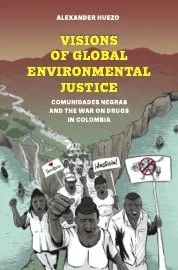
Visions of Global Environmental Justice: Comunidades Negras and the War on Drugs in Colombia

Visions of Global Environmental Justice:

Comunidades Negras and the War on Drugs in Colombia

By Alexander Huezo

Focusing on the lived experiences of Afro-Colombians processing and resisting violence against their ecological communities, Visions of Global Environmental Justice employs accounts of the supernatural narratively and analytically to frame a contemporary struggle for environmental justice. The book applies Achille Mbembe’s theorization of necropolitics to the environmental racism of the US War on Drugs in Colombia, specifically the aerial eradication of coca in the comunidades negras of the Pacific Coast. Through critical examination and deconstruction of transnational mythmaking and local oral tradition, Visions of Global Environmental Justice illustrates that non/humans rendered expendable by US-driven drug (necro)politics are indispensable to both the conceptualization and the realization of environmental justice globally. Far from being a study singularly focused on the symptoms of environmental issues, this book creatively guides us toward a broader understanding of environmental racism and justice across geographic scales and non/human agencies.

Oakland, CA; University of California Press, 2025