Open Access Free Library
CRIME+CRIMINOLOGY.jpeg

CRIME

Violent-Non-Violent-Cyber-Global-Organized-Environmental-Policing-Crime Prevention-Victimization

Posts in social sciences
“I’ve seen horrible things”: Children’s experiences of the online world

By The Children's Commission for England...

“I think the Government should do more about protecting children on the internet. Of course, it is very hard but just educating about the dangers of the internet is not enough” – Girl, 17. A year has passed since the Online Safety Act 2023 became law. This Act, a landmark piece of legislation, was welcomed by the Children’s Commissioner, following her extensive campaigning, as an important step towards a new era of the online world: one that presented an opportunity for children to learn, play and develop there safely. One year on, the legislation has yet to be implemented and important decisions regarding what those regulations will look like remain unclear. This report illustrates the extent to which children are still experiencing harm online. It sets the Children’s Commissioner’s expectations for the future of online safety policy making, and bolder steps towards robustly protecting children online. This report draws on the responses of 253,000 children and adults to The Big Ambition: a large-scale consultation of children in England carried out between September 2023 and January 2024. 2 The survey asked a broad set of questions about their lives, and in response, children shared their views on what they think needs to change to make their lives better. One of the areas they wanted action on was online safety. Children told the Children’s Commissioner’s Office that some children are more vulnerable to online harms than others, and that a variety of content and non-content factors cause them harm online. They also shared their views on who should take responsibility and make the online world safer for them. This report sets out what they said:

London: The Children's Commissioner for England, 2024. 80p.

Theft of oil from pipelines: an examination of its crime commission in Mexico using crime script analysis

By: Arantza Alonso Berbotto and Spencer Chainey

The theft of refined oil products provides criminal groups with significant financial resources that threaten the environment and socio-economic stability of countries where it occurs. Violence is also associated with this criminal activity. Using crime script analysis, a detailed interpretation of the theft of oil via the illegal tapping of pipelines in Mexico was constructed. The analysis revealed the roles performed by members of criminal groups, the recruitment of individuals outside of the criminal group to provide information about the pipelines and perform technical activities, and the supporting role of citizens and businesses from local communities. The analysis also revealed the decision-making necessary for the successful commission of oil theft via the illegal tapping of pipelines. The use of situational crime prevention measures and improvements in the use of deterrence are identified as offering opportunities for preventing this criminal activity.

GLOBAL CRIME 2021, VOL. 22, NO. 4, 265–287https://doi.org/10.1080/17440572.2021.1925552© 2021

Illegal Trade in Gold from Peru and Colombia. Understanding the Dynamics, Routes, and U.S. Linkages 

By Camilo Pardo-Herrera 

The environment is under increasing pressure from global economic dynamics and the constantly increasing demand for raw materials. In this context, environmental crimes in general, and illegal mining in particular, play a key role as they disregard any consideration for sustainable resource extraction. In the Amazon region, one of the most vital ecosystems around the world, illegal gold mining has been identified as the most critical threat to the sustainability of the life of its ecosystems. There is evidence of large quantities of illegal mining production both in Colombia (two-thirds of all production) and Peru (25 to 30 percent of all production). However, since gold is extremely valuable, and portable, it stores value —even under extreme market conditions—, it can be reshaped in any way thinkable, and is not intrinsically illegal, introducing illicitly extracted gold into official supply chains is fairly easy. Once introduced, it flows freely through national, regional, and global markets, and its proceeds do so through the international financial system. It is estimated that illegal mining accounts for up to USD 48 billion a year in criminal proceeds.1 In this context, organized crime associated with the illegal extraction of gold in the Amazon continues to grow in number, size, and scope in response to the insatiable global demand, and thanks to the possibility of laundering and reinvesting their proceeds through illicit financial flows. Thus, an efficient response to the challenges posed by illegal gold mining should be comprehensive and include not just efforts to curb illegal mining, but also, more importantly, efforts to address the illegal flows of money taking place through the gold trade. Although it only analyzes a small sample of the entire global gold market, this paper provides substantive evidence of the illegal flows of money through the gold trade from Peru and Colombia into the United States. While this report is in no position to assert the commission of crimes —since it is only analyzing data— it presents enough evidence to identify points of entry for further criminal investigations and potential judicial action. There is evidence of companies smuggling gold from Venezuela into Colombia, which is then exported to the United States. Between 2010 and 2021, a total of 68,2 tons of gold worth a total of 2.6 billion US dollars, were smuggled through the border in vicinities of Cucuta. Three companies, one in Colombia (CIJ Gutierrez) and two in the United States (Asahi Refining USA Inc., and Johnson Matthey Inc.) concentrate over 90 percent of this trade. Gold trade through this route stopped after 2018 when an Executive Order was signed targeting all parties involved in the trade of Venezuelan gold. There is also evidence of gold and mercury smuggling along the border between Peru and Bolivia and illegal gold production shifting geographies after policy decisions are made. Data show an inexplicable spike in Bolivian gold export in 2014 —with no increases in production— which coincides both, with a ban on mercury by Peru, and a decrease in Peruvian production and exports. This suggests the shifting of illegal mining from Peru into Bolivia, and also of gold smuggling in the same direction. There are clear indications of mis-invoicing of gold trade between these three countries. Peruvian data show significantly higher weight values than those reported at US destinations between 2016 and 2018. A very similar pattern can be seen in Peruvian total exports to the world. Concurrently, trade data show that 29 percent of all shipments from Peru to the US were priced at 70 percent or less than the actual international price during that same time. Although available data does not permit us to assert whether it is a case of overstating the weight of the gold or undervaluing its value, the temporal coincidence of weight and value discrepancies allows us to suggest a general case of mis-invoicing during this time. Colombian data also suggests potential cases of mis-invoicing. Between 2015 and 2016, US statistics reported weight about 50% above those reported by Colombian customs. Price data show that in nine percent of the shipments —approximately 16 tons— gold was paid at 70 percent or less of the global gold price at the time of the transaction. Only a handful of businesses on both sides of the transactions explain most of this trade and are identified — 85 percent of the undervalued shipments are executed by five Colombian firms, and six businesses on the US side concentrate 86 percent of undervalued purchases. Trade in overpriced gold is also identified. Data analysis suggests irregular patterns in the rate between net and gross weights, which could respond to fraudulent reporting and concurrent illicit flows of value. For example, while most shipments use 0.2 grams (or less) of packaging per every gram of gold sent, an important percentage report uses three and up to five times that weight. Of these irregular shipments, over 90 percent were sent by one company in Colombia —Metales Procesados Industriales— to two businesses in the US —Atomic Gold Inc., and United Precious Metal Refining Inc. The analysis also raises warnings as to how certain reports are made. This is the case of the volume of shipments reported by Colombian customs, which is not the result of a measurement, but of an estimation using the net weight of the shipment. Instead of measuring the volume of each shipment, this field is populated using the density of gold, which is a constant, derived from the net weight of the shipment. Although not the result of fraud, but a standard procedure, this hinders transparency and the possibility of monitoring the trade between Colombia and the US. There is evidence of a trend to create shell companies to engage in the trade in gold; presumably of illegal gold. Peruvian tax data shows large numbers of companies participating in the trade in a very sporadic fashion, which contradicts stable and long-lasting trade relationships usual in the international gold market. These companies have a very short legal life, and concentrate all of their commercial activity within a few months, only to cease to exist shortly after. Between 2016 and 2021, these companies traded gold for a total of 230 million USD. 

The Terrorism, Transnational Crime and Corruption Center. George Mason University. Arlington, Va. 2022. 34p.


“Counterfeit PPE: Substandard Respirators and their Entry into Supply Chains in Major Cities.”

By Layla Hashemi, Edward Huang & Louise Shelley 

 Over 58 million counterfeit respirators of substandard quality unable to protect individuals from infection have been seized globally since the start of the COVID-19 pandemic. These seizures have primarily occurred in urban warehouses and ports around the world according to analysis of public and corporate data shared with the authors. The presence of tens of millions of respirators in storage facilities prior to distribution demonstrates that urban areas are key elements of illicit supply chains. Data suggests that the concept of urban insecurity needs to be reconsidered in light of illicit supply chains for counterfeit respirators and their role in facilitating disease transmission in urban areas. The analysis presented in this article suggests that threats to human life should not be confined narrowly to violent acts or the consumption of drugs. Human life can also be threatened through the massive distribution of counterfeit N95 masks during a pandemic, a problem that has become more acute with more contagious mutations of COVID-19. 

Urban Crime - An International Journal Vol. 3-No 2-September 2022 

A Structured Methodical Process for Populating a Crime Script of Organized Crime Activity Using OSINT

By Spencer P. Chainey & Arantza Alonso Berbotto 

Crime script analysis is becoming an increasingly used approach for examining organized crime. Crime scripts can use data from multiple sources, including open sources of intelligence (OSINT). Limited guidance exists, however, on how to populate the content of a crime script with data, and validate these data. This results in crime scripts being generated intuitively, restricts them from being scrutinized for their quality and limits the opportunity to combine or compare crime scripts. We introduce a practical process for populating the content of a crime script that involves simple coding procedures and uses document analysis to quality assure data that are extracted from open sources. We illustrate the process with the example of the theft of oil from pipelines in Mexico committed by organized crime groups. The structured methodical process we introduce produces a crime script of high quality, helps to improve the systematic analysis of decision-making performed by members of organized crime groups, and can improve the identification of opportunities for crime control.

Published: 23 August 2021, Trends in Organized Crime, Volume 25, pages 272–300, (2022)

Phishing Risks in a University Student Community

By Roderic Broadhurst, Katie Skinner, Nicholas Sifniotis, Bryan Matamoros-Macias and Yuguang Ipsen

In an exploratory quasi-experimental study, 138 students recruited during a university orientation week were exposed to social engineering directives in the form of fake emails, or phishing, over several months in 2017. The study assessed the risks of cybercrime for students by observing their responses. Three types of scam emails were distributed that varied in the degree of individualisation: generic, tailored, and targeted or ‘spear’. The study explored the influence of scam type, cybercrime awareness, gender, IT competence and perceived internet safety on susceptibility to email scams.Although tailored and individually crafted email scams were more likely to induce engagement than generic scams, differences were not significant. Analysis of the variables showed that international students and first year students were deceived by significantly more scams than domestic students and later year students.


Trends & issues in crime and criminal justice no. 587. Canberra: Australian Institute of Criminology. 2020. 16p.

"Expected to Happen": Perspectives on Post-Release Overdose From Recently Incarcerated People With Opioid Use Disorder

By Pryce S. Michener, Elyse Bianchet, Shannon Fox, Elizabeth A. Evans & Peter D. Friedmann 

Background

Opioid-related overdose is the leading cause of death for people recently released from incarceration, however treatment with medications for opioid use disorder (MOUD) during incarceration can reduce the mortality risk. This study seeks to qualitatively analyze perceptions of post-release overdose risk from the perspectives of people who received MOUD while incarcerated in one of eight Massachusetts jails during 2021–2022 using the Risk Environment Framework to guide analyses.

Methods

N = 38 participants with lived experience of MOUD treatment during incarceration who are now living in the community were interviewed on factors that may contribute to or protect against post-release overdose risk. Themes were identified inductively and deductively using the Risk Environment Framework and its domains, which organizes themes along physical, social, economic, and policy environments on both the micro- and macro- scales.

Results

The physical risk environment included loss of opioid tolerance during incarceration, polysubstance use, and the toxicity of the regional drug supply as key producers of increased risk for post-release overdose. Social drivers of risk included peer group risk norms—including peer-driven harm reduction practices and interpersonal relationships between drug sellers and buyers—as well as macro-level social determinants of health such as housing insecurity and availability of mental health services. Economic drivers of post-release overdose risk included lack of income generation during incarceration and employment challenges. Participants discussed several aspects of policy that contribute to post-release overdose risk, including availability of harm reduction supplies, public health services, and broader policy around MOUD.

Conclusions

The perspectives of people with lived experience are vital to understanding the disproportionate risks of overdose for those recently released from incarceration. Our results highlight the intersectional factors that produce and reproduce the post-release overdose risk environment, providing support for interventions across each domain of the Risk Environment Framework. By capturing perspectives from people with lived experience of OUD and incarceration during this critical period of risk, we can better identify interventions that target and mitigate overdose-related harm in this population.

Harm Reduction Journal (2024) 21:138

Immigrants and Crime in the United States 

By Ariel G. Ruiz Soto

Immigrants in the United States commit crimes at lower rates than the U.S.-born population, notwithstanding the assertion by critics that immigration is linked to higher rates of criminal activity. This reality of reduced criminality, which holds across immigrant groups including unauthorized immigrants, has been demonstrated through research as well as findings for the one state in the United States—Texas—that tracks criminal arrests and convictions by immigration status. A growing volume of research demonstrates that not only do immigrants commit fewer crimes, but they also do not raise crime rates in the U.S. communities where they settle. In fact, some studies indicate that immigration can lower criminal activity, especially violent crime, in places with inclusive policies and social environments where immigrant populations are well established. 

Washington, DC: Migration Policy Institute, 2024. 7p.

The Real 'Bond Epidemic': Misinformation, False Narratives, and Bias in the Media

By Elaine Hennig and Benjamin Greaves

Since Harris County’s misdemeanor bond system was first declared unconstitutional by a federal district court in 2017, the county has implemented several reforms as part of the resulting settlement. Before the resolution of the lawsuit, indigent defendants were detained pretrial solely based on their inability to pay bond, while their wealthier counterparts could post bond and expect prompt release. The county corrected this wealth-based discrimination by requiring the majority of misdemeanor defendants to be released on personal recognizance (PR) bonds, which do not require an upfront cash payment. By providing defendants with a new system for bonding out of jail that does not discriminate based on income, the implemented reforms ensure that defendants are not prematurely punished with jail time— upholding the principle of a ‘presumption of innocence’ for the criminally accused, and preventing taxpayers from footing the bill for unnecessary weeks or months of incarceration. Though these changes have only been applied to misdemeanor cases, several ongoing lawsuits have set the stage for reforms that could similarly improve the felony bond system. While these two systems are legally different, the rationale for reform remains the same: protecting constitutionally guaranteed rights and preventing wealth-based discrimination. Despite the more equitable reforms to Harris County’s misdemeanor system, opponents of bond reform frequently criticize the changes. Though many opponents still claim to support the principles of reform, they regularly scapegoat bond reform for the various failures of the criminal legal system. Through the use of misinformation, propagation of false narratives, and exploitation of race-based disparities, they portray bond reform as a threat to public safety. Unfortunately, this disinformation effort is facilitated by local media outlets, who amplify the voices of opponents and disseminate the narratives they promote. This report aims to examine media coverage of bond in Harris County, and to better understand the media’s role in shaping the narrative of bond reform. It draws on a content analysis of 226 news articles run by six Houston-area television stations between January 2015 and June 2021. Stories qualified for selection if they discussed bond reform, bond debates, and/or people who allegedly committed crimes while out on bond. While bias in coverage was the primary focus of this analysis, we also reviewed 15 other key variables, such as referenced ‘experts’ and the defendant’s race or ethnicity. This analysis reveals that many local media stations disproportionately publish biased articles in their reporting on bond. The media consistently provide a platform for opponents of bond reform to represent bond release as a threat to public safety, while frequently failing to contextualize opponents’ claims or feature an alternative view. In cherry-picking and sensationalizing stories about defendants who are arrested while out on bond, media outlets construct a distorted narrative of dangerous releasees, in effect exaggerating the risks of bond reform and minimizing its positive impact. These efforts continually undermine bond reform, serving only to generate fear of people released on bond pretrial. The shift in news coverage of bond is perhaps best seen through a comparison of coverage prior to and following the implementation of Harris County’s proposed settlement in 2019. Over the 48-month period from January 1, 2015, to December 31, 2018, 42 total articles focused on bond in relation to  reform or released defendants. Of those articles, only 33 percent were found to be negatively biased. In contrast, over a shorter 30-month period from January 1, 2019, to June 30, 2021, not only did the number of bond-focused articles more than quadruple to 184, but the percentage of negatively biased articles nearly doubled to 61. Although bias in media coverage is one of the most—if not the most—alarming variables analyzed in this report, several other variables have revealed similarly concerning trends. With ongoing attacks against bond reform efforts in Texas and in Houston specifically, recognizing and correcting these trends in media coverage is critical to ensuring that Harris County residents have a more informed perspective of both misdemeanor bond reform and bond reform more generally.   

Austin: TEXAS CENTER FOR JUSTICE AND EQUITY, 2021. 34p.

How Does Domestic Violence Escalate Over Time?

By Hayley Boxall and Siobhan Lawler

A key assumption in the domestic violence literature is that abuse escalates in severity and frequency over time. However, very little is known about how violence and abuse unfolds within intimate relationships and there is no consensus on how escalation should be defined or how prevalent it is. A narrative review of the literature identified two primary definitions of escalation: a pattern of increasingly frequent and/or severe violent incidents, or the occurrence of specific violent acts (ie outcomes). Escalation appears to be limited to serious or prolific offenders rather than characterising all abusive relationships. However, disparities in prevalence estimates between those provided by victim–survivors and recorded incident data highlight the difficulty of measuring this aspect of abusive relationships.

Trends & issues in crime and criminal justice no. 626. Canberra: Australian Institute of Criminology 2021.  17p.

Production and Distribution of Child Sexual Abuse Material by Parental Figures

By Michael Salter, WK Tim Wong, Jan Breckenridge, Sue Scott, Sharon Cooper and Noam Peleg

Child sexual abuse material (CSAM) is widely available online. Existing research indicates that the parents and parental figures of victims are notably represented in offender populations. However, there is limited research in this area. Drawing on Australian media and legal databases, this study created a database of 82 cases of CSAM production and distribution perpetrated by parents and/or parental figures from 2009 to 2019. The study found that perpetrators are most often the male parental figures of the victims, and victims are predominately girls under nine years of age. The findings reveal distinct patterns and scenarios of parental CSAM offending that may inform prevention, early intervention and improved responses to victims. The study documented the significant impact of parental CSAM offending on victims and the need for specialist victim support.

Trends & issues in crime and criminal justice no. 616.  Canberra: Australian Institute of Criminology. 2021. 17p.

Criminal mobility of outlaw motorcycle gangs in Australia

By Christopher Dowling and Anthony Morgan

The criminal mobility of outlaw motorcycle gang (OMCG) members presents a significant challenge to Australian governments and police. Examining patterns of mobility can help to better understand the opportunity structures that underpin offending by OMCGs and to drive national collaborative responses to these gangs. This study examines the prevalence and patterns of criminal mobility in a sample of almost 4,000 OMCG members in more than 400 chapters. Around one in 10 members showed evidence of criminal mobility over the long term, while more than one-third of chapters comprised criminally mobile members. Criminally mobile gang members were heavily concentrated in a small number of chapters. Patterns of criminal mobility primarily involve movements into east coast jurisdictions. New South Wales and Queensland emerged as the most common destinations for criminally mobile OMCG members  

Trends & issues in crime and criminal justice no. 619. Canberra: Australian Institute of Criminology. 2021. 16p

The Relationship Between Drug Price and Purity and Population Level Harm

By Caitlin Hughes, Shann Hulme and Alison Ritter

In illicit drug markets, the price and purity of drugs change frequently. While it is well known that purity-adjusted price affects drug use, impacts on other outcomes are less clear. This rapid review examines the relationship between price, purity and seven population level measures of drug-related harm and any differences across three drug types. With a few exceptions, it found an inverse relationship between purity-adjusted price and drug-related harm, with higher purity-adjusted price associated with less drug-related harm, and lower purity-adjusted price associated with increased harm. This shows the value of price and purity data for predicting drug market impacts and the importance of improving price and purity data collection and analyses, particularly in Australia.

Trends & issues in crime and criminal justice no. 598. Canberra: Australian Institute of Criminology 2020. 26p.

Hurricane Milton Recovery: Brief Overview of FEMA Programs and Resources

By: Lauren Stienstra, Diane P. Horn, Erica A. Lee, Bruce R. Lindsay, William L. Painter, Elizabeth M. Webster

On October 9, 2024, Hurricane Milton made landfall as a Category 4 hurricane in Florida’s Tampa Bay area bringing heavy rain, storm surge, and floods to many counties on the coast and in the interior of the state. Some areas in the state are still actively recovering from Hurricane Helene.

President Biden had previously issued an emergency declaration for this storm on October 7, under the Robert T. Stafford Disaster Relief and Emergency Assistance Act (the Stafford Act, P.L. 93-288, as amended; 42 U.S.C. §§5121 et seq.), authorizing Public Assistance (PA) for emergency protective measures put into action beginning October 5, 2024. On October 8, 2024, President Biden issued another emergency declaration authorizing federal assistance to Seminole Tribe of Florida.

As of October 11, President Biden declared a major disaster for Hurricane Milton in Florida, authorizing PA, Individual Assistance, and Hazard Mitigation Assistance. President Biden also increased the federal share of eligible response costs; the federal government will cover 100% of eligible costs of PA provided for emergency protective measures and debris removal for a period of 90 days.

The situation remains dynamic; additional declarations, or additional forms of assistance are expected given Milton’s impact.

Information about state and county disaster assistance is published in FEMA’s declaration database. FEMA’s Hurricane Milton web page provides information on how to apply for disaster assistance. FEMA has also created another site to dispel rumors and misinformation related to aid to survivors, evacuation, and relief funding.

CRS Insight, IN12438; Oct. 13, 2024

Immigrants and Crime in the United States 

By Ariel G. Ruiz Soto

Immigrants in the United States commit crimes at lower rates than the U.S.-born population, notwithstanding the assertion by critics that immigration is linked to higher rates of criminal activity. This reality of reduced criminality, which holds across immigrant groups including unauthorized immigrants, has been demonstrated through research as well as findings for the one state in the United States—Texas—that tracks criminal arrests and convictions by immigration status. A growing volume of research demonstrates that not only do immigrants commit fewer crimes, but they also do not raise crime rates in the U.S. communities where they settle. In fact, some studies indicate that immigration can lower criminal activity, especially violent crime, in places with inclusive policies and social environments where immigrant populations are well established. A Look at the Overall Immigrant Population National studies have examined incarceration rates and prosecutions of immigrants in the country, overwhelmingly finding that immigrants of all legal statuses commit crimes at lower rates than those who were born in the United States. Immigrants Are Prosecuted and Imprisoned at Lower Rates than the U.S. Born Immigrants in the United States have had lower incarceration rates than the native-born population since at least 1870 (when such data were first recorded). In 2020, immigrants were 60 percent less likely to be incarcerated than the U.S. born, according to a study by the National Bureau of Economic Research. And though a 2021 Justice Department study points out prosecutions of immigrants increased between 1990 and 2018, nearly 90 percent were for violations of immigration-related laws. Notably, U.S. born citizens were ten times more likely than immigrants to be incarcerated for committing weapons- related offenses, five times more likely for violent offenses, more than twice as likely for property crimes, and nearly twice as likely for drug offenses.  At the state level, multiple studies have found there is no clear relationship between violent crime and immigration. And research at the city level suggests that increases in immigration can be associated with declining homicide rates, with the largest effect on municipalities with long histories of immigration, as well as reductions in property crimes and robbery. This makes immigrants  less likely to be either offenders or victims of crime at the local level compared to the U.S.-born population

Washington, DC: Immigration Policy Institute, 2024. 5p.   

Is the UNTOC Working? An assessment of the implementation and impact of the Palermo Convention

By Mark Shaw | Ian Tennant Ana Paula Oliviera | Daren Brookbanks

In 2000, the United Nations Convention Against Transnational Organized Crime (UNTOC), also known as the Palermo Convention, was adopted in a milestone moment for fostering global cooperation to combat organized crime. With 192 state parties, the convention and its protocols have provided a crucial legal framework for addressing types of crime such as human trafficking, migrant smuggling, and firearms trafficking. However, as transnational criminal networks continue to expand, new challenges are emerging, and the global community must take decisive action to ensure the UNTOC reaches its full potential. Our latest report highlights key obstacles to effective implementation: inconsistencies in national legislation, a lack of centralized data, and delays and restrictions in the convention’s Independent Review Mechanism (IRM). While the UNTOC’s widespread ratification is an achievement, these gaps hinder its ability to deliver impactful results. Without timely evaluations and better international cooperation, the global response to organized crime remains fragmented and insufficient. We believe that strengthening the UNTOC requires more robust data collection, greater transparency, and deeper engagement with civil society. Our report recommends the creation of an independent research center to monitor organized crime trends and track the convention’s progress. Additionally, we call for increased political will and resources to accelerate the IRM, ensuring that the UNTOC becomes a more powerful tool in the fight against evolving criminal markets.

Geneva: Global Initiative Against Transnational Organized Crime. 2024. 48p.

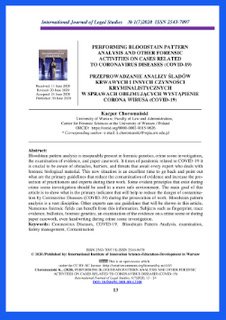
PERFORMING BLOODSTAIN PATTERN ANALYSIS AND OTHER FORENSIC ACTIVITIES ON CASES RELATED TO CORONAVIRUS DISEASES (COVID-19)

By: Kacper Choromański

Bloodstain pattern analysis is inseparably present in forensic genetics, crime scene investigation, the examination of evidence, and paper casework. It times of pandemic related to COVID-19 it is crucial to be aware of obstacles, barriers, and threats that await every expert who deals with forensic biological material. This new situation is an excellent time to go back and point out what are the primary guidelines that reduce the contamination of evidence and increase the protection of practitioners and experts during their work. Some evident principles that exist during crime scene investigation should be used in a more safe environment. The main goal of this article is to show what is the primary indicator that will help to reduce the danger of contamination by Coronavirus Diseases (COVID-19) during the prosecution of work. Bloodstain pattern analysis is a vast discipline. Other experts can use guidelines that will be shown in this article. Numerous forensic fields can benefit from this information. Subjects such as fingerprint, trace evidence, ballistics, forensic genetics, an examination of the evidence on a crime scene or during paper casework, even handwriting during crime scene investigation.

International Journal of Legal Studies No 1(7)2020 ISSN 2543-7097

Mexican Cartels and the FTO Debate The Designation Process and Relevant Government Stakeholders 

By María Calderón 

Mexican cartels represent a multifaceted and complex problem with significant implications for Mexico and the United States. These criminal organizations have long been a U.S. national security concern, which has become more severe with an increase of lethal drugs smuggled into the U.S., impacting millions of lives in North America. There are debates between governments and organizations on the most impactful way to combat these illicit groups. These have included the question of whether designating Mexican cartels as Foreign Terrorist Organizations (FTOs) would debilitate transnational criminal organizations and reduce the amount of drugs entering the United States. An FTO is a legal designation the United States government uses to identify foreign organizations that engage in premeditated, politically motivated acts of terrorism against noncombatant targets. Designating a group as an FTO carries legal and financial implications aimed at protecting national security. In the past, when Mexican cartels have harmed American citizens, members of Congress and other experts have been quick to propose an FTO designation for these organizations. However, designating a group as an FTO requires completing a specific and multi-faceted legal process and meeting certain criteria. The potential designation of Mexican cartels as FTOs is complex and contentious as it involves considering various implications, including security concerns, legal issues, and human rights impacts. This paper aims to explain the stages of an FTO designation and the roles of the various government stakeholders involved. Clarifying the complexities and technicalities of this process may prove beneficial when engaging in debates and weighing the potential impact of an eventual FTO designation for Mexican cartels.

Washington, DC:  Woodrow Wilson International Center for Scholars, 2024. 16p.

Mainstream Media Use In Far-Right Online Ecosystems

By Mario Peucker, Thomas J Fisher, Jacob Davey

The media does not enjoy a high level of trust among Australians, as many people question the commitment of mainstream media to objective and nonpartisan reporting. While this mistrust is widespread, it manifests in particularly antagonistic ways within far-right milieus, where mainstream media is often seen through a conspiratorial lens as the ‘enemy of the people’ who actively conspire against the wellbeing of ‘ordinary’ or ‘white’ people. This almost unanimously hostile perception, however, does not stop people within far-right online spaces from posting mainstream media outputs to convey ideological messages in their online communities. Context This research report presents key findings from an analysis of far-right online communities on Facebook and the alt-tech fringe platform Gab, which has been described as a ‘right-leaning echo chamber’ (Lima et al. 2018:1). The study was conducted by researchers at the Institute for Sustainable Industries & Liveable Cities at Victoria University (VU), in collaboration with the Institute for Strategic Dialogue (ISD), within the research stream ‘Dynamics of Violent Extremism’ at the Centre for Resilient and Inclusive Societies (CRIS). What we did The research combines quantitative and qualitative methods. We analyzed around 11,000 Facebook posts and 45,000 Gab posts by Australian-based accounts and users who meet our working definition of far-right (see section 2). This quantitative analysis offers insights into the prevalence of mainstream media sources in their far-right online messaging and which outlets are particularly frequently shared. In addition, we conducted a qualitative multimodal in-depth analysis of a quasi-random sample of 224 Facebook and 298 Gab posts that contained an outbound link to a URL domain associated with a mainstream media outlet. This qualitative analysis allowed us to identify how mainstream media are (re)framed and (mis)appropriated within these far-right online space to deliver certain ideological messages.    

Melbourne; The Centre for Resilient and Inclusive Societies. August 2022. 26p.