Open Access Publisher and Free Library
CRIME+CRIMINOLOGY.jpeg

CRIME

Violent-Non-Violent-Cyber-Global-Organized-Environmental-Policing-Crime Prevention-Victimization

The Anti-illicit Activity Regime of the Multilateral Development Banks: Criminal Acts or Prohibited Practices?

By Adrian Robert Bazbauers and Anthea McCarthy-Jones

 The spread of illicit activity across the global economy presents significant challenges to international development. Despite the well-recognized global incidence of corruption, fraud, and money laundering in development-focused investment projects, the responses of the multilateral development banks (MDBs) to these threats remain understudied. Our article offers the first comprehensive study into the comparative historical emergence and evolution of MDB responses to illicit activity. By identifying and analyzing critical junctures in this history, we argue that the MDBs have tended to approach illicit activity as prohibited practices rather than criminal acts. We contend that this is an intentional choice made by the MDBs that absolves these organizations from any real responsibility in minimizing illicit activity, finding their concern to be ensuring contractual compliance in their lending operations rather than curtailing criminal behavior and their preference to be resolving contractual deviations in-house as opposed to coordinating with local jurisdictions and law enforcement agencies.

Journal of Illicit Economies and Development, 6(1): pp. 112–128.

download
The Impact of State-level U.S. Legalization Initiatives on Illegal Drug Flows 

By Vivian Mateos Zúñiga and David A. Shirk

Scholars and legalization advocates have argued that the legalization of cannabis would help curb drug flows from Mexico and weaken criminal organizations south of the border. However, there is little empirical research examining how the legalization of cannabis for medical and recreational purposes at the state-level in the United States has affected production levels and flows of cannabis from Mexico. To examine the theory that drug legalization reduces the incentives and profits for international drug trafficking organizations (DTOs), the authors draw on a mixed methodological approach that includes descriptive and inferential statistical analysis of data from the U.S. State Department, archival research using primary and open-source documents from U.S. and Mexican government and media sources, and interviews with U.S. officials and security experts to analyze trends in seizures and legalization. Drawing on this information, we employ a series of statistical tests to examine the relationship of greater legal access to cannabis in U.S. states—measured by the percentage of the population living in states with access to legalized medical or recreational marijuana over time—to illegal eradication and seizures of drugs by Mexican government and U.S. border authorities. We use this measurable outcome as a proxy for illicit drug production and transshipment in Mexico. We find a substantial and statistically significant decrease in the amounts of cannabis apprehended by Mexican and U.S. border authorities in relation to the rate of legalization in the United States using our measurements of drug legalization. At the same time, the authors find additional statistically significant evidence that, as legal access to cannabis has increased, flows of other illicit drugs increased simultaneously, suggesting that criminal organizations have diversified into other drugs to remain profitable, particularly heroin and methamphetamine. Our findings do not find any evidence that cocaine has been significantly affected, for reasons we discuss.   

Volume 19, Number 1 January 2022 San Diego: Justice in Mexico, University of San Diego, 2022.

download
“It Should Be Hard to Be a Drug Abuser” An Evaluation of The Criminalization of Drug Use in Sweden

By Albin Stenström, Felipe Estrada, Henrik Tham

Drug use was criminalized in Sweden in 1988 with the aim of reducing the number of consumers and drug-related risks and harms. Imprisonment was introduced into the penalty scale in 1993 to improve the legislation’s effectiveness. The criminalization has never been evaluated. Method: Goal-attainment evaluation based on a range of indicators from surveys, case-finding estimates, healthcare and cause-of-death data, and crime statistics. Comparative drug policy analysis is conducted with other Nordic countries. Results: The criminalization is not followed by a reduced or more expensive drug supply, reduced consumption levels, problematic drug use or healthcare needs, or fewer drug-related deaths. Most of the indicators instead show the opposite. Control costs are high, and trends are no better than those of other Nordic countries, despite Sweden’s more repressive drug policy. Conclusion: Criminalization emerges as an ineffective, expensive, and harmful means of dealing with the drug problem.

International Journal of Drug Policy Volume 133, November 2024, 104573

download
The Intended and Unintended Consequences of Ban the Box

By Steven Raphael

I review the growing body of research that either directly assesses the effect of Ban the Box (BTB) on the employment prospects of those with criminal histories, tests for spillover effects operating through statistical discrimination, or assesses the labor-market impacts of related screening practices. I begin with a theoretical discussion that works through how widespread reluctance to hire those with criminal histories is likely to generate market-level employment and earnings penalties for various groups of workers, and how the size and distribution of these penalties likely depend on the information available to employers. I then turn to a review of research over the past 15 years or so that either directly assesses the impact of BTB or addresses highly related and relevant research questions. The weight of the empirical evidence suggests that BTB does not improve the employment prospects of those with criminal histories at private-sector employers, although there is some evidence of an improvement in employment prospects in the public sector. Regarding spillover effects operating through statistical discrimination, several studies indicate that BTB harms the employment prospects of African-American men. Furthermore, research on the effects of credit checks, occupational licensing, and drug testing appears to indicate that more information available to the employer improves the employment prospects of African Americans. Collectively, these findings imply that in the absence of objective information, employers place weight on stereotypes about the characteristics of black workers that are generally negative and inaccurate.

Annu. Rev. Criminol. 2021. 4:191–207

download
Firearm Instrumentality: Do Guns Make Violent Situations More Lethal?

By Anthony A. Braga, Elizabeth Griffiths, Keller Sheppard, and Stephen Douglas

One of the central debates animating the interpretation of gun research for public policy is the question of whether the presence of firearms independently makes violent situations more lethal, known as an instrumentality effect, or whether determined offenders will simply substitute other weapons to affect fatalities in the absence of guns. The latter position assumes sufficient intentionality among homicide assailants to kill their victims, irrespective of the tools available to do so. Studies on the lethality of guns, the likelihood of injury by weapon type, offender intent, and firearm availability provide considerable evidence that guns contribute to fatalities that would otherwise have been nonfatal assaults. The increasing lethality of guns, based on size and technology, and identifiable gaps in existing gun control policies mean that new and innovative policy interventions are required to reduce firearm fatalities and to alleviate the substantial economic and social costs associated with gun violence.

Annual Review of Criminology, Vol. 4 (2021), pp. 147–164

download
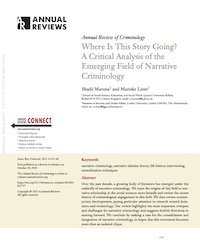
Where Is This Story Going? A Critical Analysis of the Emerging Field of Narrative Criminology

By Shadd Maruna, and Marieke Liem

Over the past decade, a growing body of literature has emerged under the umbrella of narrative criminology. We trace the origins of this field to narrative scholarship in the social sciences more broadly and review the recent history of criminological engagement in this field. We then review contemporary developments, paying particular attention to research around desistance and victimology. Our review highlights the most important critiques and challenges for narrative criminology and suggests fruitful directions in moving forward. We conclude by making a case for the consolidation and integration of narrative criminology, in hopes that this movement becomes more than an isolated clique.

Annual Review of Criminology Vol. 4 (2021), pp. 125–146

download
Human Mobility and Crime: Theoretical Approaches and Novel Data Collection Strategies

By Christopher R. Browning, Nicolo P. Pinchak, and Catherine A. Calder

This review outlines approaches to explanations of crime that incorporate the concept of human mobility—or the patterns of movement throughout space of individuals or populations in the context of everyday routines—with a focus on novel strategies for the collection of geographically referenced data on mobility patterns. We identify three approaches to understanding mobility–crime linkages: (a) Place and neighborhood approaches characterize local spatial units of analysis of varying size concerning the intersection in space and time of potential offenders, victims, and guardians; (b) person-centered approaches emphasize the spatial trajectories of individuals and person–place interactions that influence crime risk; and (c) ecological network approaches consider links between persons or collectivities based on shared activity locations, capturing influences of broader systems of interconnection on spatial- and individual-level variation in crime. We review data collection strategies for the measurement of mobility across these approaches, considering both the challenges and promise of mobility-based research for criminology.

Annual Review of Criminology, Vol. 4 (2021), pp. 99–123

download
Genocide, Mass Atrocity, and Theories of Crime: Unlocking Criminology's Potential

By Susanne Karstedt, Hollie Nyseth Brehm, and Laura C. Frizzell

Surprisingly, scholars studying mass atrocity and genocide have frequently sidelined criminological theories and concepts. Other disciplines have addressed these crimes while mostly ignoring criminological insights and theories. In this review, we assess the potential of criminological theories to contribute to explaining and preventing mass atrocities and genocide, highlight criminological insights from the study of these crimes, and unlock the existing criminological knowledge base for application in the context of these crimes. We begin by outlining how mass atrocities and genocide are similar to other crimes that criminologists have routinely studied. We then turn toward frameworks of structural causation, focusing on the state and community levels. Subsequently, we address micro-level theories that inform why individuals commit such violence, ranging from theories of choice, the life course, and techniques of neutralization to social learning theory and theories of desistance from crime. Finally, we address the victims of genocide and mass atrocity, including the factors associated with victim labels and victimhood itself.

Annual Review of Criminology, Vol. 4 (2021), pp. 75–97

download
The Causes and Consequences of Urban Riot and Unrest

By Tim Newburn

This review explores those varied bodies of work that have sought to understand crowd behavior and violent crowd conduct in particular. Although the study of such collective conduct was once considered central to social science, this has long ceased to be the case and in many respects, the study of protest and riot now receives relatively little attention, especially within criminology. In addition to offering a critical overview of work in this field, this review argues in favor of an expanded conception of its subject matter. In recent times, scholarly concern has increasingly been focused on questions of etiology, i.e., asking how and why events such as riots occur, with the consequence that less attention is paid to other, arguably equally important questions, including how riots spread, how they end, and, critically, what happens in their aftermath. Accordingly, as a corrective, the review proposes a life-cycle model of riots.

ANNUAL REVIEW OF CRIMINOLOGY, Vol. 4 (2021), pp. 53–73

download
Toward a Criminology of Sexual Harassment

By Christopher Uggen, Ráchael A. Powers, Heather McLaughlin, and Amy Blackstone

Public attention to sexual harassment has increased sharply with the rise of the #MeToo movement, although the phenomenon has sustained strong scientific and policy interest for almost 50 years. A large and impressive interdisciplinary scholarly literature has emerged over this period, yet the criminology of sexual harassment has been slow to develop. This review considers how criminological theory and research can advance knowledge on sexual harassment—and how theory and research on sexual harassment can advance criminological knowledge. We review classic and contemporary studies and highlight points of engagement in these literatures, particularly regarding life-course research and violence against women. After outlining prospects for a criminology of sexual harassment that more squarely addresses perpetrators as well as victims, we discuss how criminological insights might contribute to policy efforts directed toward prevention and control.
Annual Review of Criminology Vol. 4 (2021), pp. 33–51

download
The recruitment of young perpetrators for criminal networks 

By Europol

This intelligence notification is based on information contributed to Europol by national law enforcement authorities. This document aims to raise awareness of the ways criminal networks exploit minors, particularly through recruitment and tasking via social media. It highlights the use of targeted language, coded messaging, and "gamification" strategies in this process. The recruitment of minors into serious and organised crime and terrorism is not a new phenomenon; however, it has increasingly become a tactic used by criminal networks to avoid detection, capture, and prosecution. In recent years, this trend has expanded across more countries, with recruitment methods evolving and minors being tasked with violent acts such as extortion and killings  

Paris: Europol: 2024. 3p.

download
Green Criminology: Capitalism, Green Crime and Justice, and Environmental Destruction

By Michael J. Lynch1, and Michael A. Long2

Green criminology has developed into a criminological subfield with a substantial literature. That literature is so vast that a single review cannot do it justice. This article examines the definition of green crime, the historical development of green criminology, some major areas of green criminological research, and potential future developments. Unlike traditional criminology with its focus on human victims, green criminology recognizes that various living entities can be victims of the ways in which humans harm ecosystems. Green research thus explores crime, victimization, and justice from several theoretical positions that acknowledge these unique victims. Although green criminology contains several approaches, this review primarily focuses on political economic green criminology. The section titled The Definition, Overview, and Historical Development of Green Criminology identifies, but does not review in depth, other forms of green criminology.

Annu. Rev. Criminol. 2022. 5:255–76  

download
Don't Call It a Comeback: The Criminological and Sociological Study of Subfelonies

By Issa Kohler-Hausmann

After featuring prominently in early law and society research, the study of sub-felony enforcement and processing was largely eclipsed by the study of mass incarceration. Of late, the subject matter has enjoyed a resurgence. This review addresses what things might be included in a study of sub-felonies, what aspects about them researchers have studied, and why it might be theoretically interesting to study them.

Annu. Rev. Criminol. 2022. 5:229–53  

download
Analytic Criminology: Mechanisms and Methods in the Explanation of Crime and its Causes

By Per-Olof H. Wikström, and Clemens Kroneberg

Criminology is a smorgasbord of disparate theory and poorly integrated research findings. Theories tend to focus either on people's crime propensity or the criminogenic inducements of environments; rarely are these two main approaches effectively combined in the analysis of crime and its causes. Criminological research often either avoids questions of causation and explanation (e.g., risk factor approach) or is based on research designs that yield highly partial accounts (e.g., place-oriented experimental work). To advance knowledge about crime and its causes and prevention, we argue that there is a need for an analytic criminology that allows key theoretical insights and central empirical findings about people's crime propensities and environments’ criminogenic inducements and their combination to be integrated based on an adequate action theory. In this review, we outline this approach and its main methodological implications and discuss

Annu. Rev. Criminol. 2022. 5:179–203  

download
Resisting Carceral Confinement in Guyana: Legacies of a Colonial State

By Kellie Moss, Kristy Warren

Prisoners in Guyana have been protesting about living conditions and an overtly punitive environment since British colonial rule (1814–1966). Drawing upon official investigations, colonial records and newspaper reports, this article analyses some of the key features of resistance, including uprisings, escapes and everyday breaches of prison rules from the 19th century to the present day. It argues that Guyanese society is still impacted by the punitive nature of colonial plantation society which compels and informs prisoner experiences and responses in the nation's prisons today.

The Howard Journal of Crime and JusticeVolume 63, Issue 4: Colonialism and its aftermaths in prisons in Guyana Dec 2024 Pages 355-480

download
Understanding Toxic Panda: The New Cyber Threat Targeting Data Security

By Asmita Mallick and Prithwish Ganguli

Toxic Panda is a sophisticated Android banking trojan that targets users in Europe, Latin America, and Southeast Asia. Using advanced techniques like account takeover (ATO) and on-device fraud (ODF), it bypasses security mechanisms, including multi-factor authentication, to steal sensitive data and conduct unauthorized transactions. The malware's ability to manipulate user inputs and intercept one-time passwords makes it a significant threat. This paper explores the implications of ToxicPanda, highlights the evolving landscape of cybercrime, and offers insights into preventive measures and legal frameworks to combat emerging threats.

Unpublished paper, 2024.

download
The Limits of Consent: Sexual Assault and Affirmative Consent

By Lisa Featherstone -  Cassandra Byrnes .· Jenny Maturi -  Kiara Minto · Renée Mickelburgh - Paige Donaghy  

This open access book examines the ways that consent operates in contemporary culture, suggesting it is a useful starting point to respectful relationships. This work, however, seeks to delve deeper, into the more complicated aspects of sexual consent. It examines the ways meaningful consent is difficult, if not impossible, in relationships that involve intimate partner violence or family violence. It considers the way vulnerable communities need access to information on consent. It highlights the difficulties of consent and reproductive rights, including the use (and abuse) of contraception and abortion. Finally, it considers the ways that young women are reshaping narratives of sexual assault and consent, as active agents both online and offline. Though this work considers victimisation, it also pays careful attention to the ways vulnerable groups take up their rights and understand and practice consent in meaningful ways.

Cham: Springer Nature, 2024. 138p.

download
‘A Lot of it is Actually Just Abuse’ Young People and Pornography

By The Children’s Commissioner for England

This report draws together research from focus groups with teenagers aged 13-19 and a survey of 1,000 young people aged 16-21. Of the 64% who said that they had ever seen online pornography: • We find that pornography exposure is widespread and normalized – to the extent children cannot ‘opt-out’. The average age at which children first see pornography is 13. By age nine, 10% had seen pornography, 27% had seen it by age 11, and half of children who had seen pornography had seen it by age 13. • We also find that young people are frequently exposed to violent pornography, depicting coercive, degrading or pain-inducing sex acts; 79% had encountered violent pornography before the age of 18. Young people expressed concern about the implications of violent pornography on their understanding of the difference between sexual pleasure and harm. Indeed, this report finds that frequent users of pornography are more likely to engage in physically aggressive sex acts. • Pornography is not confined to dedicated adult sites. We found that Twitter was the online platform where young people were most likely to have seen pornography. Fellow mainstream social networking platforms Instagram and Snapchat rank closely after dedicated pornography sites. At the time of publication, the UK’s landmark Online Safety Bill is making its way through Parliament. It holds the promise of, finally, regulating pornography sites and ensuring that they implement robust age verification to protect children. Now is a vital moment to ensure that we understand the impact of pornography on children’s lives, and to legislate for a commensurate response. This report is published as the Online Safety Bill passes through Parliament. The legislation, as currently drafted, imposes important age verification requirements (technical measures to establish someone’s age) on platforms which host pornography to prevent under-18s from accessing adult content online. The research contained within this report syntheses data from a nationally representative survey of over 1,000 young people aged 16-21 in England and two focus groups with teenagers aged 13-19. All research was conducted between November 2022 and January 2023 by the Children’s Commissioner’s Office (CCo) with an aim of understanding the prevalence of pornography exposure (both intentional and unintentional) among young people and its impacts on children’s safety and wellbeing. Differences between groups are only reported where they were statistically significant. The Commissioner intends for this report to aid Parliamentarians as they make crucial decisions about the protection of children from harmful content, including pornography, through the Online Safety Bill. The Commissioner also hopes that findings from this research will support the regulator, Ofcom, in their future enforcement regime, as well as parents, teachers and other key professionals, to understand and protect children from pornography’s impacts. The main research findings are set out below. Unless otherwise indicated, figures refer to young people who have ever viewed pornography. • Pornography consumption is widespread among children. The average age at which children first saw pornography was just 13 years old. • Many children are first exposed to pornography at a very young age. A significant minority of children access pornography at very young ages: 10% had seen it by age nine, 27% had seen it by age 11 and 50% of children had seen it by age 13. • Children often stumble accidentally across pornography online; 38% of 16-21-year-olds said that they had accidentally come across it online. In focus group discussions, young people told the CCo that accidentally viewing pornography for the first time made them feel ‘confused’, ‘insecure’, ‘troubled’ and ‘curious’. Chillingly, some young people spoke about the role of sexualised cartoons, depicting popular children’s characters and which appear in pop-up ads, in actively grooming young children towards adult pornography. • A significant minority of young people are sent explicit images involving a person known to them in real-life. Girls are disproportionately the target of ‘self-generated’ pornography, 51% of girls aged 16-21 had been sent or shown explicit content involving someone they know in real-life, compared to 33% of boys. • Twitter is the platform where the highest percentage of children had seen pornography; 41% of young people reported having seen it on Twitter. Dedicated pornography sites came next (37%), followed by Instagram (33%), Snapchat (32%) and search engines (30%). • Many young people seek out pornography online. Half (50%) of survey respondents, 58% of boys and 42% of girls, aged 16-21 said that they sought out online pornography themselves. • A significant proportion of males are frequent users of pornography. A fifth (21%) of males aged 16-21 viewed content at least once a day in the 2 weeks prior to the survey, compared to just 7% of girls. This is suggestive of a dependency which carries its own risk of interrelated harms. • Boys and those who first viewed online pornography at age 11 or younger were significantly more likely to become frequent users of pornography, consuming it twice or more per week. Focus group participants told us that pornography was sought for several reasons; sexual gratification, curiosity and to ‘learn’ about sex, and pressure to ‘fit in’ with peers. • Children are frequently exposed to violent pornography. The majority, 79%, of 18-21-yearolds had seen content involving sexual violence before turning 18. Early exposure to pornography and frequent consumption significantly increased the likelihood of viewing violent content. Young people are significantly more likely to see violence perpetrated against a woman (65%) than against a man (29%) in pornography. • A significant proportion of young people seek out violent pornography; 36% of young adults had sought out content involving at least one act of sexual violence. Again, a young age of first exposure and frequent consumption of pornography were predictors in the likelihood of actively seeking out violent content for sexual gratification.   

London: Children's Commissioner for England, 2023.   48p.

download
Evidence on Pornography’s Influence on Harmful Sexual Behavior Among Children

By The Children’s Commissioner for England

This is the second in a series of reports investigating the impact of pornography on young people, building upon the Children’s Commissioner’s report published in January 2023, “A lot of it is actually just abuse”, which set out findings from a survey of over a thousand 16-21-year-olds and focus groups with teenagers. This series of work shows the detrimental effect that pornography is having on children and young people. It adds weight to the Children’s Commissioner’s view that no child under the age of 18 should be able to access pornography. This report aimed to discover whether references to specific acts of sexual violence commonly seen in pornography could be found in official documents relating to the investigation of children who abused other children. It is not intended to be read by children, but by researchers and policy makers interested in making children safer. It makes frequent reference to sexual harassment and sexual violence, and includes descriptions of pornographic content, language, and discussion of sexual abuse. This content may be difficult to read, however, we think it is important to understand how pornography impacts children, in order that we may better protect all children from harm. The research contained within this report synthesises data from 502 documents of two types: 379 Achieving Best Evidence (ABE) transcripts of interviews with children who have been sexually harmed and children who have sexually harmed another child, from one police force, and 123 Sexual Assault Referral Centre (SARC) documents concerning children who were sexually harmed by other children from one NHS foundation trust.   

London: Children's Commissioner for England, 2023. 58p.

download
Bullying and Physical Violence and Their Association With Handgun Carrying Among Youth Growing Up in Rural Areas 

By Alice M. Ellysona , Emma Gauseb, Vivian H. Lyonsd, Julia P. Schleimerb, Kimberly Dalveb, Margaret R. Kuklinskid, Sabrina Oesterlef , Elizabeth H. Weybrightg, Ali RowhaniRahbara 

Abstract Objectives.—This study builds on prior research showing a strong relationship between handgun carrying and delinquent behaviors among urban youth by examining the association between handgun carrying trajectories and various types of violence in a rural sample. Methods: This study uses data from a longitudinal cohort study of 2,002 public school students in the United States from 12 rural communities across 7 states from ages 12–26 (2005–2019). We used logistic regressions to assess associations of various bullying and physical violence behaviors with latent trajectories of handgun carrying from adolescence through young adulthood. Results.—Compared to youth with very low probabilities of carrying a handgun in adolescence and young adulthood, trajectories with high probabilities of handgun carrying during adolescence or young adulthood were associated with greater odds of using bullying (odds ratios (ORs) ranging from 1.9–11.2) and higher odds of using physical violence during adolescence (ORs ranging from 1.5–15.9) and young adulthood (ORs ranging from 1.9–4.7). These trajectories with higher probabilities of handgun carrying were also associated with greater odds of experiencing physical violence like parental physical abuse and intimate partner violence, but not bullying. Conclusion and implication.—Experiencing and using bullying and physical violence were associated with specific patterns of handgun carrying among youth growing up in rural areas. Handgun carrying could be an important focus of violence prevention programs among those youth 

Prev Med. 2023 February ; 167: 107416. doi:10.1016/j.ypmed.2022.107416. 

download