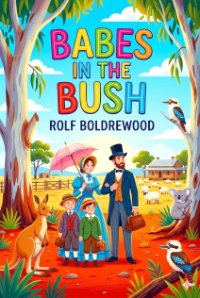
By Ronf Boldrewood
Imagine, if you will, the jarring transition of a family trading the velvet curtains and manicured gardens of an English manor for the sun-scorched, eucalyptus-scented vastness of the Australian interior. This is the heart of Rolf Boldrewood’s 1900 novel, Babes in the Bush, a sprawling narrative that serves as both a romantic adventure and a gritty survival manual for the Victorian era. While Boldrewood is often immortalized for the bushranging exploits of Captain Starlight in Robbery Under Arms, this particular work offers a more domestic, yet no less perilous, look at the "squatting" life—the high-stakes gamble of pastoral farming in the 19th-century colonies.
The story centers on the Effinghams, an aristocratic family whose financial foundation has crumbled beneath them in England. Facing the social death sentence of genteel poverty, they choose a path of radical reinvention: migrating to New South Wales to rebuild their dynasty. The title itself is a clever literary allusion to the old English folk tale "Babes in the Wood," but here, the "woods" are the unforgiving Australian scrub, and the "babes" are sophisticated adults and their children who are utterly illiterate in the language of the frontier. They are innocents abroad, armed with nothing but their British pluck and a very expensive, very impractical education.
What makes this introduction to colonial life so compelling is the man behind the pen. Rolf Boldrewood was the pseudonym for Thomas Alexander Browne, a man who didn't just write about the bush—he lived it. Having served as a police magistrate and a "squatter" (a settler who occupied large tracts of Crown land for grazing), Browne understood the soul-crushing weight of a three-year drought and the chaotic adrenaline of a cattle muster. His prose is thick with the authority of someone who has actually tasted the dust. When he describes the logistical nightmare of moving thousands of sheep across a dry plain or the specific architecture of a bark-roofed homestead, he isn't guessing; he’s reporting from the front lines of history.
However, it would be a disservice to the modern reader to ignore the specific "Victorian lens" through which this story is told. Boldrewood was a product of his time, and his writing is steeped in the ideology of Empire. The Australian landscape is frequently portrayed as a wild, "untamed" canvas waiting for the brush of British civilization to give it meaning. You will find a fascinating, if sometimes uncomfortable, tension between the family's desire to maintain English social hierarchies and the rugged, egalitarian reality of the Australian bush where a man’s worth is measured by his ability to track a stray bull rather than his family crest.
The novel also provides a window into the complex social ecosystem of the frontier. It isn't just the Effinghams vs. Nature; it is a world populated by "currency lads" (Australian-born whites), hardworking immigrants, and the Indigenous people whose land was being transformed. While Boldrewood’s depictions of Indigenous Australians are undeniably colonial and reflect the prejudices of the 1900s, they offer a stark, honest look at the mindset that drove the pastoral expansion. It is a story of resilience and adaptability, showing how the harshness of the Australian sun slowly bakes away the "Englishness" of the characters, leaving behind something harder, leaner, and distinctly Australian.
As you step into the world of the Effinghams, expect a narrative that moves with the slow, deliberate pace of a bullock team. It is a book of grand landscapes, sudden dangers, and the quiet triumph of building a home where none existed before. It remains a cornerstone of Australian colonial literature because it captures that pivotal moment when the Old World collided with the New, and the "Babes" either learned to walk the bush or were swallowed by it.
Read-Me.Org Inc. New York-Philadelphia-Australia. 2026. 353p.