Open Access Publisher and Free Library
Fiction+Mediajpg.jpg

FICTION and MEDIA

CRIME AND MEDIA — TWO PEAS IN A POD

Posts in CRIMINAL PAST
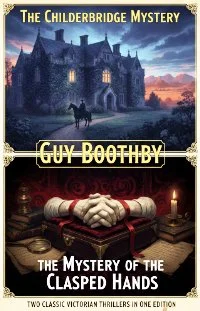
The Mystery of the Clasped Hands & The Childerbridge Mystery: Two Novels

by Guuy Boothby (Author), Colin Heston (Introduction)

In this combined edition, readers are presented with two quintessential examples of the late Victorian "shocker" from the pen of Guy Boothby, a writer who defined the era’s taste for fast-paced, sensational mystery. The first novel in this volume, The Mystery of the Clasped Hands, originally published in 1901 by F.V. White & Co., serves as a dark exploration of the macabre and the forensic. The story begins with a truly visceral hook: a wedding gift that contains the severed, preserved hands of a woman. It is a classic example of the Victorian obsession with reputation and the legal system, as the protagonist, Godfrey Tring, finds himself trapped in a web of circumstantial evidence. Boothby expertly depicts how quickly a gentleman’s life can be dismantled by a single accusation, making the legal system itself a source of mounting dread. This work highlights Boothby's skill in using sensational artifacts to drive a plot that forces the reader to question whether innocence alone is enough to survive a vengeful conspiracy.
Published just a year later in 1902, The Childerbridge Mystery shifts the focus toward the "sins of the father" trope and the intersection of colonial wealth and domestic stability. When wealthy Australian squatter William Standerton returns to England to establish himself at Childerbridge Manor, he brings with him a fortune that carries the shadow of his past. The mystery is not merely a puzzle of logic but a psychological examination of how the "New World" of the colonies—often viewed by Victorians as a place of lawless opportunity—inevitably catches up with the refined "Old World" of the English gentry. Boothby uses the tranquil setting of a country estate to highlight the tension between a man’s desire for a respectable future and the inescapable reach of his history.
Bound together, these two novels illustrate the common threads of Boothby’s literary legacy: the fragility of social identity, the weight of previous associations, and a relentless narrative pace that bridges the gap between 19th-century Gothic horror and the structured detective fiction of the 20th century. Whether dealing with a grisly forensic artifact or a haunted family legacy, Boothby provided his audience with a perfect blend of the familiar and the shocking. This edition serves as a testament to a writer who, though often overlooked today, once stood as a master of the mystery genre, capturing the collective anxieties of a world on the brink of change.

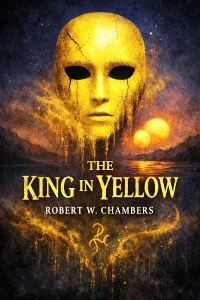
The King in Yellow

By ROBERT W. CHAMBERS. Introduction by Colin Heston

When The King in Yellow appeared in 1895, it slipped quietly into a literary world already saturated with decadence, occult enthusiasms, and the fin-de-siècle’s peculiar blend of anxiety and intoxication. Yet Robert W. Chambers’s strange mosaic of tales—united by a fictional forbidden play that unhinges those who read it—swiftly distinguished itself from its contemporaries. In the decades since, this slim volume has grown into one of the foundational works of the American weird tradition, prefiguring H. P. Lovecraft, influencing generations of modern horror writers, and unexpectedly resurfacing in the twenty-first century as a cultural touchstone.

What makes Chambers’s book so unusual is its deliberate blurring of boundaries: between reality and hallucination, sanity and delusion, art and contagion. The collection opens with “The Repairer of Reputations,” a tale set in an imagined New York of 1920—an unsettling mixture of futurism, authoritarian regulation, and manic delusion. It is here that the mysterious “King in Yellow” first exerts his influence. The narrator, a deeply unreliable figure, is convinced of his noble birthright and guided by an enigmatic “repairer” who traffics in scandal and blackmail. The narrative unfolds as a case study in self-deception, political paranoia, and the fragility of identity—yet nothing in the story is easily dismissed as mere fantasy. Reality itself buckles under the weight of the narrator’s convictions.

The Mask, perhaps the most haunting of the early tales, shifts the setting to the Latin Quarter of Paris, where art, science, and obsession converge. The grotesque beauty of Boris Yvain’s alchemical solution—capable of transforming living beings into flawless marble—creates a collision of aesthetics and mortality that typifies Chambers’s most powerful work. The story’s dreamlike quality reflects the decadent movement’s fascination with artificiality, transformation, and the erotic pull of the inanimate. Throughout, the shadow of the forbidden play hovers, never fully seen but always felt.

Other sections—“In the Court of the Dragon,” “The Yellow Sign,” and additional sketches—extend the book’s architecture of dread. Chambers never provides the text of the play itself, only its aftershocks, its “second act” whispered about as a psychic abyss from which there is no return. This structural absence is one of the book’s great innovations: The horror lies not in spectacle but in suggestion, in the void where meaning should be. The King in Yellow, the Pallid Mask, and the Lost City of Carcosa are not fully explained but instead exist as fragments of a mythology the reader assembles intuitively, as though the stories themselves are encoded with an infectious idea.

The power of The King in Yellow endures because it is not simply a collection of supernatural tales—it is a meditation on contagion: of ideas, of aesthetics, of inner instability. Chambers’s fictional play does not merely frighten; it corrodes. It reveals hidden fractures in those who encounter it and amplifies their darkest impulses. In this sense, the book mirrors its age. The 1890s were marked by the collapse of old certainties, the rise of new sciences of the mind, and an artistic fascination with decadence, degeneration, and the beautiful ruin of the self. Chambers captured that atmosphere with uncanny acuity.

Today, amidst digital conspiracies, fractured identities, and a renewed cultural fascination with alternate realities, The King in Yellow feels more relevant than ever. It invites the reader to step into a world where truth is unstable, where art is dangerous, and where the boundaries of perception are mercilessly thin. The book’s whispered mythology has become larger than the text itself, seeding later works, reappearing in unexpected media, and reminding us that the most enduring horrors are those we cannot fully see.

To open these stories is to risk a glimpse of the Yellow Sign—a symbol of beauty, madness, and forbidden knowledge. Chambers offers no assurances. He only extends an invitation to enter Carcosa, where twin suns sink over black waters and where, once the play begins, the mask cannot be removed.

Read-Me.Org Inc. New York-Philadelphia-Australia. 2026 p.209

Adventures Of An Outlaw: Abridged, simplified and readable

By Colin Heston (Author), James Tucker (Author), Ralph Rashleigh (Contributor)

This compelling narrative offers a vivid portrayal of the convict experience in early colonial Australia. The book, first published in 1929, is attributed to James Tucker, who wrote under the pseudonym Ralph Rashleigh. This introduction by Colin Heston aims to provide an overview of the book’s themes, historical context, and its significance in Australian literature. The story is set during a tumultuous period in Australian history when the continent was used as a penal colony by the British Empire. From 1788 to 1868, over 160,000 convicts were transported to Australia, fundamentally shaping the social and cultural landscape of the emerging nation. “Adventures of an Outlaw” provides a firsthand account of this era, detailing the harsh realities faced by convicts and the brutal conditions of the penal system. James Tucker, the presumed author, was himself a convict transported to Australia for forgery. His experiences and observations lend authenticity to the narrative, making it a valuable historical document. The book offers insights into the daily lives of convicts, their interactions with authorities, and their struggles for survival and dignity in an unforgiving environment. This abridged edition simplifies the narrative and corrects the many quaint spellings and expressions while keeping the essential facts and challenging experiences that challenged Rasjleigh's resilience and determination to find freedom.

First published in 1929 by Jonathan Cape and Harrison Smith1. The memoir, attributed to the pseudonym Ralph Rashleigh, is actually the work of James Rosenberg Tucker. This abridged edition Read-Me.Org Inc. 2025. 105p.

The Thief's Journal

From the Cover: In this, his most famous book, Genet charts his progress through Europe and the 1930s in rags, hunger, contempt, fatigue and vice. Spain, Italy, Austria, Czechoslovakia, Poland, Nazi Germany, Belgium . . . everywhere the pattern is the same: bars, dives, flop-houses; robbery, prison and expulsion. This is a voyage of discovery beyond all moral laws; the expression of a philosophy of perverted vice, the working out of an aesthetic of degradation. The cover shows 'Head on Stand' (1947)b y Alberto Giacometti, in the Maeght Collection.

London. Penguin Classics. 1950s? THIS BOOK CONTAINS MARK-UP