

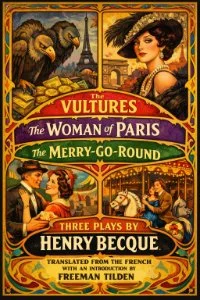
Three Plays By Henry Becque. Translated From The French With An Introduction By Freeman Tilden. Preface by Colin Heston.
To enter the world of Henry Becque is to step into a theater stripped of its finery. As we present these three plays—”The Vultures”, “The Woman of Paris”, and “The Merry-Go-Round”—it is essential to recognize the revolutionary "brutal strength" Becque required to "knock over the idols of romance" that dominated the 19th-century stage.
Freeman Tilden’s introduction serves as a vigorous defense of Becque as the pioneer of realism. Tilden correctly identifies Becque as a "revolutionist" who flouted the "happy ending" and the rigid traditions of dramatists like Sardou. He eloquently describes Becque’s vision of a stage representing the "dramatic commonplaces of every-day life" rather than the "sentimental nonsense" of the era.
However, a modern critique of Tilden’s introduction reveals two areas where his analysis might be expanded:
First, “The Nature of the "Cruel Theatre": Tilden focuses heavily on the “structural” revolution—the five-act drama and the rejection of mystery-driven plots. While he mentions Becque’s "militant" social ideas, he arguably underplays the psychological darkness of the "cruel theatre". Becque did not just want realism; he wanted truth to go "defiantly bare," revealing a world where "vultures" (lawyers, partners, and creditors) wait for a man to die before descending on his family.
Second, “The Gender Perspective:” Tilden notes that Becque voiced "the protest of women against the prejudice that kept them from earning a decent livelihood". Yet, in his discussion of “The Woman of Paris” (“La Parisienne”), Tilden remains somewhat focused on the "naughty triangle" and the prosaic nature of adultery. A modern critique would emphasize that Becque’s women are often forced into moral compromises not by choice, but by a "bureaucratic system" that offers them only parasitism or ruin.
Despite these nuances, Tilden’s assertion remains true: Becque was the "wedge that opened the way for realism". He cleared the ground for Ibsen and the modernists by proving that a play could be "clear without being obvious" and that everyday existence held enough surprises for a master of stagecraft.
In this collection, readers will witness the "unexpectedly striking" scenes that puzzled 19th-century critics—from the savage dinner of the concierges in “The Prodigal Son” to the cold-blooded notary Bourdon in “The Vultures”. We invite you to experience the "cruel theatre" in its purest form: a mirror held up to the "marvellous dramatic commonplaces" of our own human struggle.
New York. Mitchell Kennerley. 1913. Read-Me.Org Inc. New York-Philadelphia-Australia. 2026. 267p.
