Open Access Publisher and Free Library
Fiction+Mediajpg.jpg

FICTION and MEDIA

CRIME AND MEDIA — TWO PEAS IN A POD

Posts in story collection
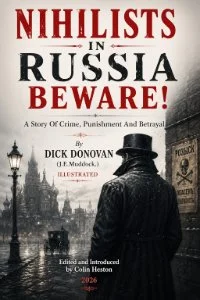
Cops And Criminals In Russia: The Stories Of Dick Donovan

by Colin Heston (Editor), Dick Donovan (Author)

Cops and Criminals in Russia, edited by Colin Heston, brings together a gripping collection of early detective fiction set within the shadowy world of imperial Russia’s secret police. Featuring Dick Donovan’s celebrated tales—The Chronicles of Michael Danevitch of the Russian Secret Service this volume offers readers a rare glimpse into a world where crime, espionage, and state power are inseparably entwined.

At the center of these stories stands Michael Danevitch, a master investigator navigating a landscape of conspiracies, political intrigue, and dangerous secrets. Unlike the gentleman detectives of Victorian England, Danevitch operates within the machinery of the Russian state itself, where justice is often subordinate to necessity and truth is obscured by layers of deception. His cases take him from dimly lit backstreets to the inner circles of power, confronting assassins, spies, and criminals whose motives are as complex as the society they inhabit.

These stories are more than classic detective adventures. They capture a moment in history when Russia’s system of policing was evolving into a powerful instrument of political control—an evolution whose echoes can still be felt today. Through Donovan’s vivid storytelling, readers encounter a world in which surveillance, infiltration, and intrigue shape both crime and its investigation, offering a perspective that feels strikingly modern.

Expertly edited and introduced by Colin Heston, this new edition situates Donovan’s work within its broader historical and contemporary context, making it essential reading for anyone interested in crime fiction, Russian history, or the enduring relationship between law enforcement and state power.

Rich in atmosphere, suspense, and historical insight, Cops and Criminals in Russia is both a compelling literary rediscovery and a timely exploration of policing in one of the world’s most enigmatic societies.

Read-Me.Org Inc. New York-Philadelphia-Australia. 2026. 211p.

The Gold Coast Regiment In The East African Campaign

By Hugh Clifford.. Introduction by Graeme Newman

The East African Campaign of the First World War remains one of the most demanding and least understood theatres of that global conflict. Far removed from the trenches of Europe, it unfolded across vast expanses of dense bush, swamps, mountains, and savannah—lands where climate, terrain, and disease were often deadlier adversaries than the enemy’s rifles. In this harsh environment, the soldiers of the Gold Coast Regiment distinguished themselves with a fortitude and endurance that earned them a lasting place in the annals of imperial military history.

The Gold Coast Regiment, drawn predominantly from the peoples of West Africa and led by British officers, brought to East Africa a unique blend of discipline, adaptability, and martial tradition. Their participation in the long pursuit of General Paul von Lettow‑Vorbeck’s elusive Schutztruppe represented both a severe test of their abilities and a defining moment in their collective identity. The campaign demanded not only courage under fire but also the capacity to march extraordinary distances, survive with minimal supplies, and maintain cohesion amid the ravages of tropical disease and the unpredictable rhythms of guerrilla warfare.

Sir Hugh Clifford, K.C.M.G.—administrator, colonial governor, and a man deeply familiar with West Africa—brings a rare perspective to this narrative. His closeness to the region and its peoples lends the work a depth of understanding that extends beyond the purely military. Clifford’s account is not merely a chronicle of battles and maneuvers; it is also a tribute to the character, loyalty, and steadfastness of the African soldiers who served with such distinction. He illuminates how, in the face of profound hardship, these men forged bonds of trust and cooperation with their officers, contributing decisively to the eventual success of British and Allied arms in the region.

This book therefore stands as both a historical record and a testament—an effort to ensure that the bravery and sacrifices of the Gold Coast Regiment are neither forgotten nor overshadowed by more widely known campaigns. In revisiting their story, readers gain insight not only into a pivotal chapter of African military history but also into the wider, often overlooked global dimensions of the First World War. The narrative that follows invites us to honour the endurance, resilience, and unyielding spirit of a regiment that marched far from home and left an indelible mark on the course of the war in Africa.

Crime And Custom In Colonial Society: The Stories Of Sir Hugh Clifford

Eduted By Graeme R. Newman

Crime and Custom in Colonial Society brings together, for the first time in a single volume, the complete stories from In Court and Kampong and In Days That Are Dead by Hugh Clifford—newly introduced and contextualized by Graeme Newman for modern readers.

Set in British Malaya at the height of empire, these vivid and often unsettling narratives explore a world where radically different systems of law, morality, and social obligation collide. In the kampong villages, life is governed by custom, kinship, and deeply rooted traditions. In the colonial courts, British officials impose formal legal codes that claim universality but often fail to grasp the lived realities of the people they judge. Between these two worlds lies a fraught and morally ambiguous terrain—one in which the meaning of “crime” itself is constantly contested.

Taking its title as a deliberate echo of Crime and Custom in Savage Society by Bronisław Malinowski, this volume invites readers to reconsider one of the central questions of legal and social theory: how do societies define wrongdoing, and what gives law its authority? Where Malinowski revealed the internal coherence of indigenous systems of custom, Clifford’s stories expose the tensions, misunderstandings, and injustices that arise when those systems are overridden by colonial power.

These tales are more than historical curiosities. They are gripping human dramas—stories of loyalty and betrayal, honor and punishment, authority and resistance—told with the insight of a colonial administrator who witnessed firsthand the complexities of governing a plural society. At the same time, they offer a profound meditation on legal pluralism, cultural conflict, and the limits of imposed justice—issues that remain urgently relevant in today’s globalized world.

This new edition features a substantial scholarly introduction by Graeme Newman, situating Clifford’s work within the broader traditions of criminology, anthropology, and colonial history. Crime and Custom in Colonial Society will appeal to readers of historical fiction, students of law and sociology, and anyone interested in the enduring question of how law is shaped by culture—and how it, in turn, shapes human lives.

Read-Me.Org Inc. New York-Philadelphia-Australia. 2026. 297p.

Beyond Sherlock Holmes

Edited by Graeme R. Newman

Step out of the shadow of 221B Baker Street and into the gaslit world of the "Great Detectives."

While Sherlock Holmes reigned supreme in the pages of The Strand, he was far from the only mind at work in the fog-choked streets of Victorian London. "Beyond Sherlock Holmes: The Rivals, Rogues, and Rationalists of the Golden Age" is a definitive collection of public domain masterpieces that defined the evolution of the modern thriller.

From the "ratiocination" of Edgar Allan Poe to the forensic laboratories of Dr. Thorndyke, this anthology gathers the brilliant specialists who refined, subverted, and occasionally haunted the detective genre. These are the stories that gave Holmes his fiercest competition—characters who used logic, science, and even the occult to solve the "impossible."

Inside this collection, you will discover:

  • The Forensic Pioneers: Join Dr. Thorndyke as he utilizes the first true "mobile crime lab" to solve murders through microscopic analysis.

  • The Logic Masters: Witness The Thinking Machine prove that "two and two make four" by thinking his way out of an inescapable prison cell.

  • The Shadow Detectives: Meet Max Carrados, the blind investigator whose heightened senses allow him to observe truths that even Holmes would miss.

  • The Occult Investigators: Follow Thomas Carnacki as he bridges the gap between science and the supernatural to hunt "monsters" through the lens of logic.

  • The Mastermind Villains: Face the terrifying ambition of Dr. Nikola, the Victorian "supervillain" whose global reach predates Bond villains by half a century.

  • The Gentleman Thieves: Cross the line with A.J. Raffles and Arsène Lupin, the brilliant "cracksmen" who prove that the detective’s mind is just as effective when applied to the perfect heist.

A Must-Have for Fans of Classic Mystery

Whether you are a scholar of criminology or a lover of "Victorian Shockers," this volume offers a panoramic view of an era defined by gaslight, cobblestones, and the birth of forensic science. Curated with an extensive introduction detailing the history and impact of these "Rivals of Sherlock," this book is more than a collection—it is a journey through the evolution of the human mind at work.

Stories included in this edition: THE MURDERS IN THE RUE MORGUE, Edgar Allan Poe-- THE CASE OF LAKER, ABSCONDED, Arthur Morrison-- THE CASE OF THE DIXON TORPEDO, Arthur Morrison-- THE PROBLEM OF CELL 13, Jacques Futrelle-- THE SILENT BULLET, Austin Freeman-- THE COIN OF DIONYSIUS, Ernest Bramah-- THE GATEWAY OF THE MONSTER, Wiliam Hope Hodgson-- THE RED LODGE, Russell Wakefield-- THE ADVENTURE OF THE SPECKLED BAND, Arthur Conan Doyle-- THE IDES OF MARCH, E.W.Hornung-- THE ARREST OF ARSÈNE LUPIN, Maurice Leblanc.

Read-Me.Org Inc. New York-Philadelphia-Australia. 2026. 330p.

Further Rivals of Sherlock Holmes

Edited by Sir Hugh Greene

The Further Rivals of Sherlock Holmes is the third volume in Hugh Greene’s celebrated series of anthologies that revive lesser‑known detective fiction from the Victorian and Edwardian eras. First published in 1973, this collection focuses particularly on crime and mystery stories set outside London, offering a contrast to the urban investigations associated with Sherlock Holmes.

Greene gathers an eclectic mix of authors—from C. L. Pirkis to Ernest Bramah, Arthur Morrison, Fergus Hume, Jacques Futrelle, and others—presenting detectives with distinct personalities, investigative styles, and moral shades. The volume features a blend of traditional detection, espionage, psychological mystery, and even touches of the gothic. Stories include cases solved by women detectives like Dora Myrl and unusual protagonists such as Judith Lee, a young lip‑reader who cracks crime through observation and intuition.

What defines this anthology is its sense of variety and rediscovery. Greene chose stories that had been overshadowed by Conan Doyle’s dominance but which reveal the richness and diversity of early crime fiction—full of ingenuity, twisted plots, and vivid period atmosphere. Together, these tales expand the world of detective literature, showcasing that Holmes was only one among many fascinating sleuths of his time.

If you’d like, I can also summarize individual stories, compare this volume with the rest of the series, or help locate a cover image.

New York.. Pantheon. 1973. 318p.

The Rivals of Sherlock Holmes

Edited by Hugh Greene

The Rivals of Sherlock Holmes is a classic anthology compiled by Hugh Greene that showcases a wide range of lesser‑known detective stories from the late Victorian and Edwardian eras. Greene sought to highlight the vibrant landscape of crime and mystery fiction that flourished alongside, and sometimes even before or beyond, Conan Doyle’s famous detective. The collection illustrates that Sherlock Holmes, while dominant today, once stood among many competing sleuths created by equally imaginative writers.

The stories Greene selected feature diverse detectives—amateur investigators, professional policemen, scientific detectives, con‑artists‑turned‑sleuths, and eccentric specialists—reflecting the creativity of the period’s crime fiction. The settings also vary widely, from London fog to rural estates, bustling streets, and exotic locales, providing a vivid panorama of the era. The anthology’s purpose is not only entertainment but also a historical reminder: Doyle was not alone in shaping detective fiction, and readers once had many “rivals” to choose from.

The cover of this edition visually underscores its period atmosphere. It depicts two men in period clothing—one standing, one lying across a cart—set against a Victorian street scene marked by signs such as “Bottle Water” and “Cork Board,” evoking the gritty, textured world these early detectives inhabited. [amazon.com]

New York.. Pantheon. 1970. 352p.

The Spies And Criminals Of Edgar Wallace -Volume 2

SCOTLAND YARD AND BEYOND

By Edgar Wallace. Edited and Introduced by Graeme R. Newman

The Spies and Criminals of Edgar Wallace — Volume 2 brings together one of Edgar Wallace’s most intriguing crime novels alongside the stories that introduced one of his most famous creations. At the center of this volume is the gripping novel The Black, a tale of mystery, intrigue, and shadowy power in which a secretive criminal force challenges the authority of the law and tests the ingenuity of those determined to bring it down. Filled with unexpected twists, daring schemes, and Wallace’s trademark rapid pacing, the novel showcases the author at the height of his storytelling powers.

Complementing the novel are the classic stories of The Law of the Three Just Men, the remarkable vigilante trio who became one of Wallace’s most celebrated inventions. Acting outside the formal machinery of government, the Three Just Men intervene when justice fails. Their warnings are precise, their judgments uncompromising, and their reach seems limitless. Governments tremble when they speak, for their word is always followed by action.

Together, The Black and the stories of The Law of the Three Just Men reveal Wallace’s extraordinary ability to create suspenseful plots and unforgettable characters. His world is one where spies, secret societies, and daring investigators move through a landscape of danger and intrigue, where justice may come from unexpected quarters, and every page brings a new surprise.

In this second volume of The Spies and Criminals of Edgar Wallace, readers are invited to rediscover the excitement, ingenuity, and narrative brilliance that made Wallace one of the most widely read thriller writers of his time—and whose stories continue to entertain audiences around the world.

Read-Me.Org Inc. New York-Philadelphia-Australia. 2026. 299p.

Studies in Brown Humanity: :Being Scrawls and Smudges in Sepia, White, and Yellow

By Hugh Clifford (Author), Graeme Newman (Introduction)

Studies in Brown Humanity by Sir Hugh Clifford is a striking collection of literary sketches drawn from the author’s experiences as a British colonial administrator in the Malay Peninsula during the late nineteenth century. Blending storytelling with observation, Clifford presents a series of vivid portraits of village life, local customs, personal conflicts, and dramatic encounters shaped by the social structures of colonial Southeast Asia. The narratives explore themes of honor, betrayal, justice, and authority, often focusing on moments when traditional Malay codes of conduct collide with the legal and moral framework imposed by the British colonial state.

Although written as literary sketches rather than formal social analysis, the book provides revealing insights into the ways communities understand wrongdoing and punishment. Clifford’s stories depict acts of violence, disputes over reputation, and conflicts between individuals and authority, illustrating how social norms, kinship ties, and communal expectations shape both criminal behavior and responses to it. In this sense, the work can be read not only as colonial literature but also as an early, informal contribution to the sociological study of crime and social control.

At the same time, Studies in Brown Humanity reflects the attitudes and assumptions of its imperial context. Clifford’s interpretations are filtered through the perspective of a European observer, and the book reveals much about the intellectual climate of the British Empire at the turn of the twentieth century. For modern readers, the volume is therefore both a vivid narrative of colonial life and a historical document that illuminates how crime, justice, and cultural difference were understood within the framework of empire.

Rich in atmosphere and dramatic detail, Clifford’s work remains valuable today as a window into the complex social worlds of colonial Southeast Asia and as a reminder of how early narratives about crime and punishment were shaped by the cultural and political conditions of their time.

Read-Me.Org Inc. New York-Philadelphia-Australia. 2026. 291p.

The Further Side of Silence

Sir Hugh Clifford, K. C. M. G.

The Further Side of Silence by Hugh Clifford is a collection of interrelated stories set in the Malay Peninsula during the late nineteenth century, a period when traditional Malay societies were increasingly encountering the expanding authority of the British Empire. Drawing heavily on Clifford’s own experiences as a colonial administrator in the region, the book portrays the lives, customs, conflicts, and moral dilemmas of the people who inhabited the jungles, villages, and royal courts of Malaya.

Through dramatic narratives and vivid descriptions of the tropical landscape, Clifford explores themes of loyalty, honor, justice, and power within a society shaped by ancient traditions and emerging colonial rule. His stories depict Malay chiefs, warriors, villagers, and forest peoples whose lives are entangled in political intrigue, personal rivalries, and the pressures of a changing world.

Part adventure literature and part social observation, the book offers modern readers a window into the cultural and political realities of Southeast Asia during a transformative historical moment. At the same time, it stands as an example of early twentieth-century colonial literature, reflecting both the fascination and the assumptions with which Western writers interpreted the societies they governed.

Read-Me.Org Inc. New York-Philadelphia-Australia. 2026. 198p.

The Kidnapped President. A Crime Of The Under-Seas.

By Guy Boothby. Introduction by Colin Heston

This volume brings together some of the most imaginative and high-stakes narratives from the pen of Guy Boothby, a writer who reigned as one of the most popular masters of the Victorian "shocker." At a time when the British Empire was at its zenith and the possibilities of modern technology were just beginning to fire the public imagination, Boothby crafted stories that blended geopolitical intrigue with the dark, uncharted corners of the globe.


The centerpiece of this collection, The Kidnapped President (1902), catapults the reader into a world of political conspiracy and daring maritime adventure. Set against the backdrop of a South American revolution, the story follows the audacious abduction of a head of state and the relentless pursuit that follows. Boothby’s personal history as a world traveler is evident here; his descriptions of the sea and the desperate maneuvers of those living on the edge of the law carry an authenticity that few of his contemporaries could match. It is a quintessential example of the "international thriller" before the genre had even fully formed, exploring themes of loyalty, power, and the high price of political ambition.
In A Crime of the Under-Seas (1905), Boothby pivots toward a more localized but no less intense mystery. This narrative delves into the treacherous world of pearl fishing and the cutthroat competition of the maritime trade. When a valuable discovery is marred by a calculated crime, the story becomes a tense examination of greed and the lengths to which men will go when they believe they are beyond the reach of land-based authorities. It serves as a perfect companion to the broader political scope of The Kidnapped President, focusing instead on the gritty, high-stakes reality of those who make their living on the ocean's floor.

Rounding out this edition is a selection of Boothby’s shorter fiction, which highlights his versatility as a storyteller. From eerie tales of the supernatural to sharp, punchy vignettes of colonial life, these stories demonstrate the narrative economy that made him a favorite of the era's leading magazines. Whether he is exploring a haunted family legacy or a clever piece of detective work, Boothby’s prose remains relentlessly paced, always keeping the reader’s curiosity at a fever pitch.
Together, these works offer a vivid window into the anxieties and fascinations of the early 20th century. Guy Boothby understood that his audience craved both the thrill of the unknown and the satisfaction of a justice served, and in this collection, he delivers both with his trademark energy. From the corridors of power to the depths of the sea, this volume invites you to rediscover a pioneer of the thriller genre at the height of his creative powers.

Read-Me.Org Inc. New York-Philadelphia-Australia. 2026. 200p.

The Story Page

By Charlie Blank

The Story Page: Embracing Ten Interesting Tales is a short story anthology by Charlie Blank, published in 1933 by The O’Sullivan Publishing House in Chicago. The book is a collection of ten distinct narratives that explore themes of missed opportunities, second chances, and the dramatic twists of fate that define human lives during the early 20th century.

The collection is dedicated "Lovingly to Mother". It features the following ten stories:

1. "The Unanswered Call.. 2. His Second Chance-3. Ann-4. The Destroyer 5. The Teetotal Tar. 6. The Sequel, Unique. 7. The Phantom at the Wheel. 8. A Brush with Civilization. 9. The Crampton Kidnapping. 10. A Peep into the Hereafter.

The stories often focus on characters at emotional or moral crossroads, dealing with the consequences of their choices or the intervention of tragedy.

Thematic Overview.

“Tragedy and Irony:” In "The Unanswered Call," a nurse named Jane Merrick decides to end her eight-year relationship with a man named Jerry. She intentionally ignores his persistent phone calls to prove her resolve, only to receive a call from a hospital informing her that he was fatally struck by a car thirty minutes prior—the very period during which she refused to answer.

The Struggle for Redemption:. "His Second Chance"* follows John V. Caruthers, a man living in poverty and shame after losing his job during the Depression and embezzling money to play the stock market. The story explores his internal battle as a fugitive from justice, trying to earn enough money through a risky oil venture to make amends for his past.

Historical Context: The narratives are deeply rooted in their era, referencing the **Great Depression**, the volatility of the **Stock Exchange**, and the personal toll of financial ruin.

The prose is character-driven and often somber, highlighting the thin line between a "fresh youthfulness" and a life turned "sordid and bitter" by time and circumstance.

The O’Sullivan Publishing house. Chicago. Illinois. 1938. 229p.

The La Chance Mine Mystery

By S. Carleton. Introduction by Colin Heston.

The 1920 publication of The La Chance Mine Mystery by S. Carleton, the pseudonym for Susan Morrow Jones, represents a pivotal moment in the evolution of the North American thriller. By weaving the Victorian Gothic tradition into the rugged landscape of the Canadian wilderness, Carleton created a narrative that serves as a sophisticated precursor to modern psychological suspense. In contemporary literature, this work remains highly relevant as a masterclass in atmospheric isolation, where the "frozen North" acts not merely as a setting but as a primary antagonist. This technique mirrors modern "Environment as Character" tropes seen in current survivalist fiction, reminding readers that the primitive fear of being trapped in a vast, uncaring wilderness transcends technological advancement and remains a powerful literary hook.

From a criminological perspective, the novel offers a compelling study of frontier anomie. In the absence of formal state policing, the isolated mine becomes a vacuum where white-collar crimes like corporate fraud and title theft inevitably devolve into violence. This lack of social control forces characters into a state of informal justice, predating modern investigative frameworks through "bushcraft forensics." In an era before chemical analysis or DNA, Carleton’s characters rely on environmental reconstruction—analyzing the crust of snowdrifts or the set of a footprint—to determine the timing of a crime. This reliance on natural preservation within a crime scene provides a proto-historical look at how physical environment shapes both criminal opportunity and the subsequent forensic analysis used to untangle it.

The social dynamics of the mine also provide deep insights into early 20th-century victimology. Carleton highlights a hierarchy of vulnerability, focusing on how marginalized laborers and isolated individuals are targeted by those with institutional power. In this setting, victims are often chosen specifically because their disappearances can be conveniently blamed on the harsh climate rather than foul play. This exploration of "invisible victims" and structural exploitation resonates with modern social justice themes regarding labor and corporate overreach. By subverting the "hard-boiled" male tropes of her time, Carleton used her unique perspective as a female author to provide an emotional depth and keen eye for power imbalances that continue to inform the DNA of modern suspense and elevated horror.

Read-Me.Org Inc. New York-Philadelphia-Australia. 2026. 192p.

THE VULTURES==THE WOMAN OF PARIS==THE MERRY-GO-ROUND

Three Plays By Henry Becque. Translated From The French With An Introduction By Freeman Tilden. Preface by Colin Heston.

To enter the world of Henry Becque is to step into a theater stripped of its finery. As we present these three plays—”The Vultures”, “The Woman of Paris”, and “The Merry-Go-Round”—it is essential to recognize the revolutionary "brutal strength" Becque required to "knock over the idols of romance" that dominated the 19th-century stage.

Freeman Tilden’s introduction serves as a vigorous defense of Becque as the pioneer of realism. Tilden correctly identifies Becque as a "revolutionist" who flouted the "happy ending" and the rigid traditions of dramatists like Sardou. He eloquently describes Becque’s vision of a stage representing the "dramatic commonplaces of every-day life" rather than the "sentimental nonsense" of the era.

However, a modern critique of Tilden’s introduction reveals two areas where his analysis might be expanded:

First, “The Nature of the "Cruel Theatre": Tilden focuses heavily on the “structural” revolution—the five-act drama and the rejection of mystery-driven plots. While he mentions Becque’s "militant" social ideas, he arguably underplays the psychological darkness of the "cruel theatre". Becque did not just want realism; he wanted truth to go "defiantly bare," revealing a world where "vultures" (lawyers, partners, and creditors) wait for a man to die before descending on his family.

Second, “The Gender Perspective:” Tilden notes that Becque voiced "the protest of women against the prejudice that kept them from earning a decent livelihood". Yet, in his discussion of “The Woman of Paris” (“La Parisienne”), Tilden remains somewhat focused on the "naughty triangle" and the prosaic nature of adultery. A modern critique would emphasize that Becque’s women are often forced into moral compromises not by choice, but by a "bureaucratic system" that offers them only parasitism or ruin.

Despite these nuances, Tilden’s assertion remains true: Becque was the "wedge that opened the way for realism". He cleared the ground for Ibsen and the modernists by proving that a play could be "clear without being obvious" and that everyday existence held enough surprises for a master of stagecraft.

In this collection, readers will witness the "unexpectedly striking" scenes that puzzled 19th-century critics—from the savage dinner of the concierges in “The Prodigal Son” to the cold-blooded notary Bourdon in “The Vultures”. We invite you to experience the "cruel theatre" in its purest form: a mirror held up to the "marvellous dramatic commonplaces" of our own human struggle.

New York. Mitchell Kennerley. 1913. Read-Me.Org Inc. New York-Philadelphia-Australia. 2026. 267p.

Round Up: The Stories Of Ring W. Lardner

By Ring W. Gardner (Author), Colin Heston (Preface) Format: Kindle Edition

Round Up gathers together the taut, muscular stories of Ring W. Lardner, a writer whose work bridges the divide between the mythologized West and its harsher, less forgiving realities. In these pages, Lardner is neither sentimental nor nostalgic. He strips the Western narrative to its barest elements, presenting us with a landscape that is both expansive and claustrophobic, and characters who are caught between the lure of freedom and the inevitability of fate.
Lardner’s contribution to the American short story lies in his ability to invest the familiar tropes of frontier life with psychological depth and moral ambiguity. His cowboys and ranchers are not mere archetypes; they are restless souls negotiating loyalty, isolation, and survival in a world where law and justice are provisional at best. The violence in these stories is never gratuitous—it is sudden, often senseless, and always carries a human cost. Lardner understands that the West was not only a place but also an idea, one that promised reinvention yet often delivered ruin.
What sets Lardner apart from many of his contemporaries is his prose: terse, unsentimental, yet charged with a quiet lyricism. His narratives move with the inevitability of a gathering storm, his dialogue as spare as the plains he describes. The result is a body of work that feels astonishingly modern in its refusal of easy resolutions.
In an era when the Western genre risks being dismissed as an artifact of popular culture, Round Up demands reconsideration. These are not mere adventure tales or moral fables. They are stories of a liminal world, where the boundaries between civilization and wilderness, justice and vengeance, myth and memory, blur and collapse. Lardner’s West is not simply the West that was; it is also the West as it continues to haunt the American imagination.

The New Arabian Nights: Vol.4. Works of R;L;S.

By Robert Louis Stevenson. Edited by Colin Heston

"The New Arabian Nights" by Robert Louis Stevenson is a captivating collection of short stories that showcases his talent for blending adventure, mystery, and humor. Volume 4 of his works includes these tales, which are inspired by the classic "Arabian Nights" but set in contemporary Europe.

The Suicide Club: The collection opens with "The Suicide Club," a trilogy of stories that revolve around Prince Florizel of Bohemia and his loyal companion, Colonel Geraldine. They stumble upon a secret society where members gamble with their lives, seeking an escape from their troubles through death. The stories are filled with suspense, intrigue, and Stevenson's signature wit, as the prince and the colonel navigate dangerous situations to uncover the club's dark secrets.

The Rajah's Diamond: Another notable story is "The Rajah's Diamond," which is divided into four parts. It follows the adventures of a priceless diamond and the various characters who come into possession of it. The diamond's journey leads to a series of thrilling and unexpected events, showcasing Stevenson's ability to weave complex plots and create memorable characters.

Other Stories: The volume also includes other engaging tales such as "The Pavilion on the Links," a story of love, betrayal, and revenge set against the backdrop of a remote Scottish coast, and "A Lodging for the Night," which features the infamous French poet François Villon and his escapades in medieval Paris.

"The New Arabian Nights" is a testament to Stevenson's versatility as a writer. Each story is rich with vivid descriptions, dynamic characters, and a blend of humor and suspense. Stevenson's ability to transport readers to different settings and immerse them in the adventures of his characters makes this collection a delightful and compelling read. Volume 4 of his works highlights Stevenson's skill in crafting engaging narratives that continue to captivate readers with their originality and charm.

Australia. Read-Me.Org. Inc. 2025. 197p.

Round the Camp Fire

USED BOOK. MAY CONTAIN MARK-UP

By E. E. Reynolds

FROM THE PREFACE: “The yarns in this book are all narratives of actual experiences. It is not usually difficult to get the books written by famous explorers, such as Livingstone, and their achievements are also recorded in biographies; but there have been a great many men who have travelled in the lesser known parts of the world without becoming famous. Many of the stories that follow are drawn from the adventures ofsuch minor explorers. One group. of the yarns is about early settlers in the Dominions; these men and women had to endure much hardship while creating new homes, but unfortunately few of themrecorded their experiences.

Oxford University Press. 1953. 160p.

The Jungle Book

By Rudyard Kipling

PUBLISHER PREFACE: The book you are about to read is composed of stories written by Rudyard Kipling. Originally, these stories were in two volumes entitled "The Jungle Book." * and " The Second Jungle Book." The present volume combines all of the Mowgli Stories under one cover. In addition, "Rikki Tikki Tavi," "The Elephant Boy," * and "The Miracle of Purun Bhagat" have been included. Certain other stories that appeared in the original books have been omitted due to limitations of space. The stories that do appear in this book are unabridged, exactly as Kipling originally published them.

London. Classic Press and Ottenhelmer publishers. 1968, 1979. 225p. UNSED BOOK CONTAINS MARK-UP

Ficciones

By Jorge Luis Borges

From the cover: ". unquestionably the most brilliant South American writing today. . .one of the genuine prose talents of our pe- riod. Written with a classical economy of means and under the control of a mind of wide culture and deep sensitivity, his stories will continue echoing in the minds of his readers as do those of Franz Kafka." -Herald Tribune Books

NY. Grove Press. 1962. 164p. USED BOOK. CONTAINS MARK-UP.

Labyrinths: Selected Stories And Other Writings

By Jorge Luis Borges. Edited by Donald A. Yates and James E. Irby

FROM THE PREFACE: Jorge Luis Borges is a great writer who has composed only little essays or short narratives. Yet they suffice for us to call him great because of their wonderful intelligence, their wealth of invention and their tight, almost mathematical, style. Argentine by birth and temperament, but nurtured on univer- sal literature, Borges has no spiritual homeland. He creates, outside time and space, imaginary and symbolic worlds. It is a sign of his importance that, in placing him, only strange and perfect works can be called to mind. He is akin to Kafka, Poe, sometimes to Henry James and Wells, always to Valéry by the abrupt projection of his paradoxes in what has been called 'his private metaphysics'.

London. Penguin. 1964. 276p. USED BOOK. CONTAINS MARK-UP

Franz Kafka: The Complete Stories

By Franz Kafka. : Willa and Edwin Muir, Tania and James Stern

This is a 1971 collection of all Kafka’s finished works. It contains all the amazing, weird and wonderful unsettling stories from Metamorphisis to In the Penal Colony.From Wikipedia: “In 1912, Kafka wrote Die Verwandlung (The Metamorphosis, or The Transformation),[150] published in 1915 in Leipzig. The story begins with a travelling salesman waking to find himself transformed into an ungeheures Ungeziefer, a monstrous vermin, Ungezieferbeing a general term for unwanted and unclean pests, especially insects. Critics regard the work as one of the seminal works of fiction of the 20th century.[151][152][153] The story "In der Strafkolonie" ("In the Penal Colony"), dealing with an elaborate torture and execution device, was written in October 1914,[82] revised in 1918, and published in Leipzig during October 1919. The story "Ein Hungerkünstler" ("A Hunger Artist"), published in the periodical Die neue Rundschau in 1924, describes a victimized protagonist who experiences a decline in the appreciation of his strange craft of starving himself for extended periods.[154] His last story, "Josefine, die Sängerin oder Das Volk der Mäuse" ("Josephine the Singer, or the Mouse Folk"), also deals with the relationship between an artist and his audience.[155]

NY. Schoken. 1971. 487p. CONTAINS MARK-UP