

By Donovan Tan
Australia's recent anti-hate legislation, passed in January 2026, has ostensibly crippled domestic far-right organisations. The National Socialist Network’s disbandment, which immediately followed, has been celebrated by some. However, disbandment merely reframes the threat, as far-right elements have decentralised to avoid prosecution. Decentralisation disperses extremists instead of defeating them. This risks catalysing the very violence the legislation seeks to prevent. Without addressing ideological motivations, restrictive measures may prove inadequate, and even counterproductive.
By The Parliament of Queensland. The Justice, Integrity and Community Safety Committee
This report presents a summary of an examination of Queensland's Fighting Antisemitism and Keeping Guns out of the Hands of Terrorists and Criminals Amendment Bill 2026. The committee’s task was to consider the policy to be achieved by the legislation and the application of fundamental legislative principles. The committee recommends that the Bill be passed.
By James Paterson, Lydia Khalil
In the past two decades, drones have transformed from niche military tools into widely available 'commercial off-the-shelf' technologies. What was once the exclusive domain of state actors now rests within reach of nearly anyone with a credit card and a data signal. With uncrewed aircraft systems – or drone platforms – becoming cheaper, smaller, and easier to operate, the number of drone plots by domestic extremist groups has increased rapidly.
Key findings
Domestic extremist actors are incorporating drone technology into operational capabilities and attack plots, taking inspiration from the battlefield. The number of violent plots utilising drones has increased sharply over the past five years. Domestic counter-drone frameworks are mismatched to the threat. Effective protection requires layered, multi-system approaches across potential civilian targets and critical infrastructure. Easy-to-access technologies, such as 3D printing, open-source design files, additive hardware, and AI-assisted navigation are lowering the barriers to modifying and weaponising drones.
Recommendations
Countries should establish domestic counter-drone task forces to tackle domestic actor exploitation of drones. Internationally coordinated safety-by-design regulations should be implemented to make it easier to identify and respond to malicious drone use. Specific policy attention and response should be directed towards the threat posed by 3D printing in the additive manufacturing ecosystem.

By Skye Predavec, Rod Campbell, Alice Grundy
To get a firearm licence in Australia requires having a “genuine reason” to own a gun. In most jurisdictions, this requirement can be satisfied by being a paid-up member of a sports shooting club. Shooting groups promote this fact, advertising that you can join “from the comfort of home”. This may explain why up to 253,000 NSW firearms licences list shooting sports or recreational hunting as a reason for gun ownership, but fewer than 36,000 people in NSW participated in either activity in 2025. Ever since the Port Arthur massacre, Australia has been united behind the principle that strict firearm controls are important for public safety. The thin practical requirements for getting a firearm licence are not in the spirit of that principle and allow for a worrying erosion of Australia’s gun control regime.
By Rob Bonta; Immigration Detention Facility Review Team
Enacted in response to growing concerns for the health and safety of people in civil immigration detention, Assembly Bill 103 (2017) (AB 103) requires the California Department of Justice (Cal DOJ) to review and report on civil immigration detention facilities operating within the State of California. This mandate has been a critical source of transparency for the public and policymakers regarding conditions in these facilities across California. Cal DOJ has previously issued four reports on conditions in immigration detention facilities in California in 2019, 2021, 2022, and 2025, identifying and documenting substandard and inhumane conditions that fail to meet U.S. Immigration and Customs Enforcement’s (ICE) own applicable standards. In 2025, Cal DOJ found that many of these conditions worsened as the current administration’s mass deportation campaign led to overcrowding and strained resources at new and existing facilities. Tragically, there were six deaths of detained individuals between September 2025 and March 2026, four at the Adelanto ICE Processing Center and two at the Imperial Regional Detention Center—the highest number since Cal DOJ started conducting AB 103 reviews. These deaths raise serious concerns about these facilities’ ability to safely detain a growing detainee population and highlight the need for greater accountability and oversight. For its fifth report, Cal DOJ inspected all seven facilities active in 2025 in California operating pursuant to contracts with ICE, including the newly opened California City Detention Facility: 1. Adelanto ICE Processing Center
(Adelanto) operated by The GEO Group, Inc. (GEO Group) in Adelanto; 2. Desert View Annex (Desert View) operated by GEO Group in Adelanto; 3. Golden State Annex (Golden State) operated by GEO Group in McFarland; 4. Mesa Verde ICE Processing Facility (Mesa Verde) operated by GEO Group in Bakersfield; 5. Imperial Regional Detention Facility (Imperial) operated by Management & Training Corporation (MTC) in Calexico; 6. Otay Mesa Detention Center (Otay Mesa) operated by CoreCivic in San Diego; and 7. California City Detention Facility (Cal City) operated by CoreCivic in California City.
Most of these facilities are located in remote parts of the state that are difficult for family members and attorneys to access. An eighth facility, Central Valley Annex, began to hold ICE detainees in April 2026 as
Cal DOJ was finalizing publication of this report. This report does not include a review of conditions at
Central Valley Annex. Since Cal DOJ’s 2023 inspections, there has been an unprecedented surge of the population in civil immigration detention facilities within the state, which grew approximately 162% from 2,303 detainees at the time of Cal DOJ’s 2023 site visits to 6,028 at the time of site visits in 2025. This population
growth included a notable increase of about 379% in the number of female detainees, from 170 at the time of Cal DOJ’s 2023 site visits to 815 as of the 2025 visits. Notably, many of these individuals had no criminal history and were classified as low security, a significant divergence from our 2023 findings.

by Graeme Newman (Author)
How did Europe police its cities before the First World War, and what can those systems teach us today?
In Policing Europe: A Retelling of Fosdick's Classic, criminologist and policing scholar Graeme R. Newman presents a concise, modernized edition of Raymond B. Fosdick's landmark 1915 study of European policing. Based on nearly two years of firsthand research across England, Scotland, Germany, Austria-Hungary, France, Italy, Holland, and Belgium, Fosdick's original work remains one of the most comprehensive comparative examinations of police systems ever written. [Policing_Europe Word]
Traveling through the great capitals and industrial cities of Europe on the eve of World War I, Fosdick interviewed commissioners, detectives, patrol officers, judges, and government officials to answer questions that remain deeply relevant today:
Should policing be controlled locally or by the national government?
How much authority should police possess?
What creates public trust in law enforcement?
How should police leaders be selected and trained?
What prevents corruption and abuse of power?
Which organizational structures produce effective and accountable policing?
This edition preserves Fosdick's remarkable firsthand observations while updating the language for contemporary readers. It explores the contrasting traditions of British "policing by consent" and Continental state-centered policing, compares police organizations in London, Paris, Berlin, Vienna, Budapest, and Rome, and examines detective methods, recruitment, training, leadership, forensic science, and police integrity. [Policing_Europe Word]
More than a historical document, Policing Europe offers a fascinating window into the origins of many modern debates about public safety, civil liberties, professionalization, surveillance, police accountability, and the relationship between citizens and the state. Written just before a world war transformed Europe forever, it captures a vanished world while illuminating issues that continue to shape policing in the twenty-first century. [Policing_Europe Word]
Ideal for:
Students of criminology and criminal justice
Police professionals and policymakers
Historians of law, government, and public administration
Readers interested in comparative policing and European history
Anyone seeking a deeper understanding of how modern police systems evolved
A century after its original publication, Fosdick's pioneering study remains essential reading for anyone interested in the enduring challenge of balancing order, authority, liberty, and public trust. [Policing_Europe Word]
Read-Me.Org Inc. New York-Philadelphia-Australia. 2026. p172.

by Graeme Newman (Author)
In 1920, an investigator toured seventy-two American cities and concluded that the police in every one of them were failing — not from a lack of good men, but from a century of political interference, organizational chaos, and a refusal to let any competent leader keep the job long enough to matter. A hundred years later, the argument still lands.
Raymond B. Fosdick's American Police Systems was one of the most ambitious studies of policing ever produced in the Progressive Era — a firsthand, city-by-city comparison of American departments against the professional, politically insulated forces of London, Paris, and Berlin. Fosdick found American policing outmatched at nearly every turn: murder rates that dwarfed Europe's, police chiefs who rotated out with every election, civil-service rules that protected the incompetent as readily as the honest, and city after city that tore up its own police governance and started over, never once letting a good structure — or a good leader — mature.
This edition brings that argument back, rewritten for a modern reader.
This is not a facsimile reprint. Every chapter has been surveyed against Fosdick's original text — including its extensive footnotes — and rewritten fresh, in modernized prose, at roughly a fifth of the original length. The topic structure, the argument, and the great majority of Fosdick's specific facts, cases, and comparisons survive intact; the discursive, footnote-heavy academic style of 1920 does not. Readers get the substance of a landmark study without the apparatus of a century-old monograph.
A substantial new introduction places Fosdick's argument in conversation with policing today: the persistence of American police fragmentation across eighteen thousand separate agencies, the technology Fosdick could only gesture toward (national fingerprint databases, predictive policing, body-worn cameras), the surprising afterlife of "heterogeneity" as European cities have grown as demographically diverse as the American ones Fosdick once contrasted them against, the diversity of police workforces themselves in the U.S. and U.K. today, and where Fosdick's own instincts do — and don't — anticipate contemporary arguments over the scope and funding of policing.
What's inside:
- All eleven chapters of Fosdick's original argument, modernized and condensed
- A new, extensive introduction connecting the book to policing in 2026
- The original seven city police-organization charts, reproduced as images
- Modern 5x8 trade formatting with a full table of contents
Policing America, 1920-2026 is for readers of policing history, criminal justice students, and anyone following today's debates over police reform who wants to see how far back — and how little changed — those debates actually go.
A Read-Me.Org Modern Adaptation. Modernized and edited, with an introduction, by Graeme R. Newman. Based on the 1920 original by Raymond B. Fosdick.
Read-Me.Org Inc. New York-Philadelphia-Australia. 2026. p111.

By Samantha Richter
A new report from the Wilson Center for Science and Justice at Duke Law draws on more than a dozen in-depth interviews with formerly incarcerated individuals across North Carolina to uncover the real experiences of people returning from prison and where the system falls short.
Based on interviews conducted across urban and rural counties, this report, Bridging the Gap: Aligning Policy with Lived Experience to Strengthen Reentry in North Carolina examines the experience of people navigating the transition from incarceration to community life and makes recommendations to strengthen the process. Each year, approximately 18,000 people return to North Carolina communities from state prisons. While the state has joined the national initiative to improve reentry success through Reentry 2030, participants in this report described reentry as a critical and vulnerable period, where fragmented services and limited planning times can undermine support, creating a gap between available services and what people need to successfully rebuild their lives.
“What we heard consistently is that reentry isn’t a short-term process,” said report author Samantha Richter (A.B. ‘25). “People need support that is personalized, coordinated, and sustained—and they need systems that listen to their experiences and respond to what helps them succeed.”
Key Findings
Five major themes emerged from participant interviews:
Reentering community members need personalized, ongoing support: One-size-fits-all services often left participants feeling unsupported, while peer mentors with lived experience were described as especially effective.
Location shapes access and opportunity: Urban areas offered more resources, while limited flexibility around release locations sometimes forced individuals back into environments that undermined their stability.
System disconnects create difficulty in navigating resources: Even when resources existed, participants often struggled to access them due to confusion, poor communication, or lack of coordination between agencies
Timely, attentive, and thorough pre-release planning is critical for success: Participants consistently emphasized that meaningful preparation requires more than the standard 30-day planning window
Reentry services must support long-term stability: Participants repeatedly stressed that reentry challenges did not end in the first few weeks, and sustained support was necessary to build long-term stability.
Policy Recommendations
Grounded in participant experiences, the report outlines six priorities for policymakers and practitioners:
Increase flexibility in release location
Begin pre-release planning earlier and expand its scope
Strengthen employment readiness and employer connections
Expand targeted housing supports
Improve continuity between prison and community-based services
Invest in peer support programs led by people with lived experience
By Joshua Hochman
In New York State Rifle & Pistol Association v. Bruen, the Supreme Court reaffirmed that laws prohibiting the carrying of firearmsin sensitive places were presumptively constitutional. Since Bruen, several states and the District of Columbia have defended their sensitive-place laws by analogizing to historical statutes regulating firearms in other places, like schools and government buildings. Many judges, scholars, and litigants appear to have assumed that only statutescan count as evidence of the nation’s historical tradition of firearm regulation. This Note is the first expansive account since Bruen to challenge this assumption. It argues that courts should consider sources of analogical precedent outside of statutory lawmaking when applying the Court’s Second Amendment jurisprudence. Taking public transportation as a case study, the Note surveys rules and regulations promulgated by railroad corporations in the nineteenth century and argues that these sources reveal a historical tradition of regulating firearm carriage on public transportation. Bruen permits courts to engage in more nuanced analogical reasoning when dealing with unprecedented concerns or dramatic changes. One such change is the shift in state capacity that has placed sites that were privately or quasi-publicly operated before the twentieth century under public control in the twenty-first century. As in the case of schools, which the Court has already deemed sensitive, a substantial portion of the nation’s transportation infrastructure in the nineteenth century was not entirely publicly owned and operated. For this reason, courts should consider evidence of historical firearm regulations enacted not just by legislatures but by quasi-public or private corporations. This case study instructs that courts and litigants can best honor Bruen’s history-based test by considering all of the nation’s history of firearm regulation.
By Kristof Titeca and Giovanni Salvaggio
This report argues that violence attributed to the Allied Democratic Forces (ADF) in eastern Democratic Republic of Congo cannot be understood through a single lens, such as jihadism, but must instead be analysed as a multilayered phenomenon in which ideological, military, political, and economic logics coexist and overlap. While the ADF’s pledge of allegiance to the Islamic State and subsequent financial and ideological links are real and consequential, an exclusive focus on jihadism obscures the group’s deep embeddedness in local and regional political economies of violence. Drawing on long-term fieldwork in eastern Congo and Uganda, the article shows how ADF violence is intertwined with taxation, trade, resource extraction, and local power struggles, and how the ADF label itself has become a franchise used by a wide range of actors to conceal or legitimise violence. It concludes that monocausal readings - including recent attempts to frame ADF violence primarily as sectarian or anti-Christian - flatten a far more complex reality and hinder a proper understanding of the drivers of violence in eastern Congo. The ADF, in other words, is not an exception to the Congolese conflict dynamics, but an extreme and particularly violent crystallisation of it.
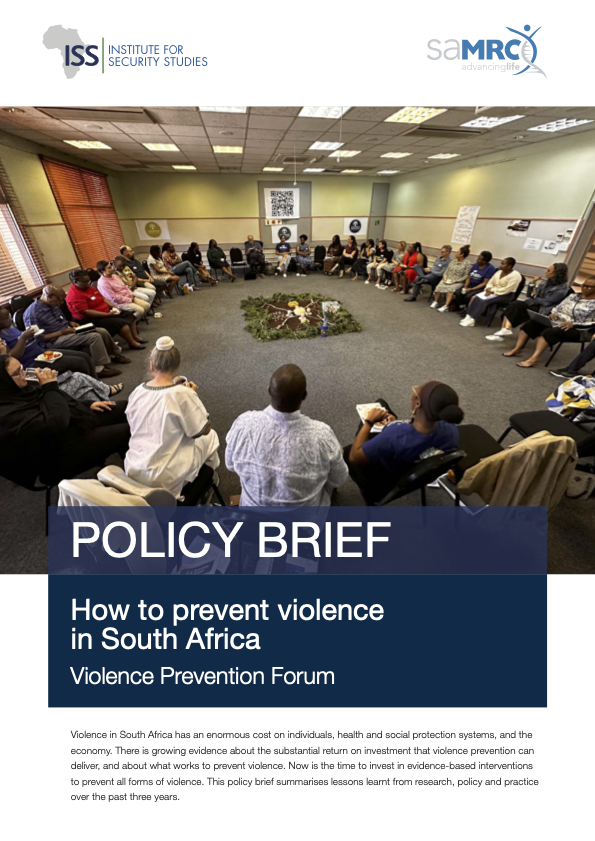
By Senzikile Bengu, Harsha Dayal, Gwen Dereymaeker, et al.
Violence in South Africa has an enormous cost on individuals, health and social protection systems, and the economy. There is growing evidence about the substantial return on investment that violence prevention can deliver, and about what works to prevent violence. Now is the time to invest in evidence-based interventions to prevent all forms of violence. This policy brief summarises lessons learnt from research, policy and practice over the past three years. Key findings Violence costs the economy, companies, and health and social systems. There is evidence for a positive return on investments when violence is prevented. This means it is cheaper to fund effective violence prevention than a criminal justice system, which reacts to violent crime. There is a growing body of research and practicebased knowledge of what works to prevent violence in South Africa. There is a strong association between violence and inequality, unemployment, food insecurity and poverty. Parenting and community-based interventions show significant effects on preventing or reducing intimate partner violence and violence against children. With regard to violence against women: The chances of getting justice for a murdered woman are low and decreasing. Police fail to make arrests despite an intimate partner or family member being involved in more than 70% of cases. Experience of trauma and poor mental health increase the chances of women students in higher education institutions being targeted for sexual violence. Circumstances that lead male students to perpetrate violence include abuse during childhood, and cultural norms equating masculinity with dominance over women. Burnout and exhaustion in frontline workers significantly hamper violence prevention efforts