Open Access Publisher and Free Library
CRIMINAL JUSTICE.jpeg

CRIMINAL JUSTICE

CRIMINAL JUSTICE-CRIMINAL LAW-PROCDEDURE-SENTENCING-COURTS

Posts tagged Latin America
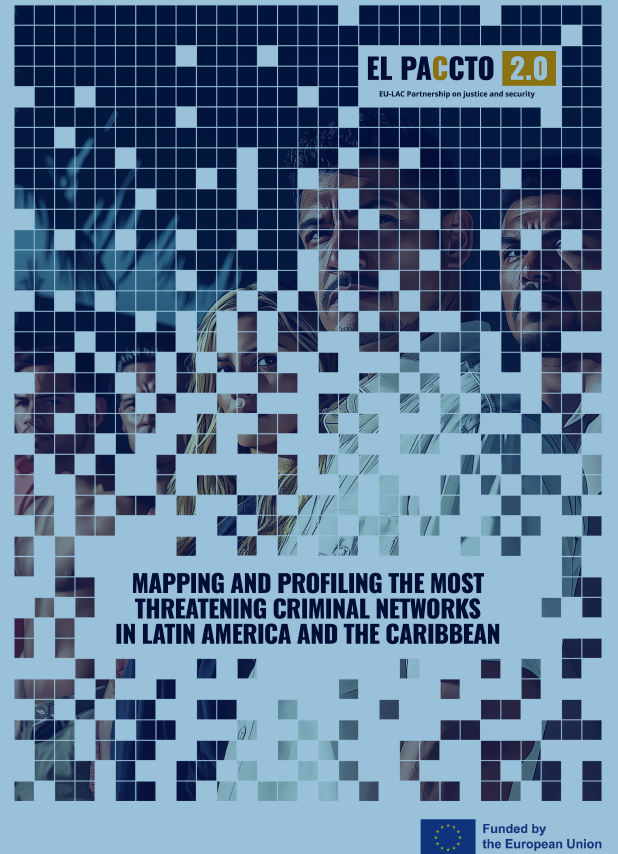
Mapping and Profiling the Most Threatening Criminal Networks in Latin America and the Caribbean- EL PAcCTO

By Jeremy McDermott,  Steven Dudley


“Connections between European and Latin American criminal networks have surged in recent years, with drugs, gold, and human trafficking proving particularly lucrative in the European market.

The number of European citizens linked to criminal networks arrested in Latin America has increased significantly, especially in Colombia, Peru, Brazil, the Dominican Republic, and Argentina. The strengthening alliance between Latin American and European crime groups now poses a global threat.

Today’s Latin America’s major criminal networks, unlike the cartels of the 1980s, operate in a world of subcontracting. Groups, or nodes in the network, often specialize in specific roles or stages of the supply chain. If a node is targeted by law enforcement, the network can quickly adjust and reconfigure itself, ensuring efficiency and the uninterrupted flow of criminal commodities.

These networks pose a serious threat to the rule of law, subverting it by establishing social norms through violence to exercise control with different forms of criminal governance. In Latin America and the Caribbean, they pose the single biggest threat to democracy in the region, using corruption to penetrate the state, and violence where bribery fails. This means it is the primary motor for human rights abuses and homicides. Corruption, like cancer, is spreading through state institutions in many nations of the region. Additionally, these networks harm economic stability development, distorting local economies, deterring foreign investment and affecting international financing.

Studying these networks is crucial to understanding the flow of illicit goods from Latin America to Europe, and essential to crafting effective strategies to combat these structures. After an analysis of different variables such as their criminal economies, geographical distribution or state response, EL PACCTO 2.0 and InSight Crime, with the support of the European Multidisciplinary Platform Against Criminal Threats (EMPACT), particularly within the Operational Action 8.3, of the High Risk Criminal Networks EMPACT, have ranked the 28 most active or relevant high-risk criminal networks in Latin America and the Caribbean, identifying key factors about their operations that reveal potential opportunities for combating organized crime in the region. This work has direct implications for both Latin America and Europe.

The list ranges from criminal networks with thousands of members to small brokers or gangs operating in Latin American countries, Caribbean islands or in Central America. In addition, the current report has sought to identify the connections or influence that high-risk criminal networks may have in different countries. This has led to the creation of a specific file for each criminal network with a specific individual map. Likewise, an aggregate map of all the information on the 28 criminal networks has been designed to provide a global overview.”

Washington, DC: Insight Crime, 2025. 114p
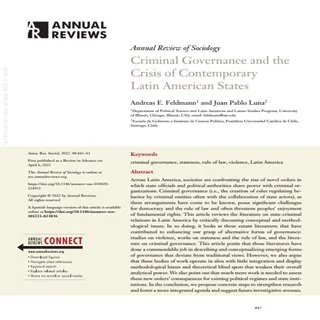
Criminal Governance and the Crisis of Contemporary Latin American States 

By Andreas E. Feldmann and Juan Pablo Luna

Across Latin America, societies are confronting the rise of novel orders in which state officials and political authorities share power with criminal organizations. Criminal governance (i.e., the creation of rules regulating behavior by criminal entities often with the collaboration of state actors), as these arrangements have come to be known, poses significant challenges for democracy and the rule of law and often threatens peoples enjoyment of fundamental rights. This article reviews the literature on state-criminal relations in Latin America by critically discussing conceptual and methodological issues. In so doing, it looks at three extant literatures that have contributed to enhancing our grasp of alternative forms of governance: studies on violence, works on stateness and the rule of law, and the literature on criminal governance. This article posits that those literatures have done a commendable job in describing and conceptualizing emerging forms of governance that deviate from traditional views. However, we also argue that these bodies of work operate in silos with little integration and display methodological biases and theoretical blind spots that weaken their overall analytical power. We also point out that much more work is needed to assess these new orders consequences for existing political regimes and state institutions. In the conclusion, we propose concrete steps to strengthen research and foster a more integrated agenda and suggest future investigative avenues.

Annu. Rev. Sociol. 2022. 48:441–61 

Targeting Illicit Wealth Through Non-Conviction Based Forfeiture: Identifying Human Rights and Other Standards for Latin America

By Oscar Solórzano

This Working Paper explores the wide variety of non-conviction based (NCB) forfeiture laws in Latin America, with a special focus on the region’s predominant model, Extinción de dominio.

It argues that NCB forfeiture legislation, which allows for the recovery of stolen assets outside of criminal proceedings, can contribute significantly to a state’s criminal policy response to rampant economic and organised crime.

The paper emphasises the importance of critically reviewing and harmonising domestic practices of NCB forfeiture around emerging standards, so that they can reach their large potential in asset recovery. Ensuring their alignment with international human rights and other recognised norms and procedural rules ultimately builds trust, lends legitimacy and fosters judicial cooperation in international NCB forfeiture cases.

Working paper 54.

Basel, SWIT: Basel Institute on Governance, 2024. 61p.

The Fight Against Systemic Corruption: Lessons From Brazil (2013-2022)

Edited by Maria Eugenia Trombini · Elizangela Valarini · Vanessa Elias de Oliveira · Markus Pohlmann

This open access book examines the interplay between public and private sectors in Latin America's biggest market. It is the result of the binational research project “Organizational Crime and Systemic Corruption in Brazil” funded by the DFG and FAPESP (2018-2023). Its contributions analyze anti-corruption, political finance, and how for-profit organizations manage illegality.

Springer Fachmedien Wiesbaden 2024. 293p. 

Justice Is Setting Them Free: Women, Drug in Latin America Policies, and Incarceration

By Coletta A. Youngers

The incarceration of women is growing at alarming rates worldwide and in Latin America it is driven by strict drug laws, with devastating consequences for the women impacted and their families. Their stories unveil contexts of poverty, lack of opportunity, and physical and sexual violence, and also reveal the discrimination of unjust legal systems and societies plagued by stigmatization and patriarchal attitudes. But they are also stories of resilience, as women coming out of prison in Latin America today are organizing and fighting for their human rights and the right to live with dignity.

In response to the growing crisis of women’s incarceration in Latin America, in 2015 organizations, experts and activists created a Working Group on Women, Drug Policies, and Incarceration, led by the Washington Office on Latin America (WOLA), the International Drug Policy Consortium (IDPC), and the Colombian NGO, Centro de Estudios de Derechos, Justicia y Sociedad – Dejusticia. Our objective is to significantly reduce the number of women deprived of liberty in Latin America, providing analysis and public policy recommendations and participating in advocacy initiatives at the international, regional, and national levels.

The purpose of this report is to reflect on almost ten years of collective research and joint advocacy by the working group, its achievements and disappointments, as well as challenges and opportunities for the future.

Washington, DC: Washington Office on Latin America, 2023.. 82p.