Open Access Publisher and Free Library
CRIMINAL JUSTICE.jpeg

CRIMINAL JUSTICE

CRIMINAL JUSTICE-CRIMINAL LAW-PROCDEDURE-SENTENCING-COURTS

Posts tagged corruption
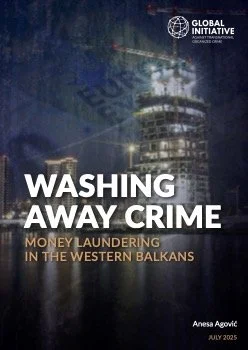
Washing Away Crime: Money Laundering in the Western Balkans

By Anesa Agovic

Money laundering remains a key enabler of organized crime in the Western Balkans, allowing criminal networks to legitimize illicit profits and integrate them into the formal economy. This report examines current trends, typologies and vulnerabilities shaping the region’s illicit financial flows.

The study outlines how systemic corruption, weak regulatory oversight, and a sizeable informal economy create fertile ground for laundering proceeds from drug trafficking, firearms smuggling, human trafficking, migrant smuggling, tax evasion and cyber-enabled crime. Key sectors, including construction, real estate and cash-intensive businesses, are often exploited, with typologies such as bulk cash smuggling, corporate layering, trade-based money laundering, underpriced real estate transactions and loan-back schemes featuring prominently.

Professional enablers, such as notaries, accountants, attorneys, and even entertainment celebrities, facilitate the integration of dirty money. The infiltration of law enforcement, misuse of remittance channels and the rise of digital currencies further complicate detection and prosecution.

The report also explores gender dynamics, highlighting the increasing role of women in money laundering activities. While some women play direct roles in financial transactions, others support criminal networks through their positions in professional sectors.

Hotspots for money laundering are often found in capitals, major cities and tourist destinations, where high-value real estate transactions and significant cash flows occur. The impact of global affairs, such as geopolitical shifts and technological advances, has amplified existing vulnerabilities.

The study calls for intensifying the prosecution of money laundering as a standalone crime, strengthening asset recovery, and reinforcing transparency across financial systems. Enhanced cooperation at the regional and international levels is vital to tackle transnational laundering schemes effectively.

This publication is part one of a two-part study of illicit finance and anti-money laundering in the Western Balkans, produced by the GI-TOC’s Observatory of Illicit Economies in South Eastern Europe with the support of the UK government’s Integrated Security Fund.

Understanding the methods and networks behind money laundering empowers governments, law enforcement, prosecutors, policymakers and civil society to disrupt the cycle of organized crime. The report underscores that combating money laundering requires addressing its root causes, from organized corruption to the misuse of legal entities and professional enablers, and demands more resilient institutions, independent regulatory bodies and robust civil society oversight.

Geneva, SWIT: Global Initiative Against Transnational Organized Crime. 2025. 72p.

download
Targeting Illicit Wealth Through Non-Conviction Based Forfeiture: Identifying Human Rights and Other Standards for Latin America

By Oscar Solórzano

This Working Paper explores the wide variety of non-conviction based (NCB) forfeiture laws in Latin America, with a special focus on the region’s predominant model, Extinción de dominio.

It argues that NCB forfeiture legislation, which allows for the recovery of stolen assets outside of criminal proceedings, can contribute significantly to a state’s criminal policy response to rampant economic and organised crime.

The paper emphasises the importance of critically reviewing and harmonising domestic practices of NCB forfeiture around emerging standards, so that they can reach their large potential in asset recovery. Ensuring their alignment with international human rights and other recognised norms and procedural rules ultimately builds trust, lends legitimacy and fosters judicial cooperation in international NCB forfeiture cases.

Working paper 54.

Basel, SWIT: Basel Institute on Governance, 2024. 61p.

Download
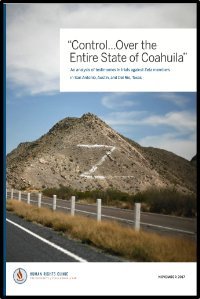
“Control...Over the Entire State of Coahuila” An analysis of testimonies in trials against Zeta members in San Antonio, Austin, and Del Rio, Texas

By Human Rights Clinic at the University of Texas School of Law.

The Human Rights Clinic at the University of Texas School of Law, in cooperation with the Centro Diocesano para los Derechos Humanos Fray Juan de Larios from Coahuila, Mexico, has compiled a report based on analyzed witness testimonies from three U.S. federal trials. Between 2013 and 2016, Zeta members were put on trial in Austin, San Antonio, and Del Rio for crimes of homicide, conspiracy to import drugs and weapons, and money laundering. These trials brought new information to light and corroborated information that has already been documented about Zeta operations and human rights abuses. First-hand testimonies of ex-Zeta cartel members and victims provide a more comprehensive understanding of the dire situation in Coahuila and offer a glimpse into the Zeta structure, members, and nexus with state officials and institutions. After reviewing the witness testimonies, the Clinic has determined two major findings: (1) the Zeta cartel committed numerous human rights abuses in Coahuila with impunity; (2) public institutions and officials played a role, by actions or omissions, in the commission of these abuses. Testimonies describe the nature and degree of Zeta influence over state and municipal officials and institutions. The Zetas paid bribes and integrated police officers into their hierarchy to ensure the cartel would be able to continue their illicit operations without resistance. However, the Zetas did not only influence low level state or municipal police; witnesses described a level of Zeta control which extended to city police chiefs, state and federal prosecutors, state prisons, sectors of the federal police and the Mexican army, and state politicians. Multiple witnesses described bribery payments of millions of dollars to Humberto Moreira and Ruben Moreira, the former and current governors of Coahuila, in exchange for complete control of the state. According to the testimonies, the Zetas’ influence over Coahuila government operations at all levels allowed them to conduct their business throughout the state with impunity and often with direct assistance from state officials and police officers. The report also documents the human rights abuses discussed in the witness testimonies, including the large-scale disappearances and killings in March and April of 2011, during what is known as the Piedras Negras and Allende Massacres. These crimes were perpetrated in response to information that three former Zeta operatives had begun to cooperate with U.S. authorities. In retaliation, the Zetas kidnapped, killed, and disappeared over 300 people who they believed to be associated with the former Zeta operatives

Austin, TX: University of Texas, Human Rights Clinic, 2017. 56p

download