Open Access Publisher and Free Library
CRIMINAL JUSTICE.jpeg

CRIMINAL JUSTICE

CRIMINAL JUSTICE-CRIMINAL LAW-PROCDEDURE-SENTENCING-COURTS

Posts in Criminal Justice
Characterizing Violence Intervention Street Outreach Participants and Service Dosage: Implications for Measurement and Evaluation 

By Marisa Ross, Susan Burtner, Andrew Papachristos and IPR

Introduction: Community violence intervention street outreach (CVI-SO) strategies are growing in popularity as non-punitive approaches to solving the public health problem of community gun violence. Evidence on the effectiveness of CVI-SO on rates of violence is mixed and faces challenges due to concerns with documentation and data privacy, intentional selection bias in program design, and variation in participant risk and needs. Effective evaluation requires methods that accurately capture the scope and delivery of services, starting with a greater understanding of the services CVI participants receive and how they vary based on individual characteristics. Methods: This study explores the services that participants received from a coalition of Chicago CVI organizations from 2017–2023. Considering administrative and programmatic data from over 4,000 participants’ nearly 200,000 interactions with providers, the researchers examine patterns in demographics, network-based risk factors, and service provision and dosage. They then use descriptive and latent profile analyses to characterize the “typical” participant in Chicago. Results: Results show that CVI work relies heavily on long-term mentoring relationships. Service patterns show that latent groups exist with varying dosage: higher dosage participants with higher risk for gun violence receive more frequent contacts over longer periods, demonstrating how organizations adjust their approach based on participant needs. Profiles that primarily receive behavioral or social supports-related services also emerge. Conclusions: Findings underscore the need for evaluation frameworks that capture both the strategic variation in service delivery and the multiple pathways through which CVI programs influence participant outcomes.

Evanston, IL: Northwestern University, 2025. 36p.
link
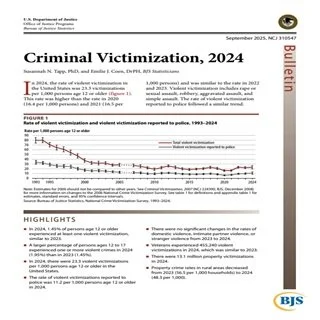
Criminal Victimization, 2024

By Susannah N. Tapp, and Emilie J. Coen
This report presents official estimates of nonfatal criminal victimizations reported and not reported to police from BJS’s National Crime Victimization Survey (NCVS). The report is the 52nd in a series that began in 1973 and includes statistics on nonfatal violent crimes (rape or sexual assault, robbery, aggravated assault, and simple assault) and property crimes (burglary or trespassing, motor vehicle theft, and other types of household theft). The report also describes the characteristics of crimes and victims. 

Data collection for the NCVS instrument redesign started in January 2024. In coordination with the U.S. Census Bureau, BJS implemented a split-sample design to concurrently administer the legacy instrument and the redesigned instrument in 2024. This report includes statistics that were produced with data collected from the 2024 legacy instrument. BJS plans to separately release victimization estimates from data collected with the 2024 redesigned instrument at a later date. For more information, see the NCVS instrument redesign.

Concurrently, BJS has updated the NCVS Dashboard (N-DASH) Tool and the NCVS API with 2024 data.

Highlights

  • In 2024, 1.45% of persons age 12 or older experienced at least one violent victimization, similar to 2023.

  • A larger percentage of persons ages 12 to 17 experienced one or more violent crimes in 2024 (1.95%) than in 2023 (1.45%).

  • In 2024, there were 23.3 violent victimizations per 1,000 persons age 12 or older in the United States.

  • The rate of violent victimizations reported to police was 11.2 per 1,000 persons age 12 or older in 2024.

U.S. Department of Justice Office of Justice Programs Bureau of Justice Statistics. 2025. 37p.

Link
Sorcery and Jurisdiction in Angola: Law and Multinormativity in Early Modern West Central Africa

By Figueiredo, João

When the Portuguese arrived at the mouth of the Zaire River in 1483, two vibrant normative regimes came into contact. The European traders, missionaries, and soldiers who followed the first explorers brought a jurisdictional system of government that accepted local uses and customs as biding and a theological understanding of natural law with universalist claims. They encountered complex African societies based on various normative systems, emphasizing arbitration and mediation between corporate groups and protection against evils attributed to preternatural forms of personal agency – what the Portuguese framed as feitiçaria or sorcery. João Figueiredo focuses on the intense cross-cultural translation of normative knowledge in West Central Africa following this initial encounter. He argues it was afforded by an evolving, shared understanding of sorcery and constant renegotiation of the limits and meanings of jurisdiction, the law, and the institutions of slavery.

Köln, Weimar,  Brill, 2025

link
Towards Coherence In Criminal Justice: Challenges, Discussions And/Or Solutions

By Jolanta Zajančkauskienė (Volume editor) Rima Ažubalytė (Volume editor) Fedosiuk Oleg (Volume editor)

This book explores the pursuit of coherence in criminal justice, addressing how criminal laws and practices can become more rational and aligned with human rights principles. It examines key criminal justice principles like legality, proportionality, and presumption of innocence, aiming to adapt them to modern societal and technological challenges. The work highlights the growing influence of international conventions and European courts on national legal systems, emphasizing the need for thoughtful implementation of transnational precedents. While focused on Lithuanian criminal justice, topics like human trafficking, drug possession, and electronic evidence are relevant across Europe, offering insights for legal researchers globally.

Bern: Peter Lang International Academic Publishers, 2025. 

link
Insuring Cyberinsecurity: Insurance Companies as Symbolic Regulators

By Talesh, Shauhin A.

Despite the massive costs associated with data breaches, ransomware, viruses, and cyberattacks, most organizations remain thoroughly unprepared to safeguard consumer data. Over the past two decades, the insurance industry has begun offering cyber insurance to help organizations manage cybersecurity and privacy law compliance, while also offering risk management services as part of their insurance packages. These insurers have thus effectively evolved into de facto regulators—yet at the same time, they have failed to effectively curtail cybersecurity breaches. Drawing from interviews, observations, and extensive content analysis of the cyber insurance industry, this book reveals how cyber insurers’ risk management services convey legitimacy to the public and to insureds but fall short of actually improving data security, rendering them largely symbolic. Speaking directly to broader debates on regulatory delegation to nonstate actors, Shauhin A. Talesh proposes a new institutional theory of insurance to explain how insurers shape the content and meaning of privacy law and cybersecurity compliance, offering policy recommendations for how insurers and governments can work together to improve cybersecurity and foster greater algorithmic justice.

Oakland: University of California Press, 2025. 277p.

link
Digitalising Courts in Asia: Exploring the Mechanics of Judicial Transformations

Edited by Siddharth Peter de Souza, Julia Wellhausen

Digitalising Courts in Asia: Exploring the Mechanics of Judicial Transformations is a book edited by Siddharth Peter de Souza and Julia Wellhausen, published by Edinburgh University Press in July 2025. It examines the diverse ways courts across Asia are undergoing digital transformation, focusing on the challenges and opportunities this presents for access to justice. The book argues for a "whole of society" approach to digitalization that prioritizes equity and ensures marginalized groups are not left behind. 

Edinburgh: Edinburgh University Press, 2025. 266

link
Contested Climate Justice – Challenged Democracy: International Perspectives

Noah Marschner, Christoph Richter, Janine Patz, Axel Salheiser (Hg.)

This international anthology is dedicated to the discourses, agitations and dynamics that have prevented, delayed, and slowed down, or even reversed, necessary transformation steps in global climate protection to this day. The book brings together perspectives from 12 different countries. It pays special attention to the interplay between climate protection policy, climate justice and democratic cohesion.

Weinheim: Campus Verlag, 2024.

download
'Treating' Violence: An Exploration of Mental Health Review Tribunal Contact and Community Treatment Order Use in People with Psychosis

By Ye In (Jane) Hwang , Nabila Chowdhury,  Colman O’Driscoll , Stephen Allnutt,  Tony Butler 

This report responds to an urgent need to enhance the management of violence among individuals with psychosis in Australia. It reviews treatment pathways, emphasising community-based care over incarceration. The Mental Health Review Tribunals (MHRTs) play a vital role in treatment oversight for those with psychosis in Australia and worldwide who are at risk of violence, with community treatment orders (CTOs) identified as effective harm prevention strategies. An exploratory study analysed data from 141,302 individuals diagnosed with psychosis in New South Wales from 2001 to 2021, revealing that 26.8 percent had MHRT contact due to violence risk, with 14.2 percent placed on CTOs. Marginalised groups were notably under-represented in MHRT interactions. Findings show higher health service use and offending behaviour among those in contact with the MHRT, highlighting the need for focused research on CTO effectiveness and equitable service access. The report advocates for a multidisciplinary approach between health and justice sectors to improve outcomes for this population.

Report to the Criminology Research Advisory Council Grant: CRG 32/21–22 Canberra: Australian Institute of Criminology, 2025. 40.

download
Michael Tonry: Escaping American Parochialism, Championing Comparative Research and Reform

By Arie Freiberg

Michael Tonry’s life and work are an exception to American exceptionalism. His lifelong concern with American parochialism and antipathy to its punitiveness, racism, and historical lawlessness have led him to look beyond its borders for explanations of such a dysfunctional sentencing regime and the means of reforming it. This article examines his interest in and contributions to comparative sentencing research and reform, his articulation of fundamental principles of justice, and his vision of an ideal sentencing system. It identifies some future directions for comparative sentencing research by extending his ideas and methods beyond the Global North.

Crim Law Forum 36, 251–268 (2025).

download
Sentencing Still Matters: Michael Tonry's Framework for Treating Like Cases Alike and Different Cases Differently

By Rhys Hester

Michael Tonry has been the leading commentator on the American sentencing reform movement since its beginning. Sentencing Matters, one of the most influential works on American sentencing ever produced, was written at the crest of the sentencing guidelines movement. Now, some fifty years into that movement, American punishment policy finds itself at a standstill. This festschrift essay honor’s Tonry’s contributions to the sentencing reform literature, contemplates the reasons why the reform movement was not more successful in the United States, and reflects on how Tonry’s work continues to provide a framework for more sensible policy. The essay draws on the field of behavioral economics to underscore the need for decision tools like sentencing guidelines to help fulfill a more fair and just system of punishment. Yet as Tonry’s work has illustrated, the Aristotelian maxim of justice requires not only that like cases be treated alike, but that different cases be treated differently.

Crim Law Forum 36, 219–231 (2025).

download
Data-Driven Criminal Justice in the Age of Algorithms: Epistemic Challenges and Practical Implications

By Francisco J. Castro-Toledo, Fernando Miró-Llinares &  Jesús C. Aguerri

The emergence of algorithmic tools and Artificial Intelligence and their use in criminal justice has raised a relevant theoretical and political debate. This article unpacks and synthesizes the debate on the role of causality for the scientific method to analyze predictive decision support systems, their practical value and epistemic problems. As a result of this discussion, it is argued that the measured usage of theory and causation-based algorithms is preferable over correlational (i.e., causally opaque) algorithms as support tools in the penal system. At the same time, the usage of the latter is supported when it is critically accompanied by abductive reasoning. Finally, the arguments put forth in this article suggest that the field of criminology needs a deeper epistemological understanding of the scientific value of data-driven tools in order to entertain a serious debate on their use.

Crim Law Forum 34, 295–316 (2023).

download
The Four Faces of Intoxication in the Botswana Criminal Justice System: “Defence”, Extenuation, Mitigation, and Aggravation

By Baboki Jonathan Dambe & Badala Tachilisa Balule 

Intoxication plays a role in the commission of crimes in most, if not all, jurisdictions. Botswana is no exception. Our law reports are replete with cases in which intoxication is alleged to have contributed to the commission of the offence. In this regard, courts continually find themselves contending with the consideration that they ought to give to the intoxication, in respect to both the criminal culpability of the accused person and their moral blameworthiness when it comes to sentencing. This paper highlights that, in the context of Botswana, intoxication may be treated as a defence, an extenuating circumstance, a mitigating factor, or an aggravating factor. It interrogates the approaches adopted by the courts in considering intoxication in these four roles. Given the divergence of judicial approach to intoxication in sentencing, the paper highlights the necessity of sentencing guidelines in order to attain a measure of predictability and consistency. Consequently, the paper assesses the sentencing guidelines adopted by other jurisdictions in respect of intoxication and the lessons to be drawn from such guidelines.

 Crim Law Forum 35, 289–318 (2024).

download
Sentencing Commissions and Guidelines: A Case Study in Policy Transfer

By Arie Freiberg & Julian V. Roberts

Over the past few decades, the traditional, discretionary approach to sentencing has been progressively replaced by structured regimes often administered by sentencing commissions or councils. Sentencing guidelines of one kind or another have proliferated across the common law world and constitute the most significant development in sentencing in a century.

In 1972 Judge Marvin Frankel of the US District Court for the Southern District of New York published a book Criminal Sentences: Law Without Order which sparked a revolution in sentencing in the US that ultimately spread around the world. His brief book provided a trenchant critique of the highly discretionary approach to sentencing which then prevailed in the US and had resulted in widespread unjustified disparity, an absence of proportionality, and racial injustice in sentencing outcomes. He proposed three major solutions to what he described as essentially a “lawless” process: (i) a permanent independent commission on sentencing; (ii) an articulation of policies or guidelines for judges to follow, and (iii) meaningful appellate review. The issues of sentencing guidance, sentencing guidelines and sentencing commissions or councils have been extensively debated in the literature since the publication of Frankel’s book. It is seldom possible to identify with accuracy the origin of an institution or concept which is then adopted, adapted, or rejected by jurisdictions beyond its original scope and geographic boundaries. How has this quiet revolution come about? How and why have the concepts of guidelines and commissions spread so rapidly?

This article examines the creation and subsequent proliferation of sentencing commissions since the establishment of the first commissions in Minnesota and Pennsylvania in 1978. From that date until the present nearly 50 commissions have been proposed, established, disestablished or considered. Much of the literature to date has focused not on the nature of the commissions themselves, but on the forms of their sentencing guidelines. These take two differing approaches, one primarily numerical, the prevailing model in the US, and one primarily narrative, the prevailing model in England and Wales and most other jurisdictions.

We explore the process by which the idea of a sentencing commission and its guidelines has spread to other jurisdictions. This process, referred to as policy transfer, diffusion, transplantation, convergence, translation or policy learning, modelling or borrowing, can provide insight into why a policy innovation in one jurisdiction is emulated or adapted in another, and the means by which such innovations are communicated over time and between jurisdictions. The study of policy transfer or diffusion also requires an analysis of the processes of indigenisation or mutation across jurisdictions.

Overview

Part II of this article examines the nature of sentencing commissions or councils and the very different US and UK models which have inspired other jurisdictions. Part III discusses what is meant by policy transfer or diffusion and the various frameworks used to describe and explain the process. Part IV examines why transfers may occur, what is transferred, the sequence of transfer, who is involved in policy transfer, its mechanisms and the conditions for transfer. Part V examines jurisdictions where they were considered but rejected, Part VI notes policy transfer failures and Part VII provides a conclusion to the article.

Crim Law Forum 34, 87–129 (2023)

download
Rate Expectations: Jurors and the Self-Reinforcing Effect of Conviction Rates

By Pieter T. M. Desmet, Jef De Mot & Michael Faure

We examined whether jurors who know that a prosecutor has a high conviction rate are more inclined to convict a defendant than jurors who know that the prosecutor has a low conviction rate. Using simulated criminal cases, we conducted two experimental studies with jury-eligible participants. Study 1 (N = 200) tested whether information about prior conviction rates (high or low) affected jurors’ estimations of the probability of guilt in the context of a robbery. Study 2 (N = 205) used another criminal trial context (murder) and another dependent variable (dichotomous guilty/not guilty verdicts). Study 2 also incorporated jury instructions on the reasonable doubt standard and included a control condition in which no information regarding the conviction rate was provided. In both studies, jurors in the high conviction rate treatment were significantly more likely to convict the accused than jurors in the low conviction rate treatment. When jurors are aware of a prosecutor's prior conviction rates, a self-reinforcing cycle may arise in which conviction rates determine conviction rates.

Crim Law Forum 34, 209–235 (2023).

download
With Courage: South Australia’s Vision Beyond Violence

By South Australia Royal Commission into Domestic, Family and Sexual Violence 

Domestic abuse In some parts of this report the term ‘domestic abuse’ is used instead of domestic, family and sexual violence. This reflects the terminology used in the Intervention Orders (Prevention of Abuse) Act 2009 (SA), in certain other legislative provisions and by South Australia Police in some circumstances. LGBTQIA+ This acronym stands for lesbian, gay, bisexual, trans and gender diverse, queer, intersex and asexual communities. The + signifies those who do not necessarily identify with any of the listed labels, but who do not conform to traditional heteronormative standards. Where the report departs from the use of this acronym, it is to reflect a specific service, organisation or group of people. Lived experience and Victim-survivor The use of the term ‘person with lived experience’ carries an acknowledgment that, for many people with lived experience of domestic, family and sexual violence, the experience is both lived and living – it is ongoing. The Commission’s Terms of Reference, Issues Paper and The Journey So Far use the term ‘victim-survivor’. This term acknowledges the ongoing effects and harm caused by violence, as well as honouring the strength and resilience of people who have experienced violence The Commission has also used the term ‘person experiencing violence’ and ‘person with lived experience of violence’ throughout its inquiry. This report uses all of these terms in acknowledgement of the diversity of preferences across individuals and the sector. It is important to remember that these terms include children and young people, who experience domestic, family and sexual violence and are victim-survivors in their own right. The Commission’s Terms of Reference explicitly refer to this, along with the need to recognise that the overwhelming majority of victim-survivors are women and children. Person using violence This report uses the term ‘person who uses violence’ when referring to an individual who uses domestic, family or sexual violence to cause harm to another. This report occasionally uses different terminology in particular contexts; for example, ‘perpetrator’ is used in the context of particular programs or services that use that term, ‘offender’ is used in the context of South Australia Police operations and policies, and ‘accused’, ‘defendant’ or ‘respondent’ is used in the context of the justice system. As outlined in the Commission’s Terms of Reference, it is recognised that the overwhelming majority of people who use violence are men.   

 Adelaide, South Australia Royal Commission into Domestic, Family and Sexual Violence, 2025. 664p.

download
Strengthening the NSW domestic and family violence sector. Workforce Development Strategy 2025–2035

By The Government of New South Wales

The strategy lays the foundation for the New South Wales domestic and family violence sector to support highly skilled workers who help victim-survivors stay safe, heal and recover. It includes actions such as prioritizing workplace safety, health and wellbeing, improving workforce recruitment and renewal, driving workforce diversity, boosting collaboration and supporting skill and capability development.

Sydney: Government of New South Wales 2025. 40.

download
Justice System Actors’ Perceptions of the Elimination of Peremptory Challenges in Arizona

By Henry F. Fradella, Cassia C. Spohn, Jessica M. Salerno, Shi Yan, Valena Beety, and Rose E. Eerdmans

This article presents the results of a mixed-methods study that surveyed legal system actors in Arizona about their perceptions of the Arizona Supreme Court’s elimination of peremptory challenges in the state. Responses from 195 participants revealed statistically significant differences between members of the bench and bar with regard to their support for the ban, its impact on litigating challenges for cause, and its perceived negative effects on selecting fair and impartial jurors from a representative cross-section of the community. Qualitative analyses provided insights into the divide, with judges expressing support for the ban largely due to perceived increased efficiency, whereas trial attorneys decried the loss of control over jury selection and its corresponding effects on the perceived fairness of trials and case outcomes. The article concludes by exploring the public policy implications of the results, including the impact of the ban on procedural justice.

download
Age of Surveillance: Conservative Age Surveillance of LGBTQ+ Youth

By Albert Fox Cahn, Esq., Brooke Cordes, Nina Loshkajian, David Siffert, Eleni Manis, PHD, MPA, Sarah Roth, and Gabriel Quagliata

We’re at an inflection point in the design of American internet as a new wave of laws seeks to dramatically expand government surveillance of everything from social media to libraries, all in the name of protecting children. But while few objectives are as laudable as keeping kids safe, the rhetoric of child protection frequently masks a far darker reality: an effort to use immense new surveillance powers to attack LGBTQ+ youth and the institutions that serve them. In recent years, far-right lawmakers have used this child protection narrative to pass a patchwork of new measures at the state level that are already radically remaking what content is available in their jurisdictions. But perhaps the most alarming discovery is how growing numbers of liberal lawmakers are now following suit, joining in to expand surveillance and control of internet platforms in ways that undermine anonymity and endanger the open internet. Of course, these newest progressive proponents of internet tracking don’t share their conservative counterparts’ anti-LGBTQ+ ideology. Instead, they’ve come to view expanded government surveillance of internet platforms as a corrective to platforms’ unethical misuse of children’s data and use of dangerous features. Unfortunately, while many of the measures making their way through statehouses are poorly positioned to address the real drivers of social media harms, they will unintentionally strengthen this far-right attack on the LGBTQ+ internet resources.

download
Selling Surveillance: Fact vs. AD Fiction

By Eleni Manis, Annie Dorsen, Evan Enzer, Owen May, Gabriella Papper, Derek Smith, Andy Ratto, Reagan Razon, Sophia Wright, Jimin Yoo, and Corinne Worthington

Billions in surveillance technology is sold annually with completely unsubstantiated, outlandish marketing claims.

These endemic practices frequently appear to constitute deceptive advertising, violating federal and state consumer protections.

Regulators are beginning to take action against some of the worst offenders, but many surveillance firms appear to make marketing claims with impunity.

A growing body of independent analysis documents surveillance systems’ ineffectiveness, errors, and bias.

download
Seeing is Misbelieving: How Surveillance Technology Distorts Crime Statistics

By Eleni Manis, Fatima Ladha, Nina Loshkajian, Aiden McKay, and Corinne Worthington

Though data is essential to understanding public safety, police data is rarely reliable.

Surveillance technology distorts crime statistics, giving the illusion that crime is concentrated in predominantly BIPOC and low-income neighborhoods that are already over-policed.

Independent audits and data verification can help produce a more accurate picture of what crime looks like and where it happens.

download