
Chad: MOVEMENT OF SUDANESE REFUGEES DRIVES HIGH DEMAND FOR HUMAN SMUGGLING
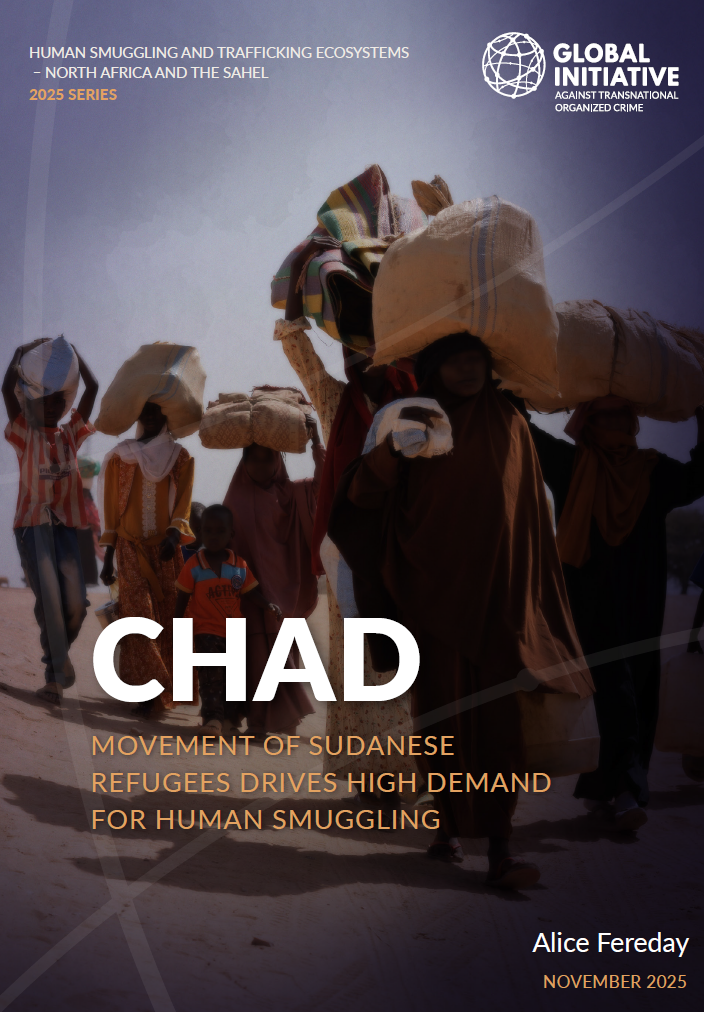
By Alice Fereday
Chad’s role as a departure and transit country for northbound migration to North Africa and Europe is often overlooked, particularly in comparison to neighbouring Niger and Sudan. However, the country’s position at the crossroads of routes connecting central and eastern Africa to Libya and Niger makes it a significant transit corridor for regional migration, and its role as a bastion of relative stability in an increasingly volatile region has further increased its importance in recent years. Since 2023, the conflict in Sudan and a major influx of refugees into Chad have further shaped these mobility dynamics, making the country a major destination and transit point for Sudanese refugee displacement in the region. At the same time, Chad is navigating a fractious and contested political transition. Political violence escalated in 2024 and remains an important source of tension and political instability. The combination of these complex internal and regional dynamics, and their impact on human smuggling dynamics, make Chad a key country to monitor. A major component of human smuggling dynamics in Chad is internal movements to the country’s northern goldfields. These mobility patterns have typically been shaped by internal factors, including political instability, rebel activity and gold mining.1 This changed in 2023 with the outbreak of the conflict in Sudan and the massive influx of refugees and returnees into eastern Chad. Though northbound movements were temporarily hindered by this shift, which resulted in a relative decrease in demand for northbound travel from eastern Chad in the early months of the conflict, by the end of 2023 human smuggling had picked up again as many Sudanese began leaving refugee camps with the intention of travelling to northern Chad, Libya, Niger and Tunisia, often with the help of smugglers.2 In 2024, these movements escalated further and human smuggling between eastern and northern Chad saw significant growth, due in large part to increasing demand among Sudanese refugees for travel to northern Chad and Libya. However, the movement of Sudanese refugees through Chad also involved travel to Niger via N’Djamena or northern Chad. Northbound movements in Chad were also driven by increasing demand for travel to the Kouri Bougoudi goldfield. The flow of prospective gold miners, which began after the goldfield reopened at the end of 2022, was also facilitated by decreased restrictions on northbound travel as risks of rebel incursions in northern Chad remained contained in 2024. This encouraged the activities of passeurs, who catered to increasing demand for northbound travel, particularly from eastern Chad.Overall, Chad recorded progressively increasing movement levels in 2024 compared to previous years, presaging its emergence as an important space to watch for migrant and refugee movement, and associated protection risks. This is the latest GI-TOC monitoring report on human smuggling in Chad. It builds on a series of annual reports – issued since 2019 – which track the evolution of human smuggling in Chad and the political, security and economic dynamics that influence it