
Open Access Publisher and Free Library
HUMAN RIGHTS.jpeg

HUMAN RIGHTS

Human Rights-Migration-Trafficking-Slavery-History-Memoirs-Philosophy

Posts tagged Constitutional rights
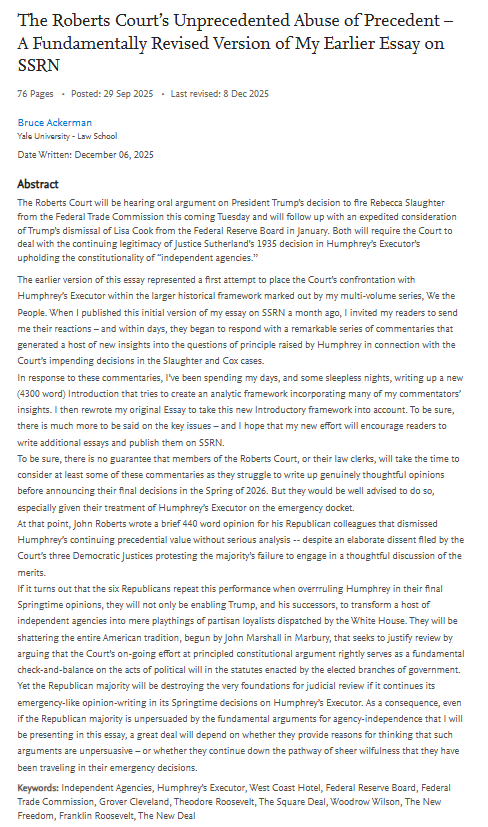
The Roberts Court’s Unprecedented Abuse of Precedent – And How It Is Destroying the Judiciary’s Role in the System of Checks-and-Balances

By Bruce Ackerman

From the days of the Federalist Papers and Marbury v. Madison, the Court’s commitment to reasoned elaboration of constitutional principle has served as the justification for its role in the system of checks-and-balances. Yet the very foundations of judicial legitimacy are at stake in two cases that the Roberts Court has scheduled for expedited consideration during the early months of its 2025-26 Term. These cases deal with the continuing legitimacy of Humphrey’s Executor’s unanimous decision upholding the constitutionality of “independent agencies” – most notably, the Federal Reserve and the Federal Trade Commission. This prospect has provoked a great deal of scholarly debate over the implications of relatively recent decisions by the Roberts Court on these issues. In contrast, my essay puts these decisions in a larger framework – emphasizing the crucial role played by the President and Congress in constructing “independent agencies” during the half-century preceding Humphrey’s unanimous decision upholding their constitutionality in 1935. It demonstrates that, after the breakthrough creation of the Interstate Commerce Commission by the Cleveland Administration, every President – from Theodore Roosevelt through Woodrow Wilson through Herbert Hoover – gained Congressional support for the creation of new independent agencies self-consciously organized to restrict presidential power in order to assure the deployment of impartial and expert regulation over crucial areas of socio-economic life. Justice Sutherland’s unanimous opinion of 1935 represents the self-conscious recognition of the legitimacy of this bipartisan affirmation of the role of expertise in modern government – and should not be cast aside without a principled confrontation with its historical foundations in American constitutional development.

Yale Law School, Public Law Research Paper, 2025

The Inquiring Mind

By Zechariah Chafee Jr.

Zechariah Chafee Jr.'s "The Inquiring Mind," published in 1928, stands as a seminal work in the discourse on civil liberties, particularly focusing on freedom of speech within the United States. He delves into the intricacies of freedom of speech providing a comprehensive exploration of the legal and philosophical foundations of free expression. The book emerged during a period marked by intense debates over civil liberties, especially in the aftermath of World War I and the accompanying "Red Scare." Chafee's work played a pivotal role in shaping modern First Amendment jurisprudence, influencing both legal scholars and judicial opinions. His defense of free speech contributed to a broader understanding of its essential role in a democratic society, challenging prevailing notions that favored repression over open discourse. The work is a cornerstone in the study of civil liberties, offering enduring insights into the complexities of freedom of speech. Its significance, rich content, and original perspectives continue to inform and challenge modern interpretations of free expression in democratic societies.

Main themes relevant to the modern era are::

  • Social Media and Free Speech: The role of platforms like Twitter, Facebook, and YouTube in shaping discourse, including issues of content moderation, algorithmic bias, and "cancel culture."

  • Misinformation and Fake News: The rise of deepfakes, conspiracy theories, and propaganda, and their impact on public perception and democracy.

  • Censorship vs. Safety: The balance between preventing harmful speech (hate speech, extremist content) and protecting the right to express controversial opinions.

  • Government and Corporate Influence: The role of states and tech companies in controlling or amplifying speech through regulations and policies.

  • AI and the Future of Expression: How AI-generated content, chatbots, and automated censorship tools impact free inquiry.

Video Block
Double-click here to add a video by URL or embed code. Learn more
Our Civil Liberties

May Contain Markup

By Osmond K. Praenkel

Importance of Civil Liberties: The document emphasizes that civil liberties, such as freedom of speech, assembly, and protection from arbitrary arrests, are fundamental to a free society.

Historical Context: It discusses the origins and development of civil liberties in the United States, particularly through the Bill of Rights and subsequent amendments.

Challenges and Limitations: The text highlights the challenges in fully realizing civil liberties, including during wartime and in the face of discrimination.

Role of the Judiciary: The document underscores the critical role of courts in interpreting and enforcing civil liberties, ensuring that government actions do not infringe on individual rights.

The Viking Press, 1944, 277 pages