By Bruce Ackerman
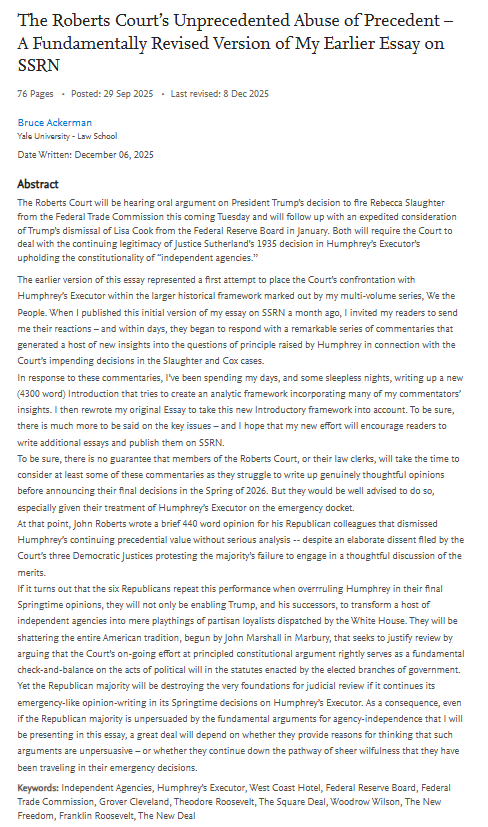
From the days of the Federalist Papers and Marbury v. Madison, the Court’s commitment to reasoned elaboration of constitutional principle has served as the justification for its role in the system of checks-and-balances. Yet the very foundations of judicial legitimacy are at stake in two cases that the Roberts Court has scheduled for expedited consideration during the early months of its 2025-26 Term. These cases deal with the continuing legitimacy of Humphrey’s Executor’s unanimous decision upholding the constitutionality of “independent agencies” – most notably, the Federal Reserve and the Federal Trade Commission. This prospect has provoked a great deal of scholarly debate over the implications of relatively recent decisions by the Roberts Court on these issues. In contrast, my essay puts these decisions in a larger framework – emphasizing the crucial role played by the President and Congress in constructing “independent agencies” during the half-century preceding Humphrey’s unanimous decision upholding their constitutionality in 1935. It demonstrates that, after the breakthrough creation of the Interstate Commerce Commission by the Cleveland Administration, every President – from Theodore Roosevelt through Woodrow Wilson through Herbert Hoover – gained Congressional support for the creation of new independent agencies self-consciously organized to restrict presidential power in order to assure the deployment of impartial and expert regulation over crucial areas of socio-economic life. Justice Sutherland’s unanimous opinion of 1935 represents the self-conscious recognition of the legitimacy of this bipartisan affirmation of the role of expertise in modern government – and should not be cast aside without a principled confrontation with its historical foundations in American constitutional development.
Yale Law School, Public Law Research Paper, 2025