Open Access Publisher and Free Library
HUMAN RIGHTS.jpeg

HUMAN RIGHTS

Human Rights-Migration-Trafficking-Slavery-History-Memoirs-Philosophy

Posts tagged freedom of speech
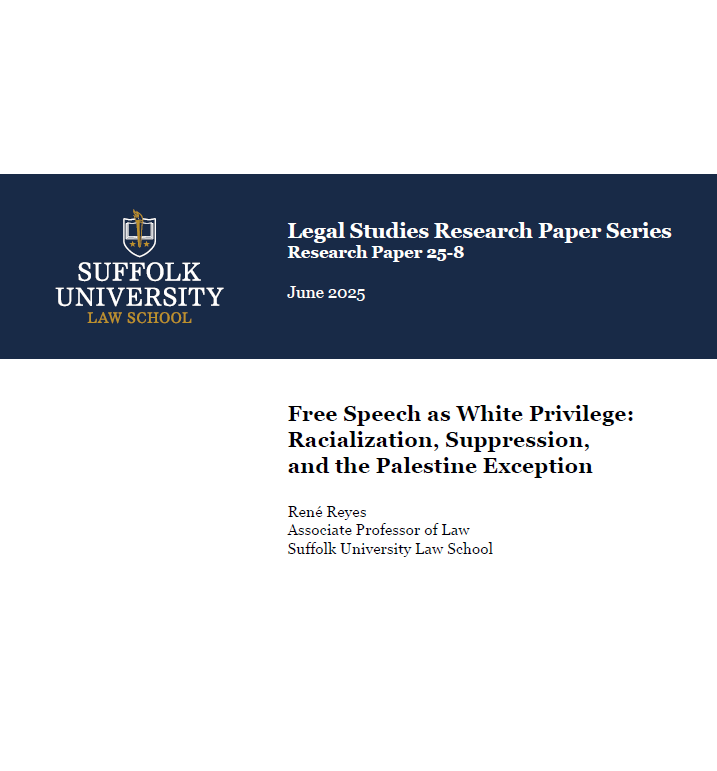
Free Speech as White Privilege: Racialization, Suppression, and the Palestine Exception

By Rene Reyes

Free speech is under siege. This is not to say that all speakers and viewpoints are at equal risk—some voices receive support and protection, while others are subject to threats and suppression.  Pro-Palestinian speech falls into the latter category.  Critics argue that there has long been a “Palestine Exception” to free speech, but efforts to silence pro-Palestinian advocacy on university campuses and elsewhere have dramatically increased since Israel began its assault on Gaza in October of 2023 in response to incursions by Hamas militants.  Many supporters of Israel contend that such restrictions on pro-Palestinian advocacy are justified, and have suggested that there is a double standard between racism and antisemitism at play when universities fail to condemn at least some forms of pro-Palestinian speech. The implication seems to be that anti-Black and Brown speech would never be tolerated on campuses, and that racialized minorities have been a special favorite of legal and institutional protections against hateful expression. The problem with this argument is that it is demonstrably false.  Indeed, this Essay argues that free speech doctrines have consistently functioned to give white people the liberty to engage in hateful speech and to deny Black, Brown, and other racialized individuals the kinds of protections from fear and harm that supporters of Israel are now demanding.  In other words, the Palestine Exception to free speech is real—and it is part of a deeper legal tradition that has enshrined free speech as an element of white privilege.

Virginia Law Review ,Vol 111, June 2025.

Violating Rights: Enforcing the World's Blasphemy Laws

By The United States Commission on International Religious Freedom (USCIRF)

USCIRF’s groundbreaking report examines the enforcement of blasphemy laws worldwide. Blasphemy laws criminalize expressions that insults or offends religious doctrines. Focusing on five-year period of 2014 to 2018, this report provides extensive data and illustrative examples to demonstrate the plethora of ways that governments’ enforcement of blasphemy laws undermines human rights, including freedom of religion or belief and freedom of expression.

Key findings from this study include the following:

There are 84 countries across the globe with criminal blasphemy laws on the books as of 2020.

Researchers, using publicly available sources, found 732 reported blasphemy-related incidents from 2014-2018 across 41 countries, or 49%, of countries with criminal blasphemy laws.

Of those 732 incidents, 674 were reported cases of state criminal blasphemy law enforcement. Of the 674 cases of state enforcement, mob activity, violence, or threats occurred in 78 cases.

81% of the cases of state enforcement were in only 10 of the countries: Pakistan, Iran, Russia, India, Egypt, Indonesia, Yemen, Bangladesh, Saudi Arabia, and Kuwait.

Together, the Asia-Pacific and Middle East regions accounted for 84% of the world’s enforcement of blasphemy laws.

In 43, or 51%, of these 84 countries, researchers did not find a single case of enforcement of criminal blasphemy laws. Researchers found no reported cases of state enforcement of criminal blasphemy laws in Latin America and the Caribbean.

Of the 732 incidents, 58 were incidents of mob activity, violence, or threats around blasphemy allegations that occurred in situations where there was no state enforcement of the blasphemy law.

Nearly 80% of the incidents of mob activity, violence, or threats (with or without state enforcement), took place in only four of the countries: Pakistan, Bangladesh, Nigeria and Egypt.

In just over half the cases of state enforcement, news reports identified the religion or belief of the accused. Of those cases, Muslims accounted for more than half (56%) of the persons arrested, prosecuted, and/or punished for alleged blasphemy crimes. Other groups frequently targeted for criminal blasphemy law enforcement, where identified, included: Christians (25%), Atheists (7%), Baha’is (7%), and Hindus (3%).

More than one-quarter (27%) of reported cases implicated alleged blasphemous speech posted on social media platforms.Washi

Washington, DC: United States Commission on International Religious Freedom, 100p.