Open Access Publisher and Free Library
HUMAN RIGHTS.jpeg

HUMAN RIGHTS

Human Rights-Migration-Trafficking-Slavery-History-Memoirs-Philosophy

Posts in Violence & Oppression
Decolonizing the Criminal Question Colonial Legacies, Contemporary Problems

Edited by Ana Aliverti, Henrique Carvalho, Anastasia Chamberlen and Máximo Sozzo  

This collection engages with debates within ‘criminology’ about matters of colonial power, which have come to be conceptualized through the language of ‘decolonization’. It explores the uneasy relationship between the ‘criminal question’ and colonialism, and foregrounds the relevance of the legacies of this relationship to criminological enquiries. It invites and seeks to pursue a better understanding of the links between imperialism and colonialism on the one hand, and nationalism and globalization on the other, by exposing the imprints of these links on processes of marginalization, racialization, and exclusion that are central to contemporary criminal justice practices within and beyond nation-states. It advances this objective by examining the reverberations of colonial history and logics in the operation of crime control. The volume also aims to explore the critical potential of criminological scholarship, as a field that sits at the margins of several disciplines and perspectives, through a direct engagement with Southern epistemologies and perspectives. To do so, it brings together established and emerging scholars from the humanities and social sciences, who work at the intersections of criminal justice and postcolonial studies.

London: Oxford University Press, 2023. 419p.

The Perfect King: The Life of Edward III Father of the English Nation

By Ian Mortimer

FROM THE INTRODUCTION: “On 19 October 1330, at dusk, two dozen men gathered in the centre of Nottingham. They were mostly in their twenties, and all on horsback, ready to ride out of the town. But unlike merchants or pilgrims assem- bling to set out together, these men were silent and unsmiling. Beneath their riding cloaks they were all heavily armed. The reason for their gathering lay within the fortress which overlooked the town. Somewhere within those walls, high on the massive outcrop, was Roger Mortimer, the earl of March, who kept the young king, Edward III, within his power and ruled in his place.”

London. Published by Jonathan Cape. 2006. 571p. USED BOOK. MAY CONTAIN MARK-UP

Trafalgar: The Nelson Touch

By David Howarth

From the opening passage: “At ten to six in the morning of the 21st of October 1805, off Cape Trafalgar in the south of Spain, Napoleon's French and Spanish fleet was sighted against the dawn sky, and men in the British fleet who were not on watch swarmed up on deck to look.

It was a beautiful autumn morning, clear under a hazy sky, with a breeze from the west-north-west so light that the sea was scarcely ruffled. The British ships, in line ahead, were sailing slowly north, and rolling in a long Atlantic swell. Some had names that were famous already, and some became famous that day: Victory, Royal Sovereign, Temeraire, Dread- nought, Revenge, Colossus, Ajax, Euryalus, Bellerophon - twenty-seven sail of the line in al, and four frigates. But they were a sight so familiar that nobody spared them a glance, except the officers of the watch on each of the quarterdecks, whose duty was to keep their own ship in station. Everyone else watched the lightening horizon. For more than two years of tedious patrol, summer and winter, blockading Napoleon's ports, the horizon at every dawn had been empty. Now, in eager anticipation, they counted the distant enemy sail: twenty, twenty-five, thirty - thirty-three of them, and frigates among them, a column five miles long, standing south for the Strait of Gibraltar.

There were seventeen thousand men in the British fleet….”

London. Collins. 1969. 165p. USED BOOK. MAY CONTAIN MARK-UP.

The Life And Times Of Winston Churchilll

By Malcolm Thomson

From Winston Churchill's speech made in the House of Commons on June 4th, 1940: “Even though large tracts of Europe and many old and famous States have fallen, or may fall, into the grip of the Gestapo and all the odious apparatus of Nazi rule, we shall not flag or fail, we shal go on ot the end, we shal fight in France, we shallfight on the seas and oceans, we shall fight with growing confidence and strength in the air, we shall defend our island whatever the cost may be, we shall fight on the beaches, we shall fight on the landing grounds, we shall fight in the fields and in the streets, we shall fight in the hills, we shall never surrender, and even if, which I do not for a moment believe, this island, or a large part of it, were subjugated and starving, then our Empire beyond the seas, armed and guarded by the British Fleet, would carry on the struggle until in God's good time the New World, with all its power and might, steps forth to the rescue and liberation of the Old.”

London. Odhams Press. 1945. 324p. USED BOOK. MAY CONTAIN MARK-UP.

Constantine's Sword: The Church and the Jews

By James Carroll

FROM THE COVER: In this "rare book that combines searing passion ... with a subject that has affected all of our lives" (Chicago Tribune), the novelist and cultural critic James Carroll maps the profoundly troubling two-thousand-year course of the Church's battle against Judaism and faces the crisis of faith it has provoked in his own life as a Catholic. More than a chronicle of religion, this dark history is the central tragedy of Western civilization, its fault lines reaching deep into our culture. A courageous and affecting reckoning with difficult truths that will touch every reader, Constantines Sword is truly a book for our times.

A Mariner Boo.k Houghton Mifelin Company. 2002. 757p. USED BOOK. CONTAINS MARK-UP.

A Long Way Gone: Memoirs of a Boy Soldier

By Ishmael Beah

The first chapter: There were all kinds of stories told about the war that made it sound as fi it was happening in a faraway and different land. It wasn't until refugees started passing through our town that we began to see that it was actually taking place in our country. Families who had walked hundreds of miles told how relatives had been killed and their houses burned. Some people felt sorry for them and offered them places to stay, but most of the refugees refused, because they said the war would eventually reach our town. The children of these families wouldn't look at us, and they jumped at the sound of chopping wood or as stones landed on the tin roofs flung by children hunting birds with slingshots. The adults among these children from the war zones would be lost in their thoughts during conversations with the elders of my town. Apart from their fatigue and malnourishment, it was evident they had seen something that plagued their minds, something that we would refuse to accept if they told us al of it.

NY. Farrar, Straus and Giroux. 2007. 256p.. USED BOOK. CONTAINS MARK-UP

China 1945: Mao's Revolution, America's Fateful Choice

By Richard Berstein

From the cover: “At the beginning of 1945, relations between Anerica and the Chinese Communists couldn't have been closer. Chinese lead ers talked of America helping to lift China out of poverty; Mao Zedong himself held friendly meetings with U.S. emissaries. By year's end, Chinese Communist soldiers were setting ambushes for American marines; official cordiality had been replaced bychilly hostility and distrust, a pattern which would continue for a quarter century, with the devastating wars in Korea and Vietnam among the consequences.

NY. Vintage. 2015. 473p. USED BOOK. CONTAINS MARK-UP

The Calendar of Saints

Compiled By Vincent Cronin

From the introduction: “…With the portrayal of saints, on the other hand, artists have felt no nced to transcend the limitations of time and place. Such portraits accurately reflect the ciilization which gave them birth, without, however, being merely local or national. Hagio-iconography has scldom been tainted by chauvinism. St George, a martyr in Palestine, is patron saint of England, while St Nicholas is honoured no less in Italy than in Russia. I can remember my surprise and delight in finding a stained- glass window of St Thomas à Becket in a church in Sicily, and a picture of St Theresa of Lisieux in a peasant cottage in the depths of Yugoslavia. The portrayal of saints, though some may regard it as merely a side-line in the history of Western civilization, can actually claim to be one of its most central and distinctive features…”

Westminster. Newman Press. 1963. 381p.

Life and Crimes of Bridget Durgan

By Rev. Mr. Brendan

The book is a short pamphlet of only 36 pages, and it tells the story of Bridget Durgan, a notorious criminal and murderess who was executed in Philadelphia in 1867. The book is written in a sensational and melodramatic style, and it describes the crimes committed by Bridget Durgan in detail, including the murder of her husband and attempted murder of her own children.

Philadelphia. C. W. Alexander. 1867. 36p.

Jesse James: the Making of a Legend

By Larry C. Bradley

"Jesse James: The Making of a Legend" is a non-fiction book written by Eric L. James, a descendant of the Jesse James family. The book was published in 2004 and offers a revisionist account of the life and legacy of Jesse James, an American outlaw and folk hero who operated in the mid to late 19th century.

The book challenges many of the popular myths and legends surrounding Jesse James, presenting a more nuanced and historically accurate portrayal of his life and activities. Eric James argues that Jesse James was not simply a violent criminal, but rather a product of his time and circumstances, who was shaped by the social and economic upheavals of the post-Civil War era.

The book explores Jesse James' early life and family background, his involvement in the Confederate cause during the Civil War, and his subsequent career as an outlaw and guerrilla fighter. It also examines the cultural and political forces that contributed to the mythologizing of Jesse James, including the role of the media, popular culture, and regional identity.

Nevada, Missouri. Larren Publishers. 1980.

The Changing Times - Revised Edition

By Ian Braybrook

Ian Braybrook was a radio broadcaster in Central Victoria for many years. His childhood and early teen years are far removed from the "glamour" of that job.

Ian's family was desperately poor and the early death of his father had a far-reaching effect on his life. By the age of thirteen, when he got his fi rst job, he had lived in twenty homes and changed schools ten times.

His story moves from Daylesford, Trentham and Blackwood districts in the Central Highlands to East Gippsland, South Gippsland, the Western District and the Riverina of NSW. His many jobs included a telegram boy, farm hand, builders and general labourer, storeman, shift worker, fruit picker, shearing shed wool presser and truck driver. Along the way he was homeless, suffered two potentially fatal illnesses, experienced violent abuse and suffered a sexual assault.

Written originally for family, the story proved to be of far wider interest. The adventures and misadventures crammed into the first eighteen years of Ian's life provide an important record of the way life was for some in the depression and post-depression era.

Castlemaine Vic. Marilyn Bennet Publishing. 2018. 286p.

Dying with Dignity: A Legal Approach to Assisted Death

By Giza Lopes

From the series foreword by Graeme R. Newman: “ Lopes convincingly argues that not only have the clergy as the shepherds of Death been replaced by modern medicine’s doctors and technologies, but that the rule of law has intervened to codify the ways and rights of helping people to die. She catalogues, with fascinating case studies and detailed historical observation, the quite different ways that the United States and European countries have tackled this problem of all problems. This is an erudite book that leaves no detail untouched; relentlessly unravels the moral, judicial, and political events that arguably precede—seen and unseen—not only every assisted death but arguably every single death on earth; and shows how these events have relentlessly set the stage for the coming movement to quicken the time it takes to die.”

Santa Barbara. Praeger. 2015. 256p.

Crisis and Legitimacy in Atlantic American Narratives of Piracy, 1678-186

By Alexandra Ganser.

The book traces the construction and function of the pirate in transatlantic American literature from the late 17th century to the Civil War, exploring in what ways the cultural imaginary teased out the pirate’s ambivalent potential as a figure of both identification and Othering, and how it has been used to negotiate ideas of legitimacy. The study recasts piracy as a discursive category moving in a continuum between the propagation of (post-)colonial adventure and accumulation on the one hand and critical commentary on exploitation and oppression on the other. Reading piracy narratives as symptomatic of various crisis scenarios in the US context, the book examines how the pirate was imbued with (de)legitimatory meaning during such periods in both elite and popular texts.

Cham: Springer Nature, 2020. 302p.

The Life and History of Francisco Villa, the Mexican Bandit

By Capt. Kennedy.

A true and authentic life history of the most noted bandit that ever lived. A man who has overthrown the government of Mexico and defied the United States.

Baltimore, MD: I. and M. Ottenheimer, 1916. 145p.

The Great American Fraud

By Samuel Hopkins Adams.

Articles on the nostrum evil and quacks, in two series, reprinted from Collier's weekly. This is the introductory article to a series which will contain a full explanation and exposure of patent-medicine methods, and the harm done to the public by this industry, founded mainly on fraud and poison. Results of the publicity given to these methods can already be seen in the steps recently taken by the National Government, some State Govermnents and a few of the more reputable newspapers. The object of the series is to make the situation so familiar- and thoroughly understood that there will be a speedy end to the worst aspects of the evil.

New York: P. F. Collier & Son 1906. 146p.

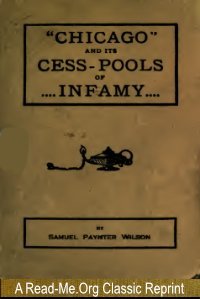
Chicago and its Cess-pools of Infamy

By Samuel Paynter Wilson.

The volume now offered to the reader aims to be a faithful and graphic pen picture of Chicago and its countless sights, its romance, its mysteries, its nobler and better efforts in the cause of humanity, its dark crimes, and terrible tragedies. In short, the work endeavors to hold up to the reader a faithful mirror in which shall pass all the varied scenes that transpire in Chicago by sunlight and by gaslight. To those who have seen the great city, the work is offered as a means of recalling some of the pleasantest experiences of their lives; while to the still larger class who have never enjoyed this pleasure, it is hoped that it will be the medium of acquiring an intimate acquaintance with Chicago in the quiet of their homes. This volume is not a work of fiction, but a narrative of well authenticated, though often startling facts. The darker sides of Chicago life are shown in their true colors, and without any effort to tone them down. Foul blots are to be found upon the life of the great city. Sin, vice, crime and shame are terrible realities there, and they have been presented here as they actually exist.

Chicago: s.n., 1910. 148p.

Chicago by Gaslight

By Samuel Paynter Wilson.

I stood on the corner of a down-town street one night in December, and as I watched the seething sea of humanity passing by, and as I looked into their weary, anxious faces, I never felt more strongly in my life the necessity for the work on the part of the forces that are making for the moral and social uplift of the city. There, in great masses before my eyes was the good and the bad, and it was easy to make the distinction. The whole maddening throng seemed bent on unrighteous and riotous pleasure. The whole tendency was downward, and nothing of elevating or enobling influence was before me there. To me it appeared the death of youth, and the grave of manhood and womanhood. All that was base and ignoble in a great city was portrayed in the vivid picture before me, and as I gazed on the throng I could see the breaking down of virtue, which ought to be strong in every woman. In presenting to the public the experiences I have had, and of the results attained as an investigator in an Association, which has gained a world wide reputation for " doing things" in the sociological world, it is with a hope that I may find a genial public, and create a more forceful and lasting impression with my friends. This little work is the result of my own personal investigation among a class of men and women, who belong to the underworld, and the work has been accompanied with much personal danger and often required the courage and ex perience of one versed in the ways of the criminal one who has the ability to be a judge of human nature and a good " mixer." The men and women with whom we come in contact are scoundrels by nature and cowards at heart; they stab you in the back and shoot you from dark alleys; they are continually on the lookout for victims and usually find the harvest bountiful, and the matter contained in this book is merely to give expression in language so simple that all may understand its meaning. There are plague spots in almost every part of the great city and vultures prey upon the innocent and descend upon the city by daylight and by gaslight without warning of their coming. The white slave dealers flaunt their dastardly vice in the face of the public, and houses of ill- fame are conducted with a boldness unequalled anywhere in the world. The evil is very great and assuming larger proportions every year. In procuring evidence, and in bringing many of these unfortunates before the courts, and after listening to the defendants in giving testimony, I have come to the conclusion that virtue in Chicago is at a very low ebb, and that the home loving virtuous wife or mother is a jewel that the gods should crave and that decent manhood should love, honor and worship.

Chicago: Author, 1910. 148p.

The story of Lena Murphy, the white slave ; The lost sisterhood

By Samuel Paynter Wilson.

Prevalence of prostitution in Chicago : startling revelations. Madame Leroque is a familiar figure in the alsatia of more than one city. She is famous in the Chicago courts as having been defendant in many cases of wrongdoing. Her career is known by the police from coast to coast, and she has plied her calling in many of the large cities of the country. It was after a "raid" that I made Lena Mur phy's acquaintance. I was making my rounds, and slung by the cold winds that swept the streets bare of dust and refuse, I entered a neighboring saloon. Seating myself at a nearby table I was soon approached by the person whom I call Lena IMurphy. Lena was flushed, and somewhat forward ; both her eyes were discolored, the result of a fight with a French inmate of the "house'' adjoining the saloon.

Chicago. Author, 1910. 48p.

Incest in Sweden, 1680–1940

By Bonnie Clementsson.

A history of forbidden relations. . Translation by Lena Olson. “On 23 June 1702, a soldier named Jon Larsson and his wife’s half-sister Karin Jönsdotter were brought before a local court in central Sweden where they tearfully confessed their sins. A few weeks before Christmas of the previous year they had engaged in sexual intercourse on one occasion, following which Karin had become pregnant.”

Lund University Press (2020) 347 pages.