Open Access Publisher and Free Library
HUMAN RIGHTS.jpeg

HUMAN RIGHTS

Human Rights-Migration-Trafficking-Slavery-History-Memoirs-Philosophy

Posts in crime
Protecting Children in Migration: A Nexus between Migration and Child Protection

By Anita Ramsak and  Eyueil Abate  

Ethiopia is a country of origin and transit, with migration primarily occurring around three main routes: (a) Eastern route through Djibouti towards Saudi Arabia; (b) Southern route through Kenya towards South Africa; and (c) Northern route through Libya towards Europe. In 2022, the number of unaccompanied children who migrated via the Eastern route doubled in comparison to 2021, and unaccompanied children made up 38 per cent of all children on the move from Ethiopia in 2022. En route, children may face protection risks including arbitrary arrest and detention, human trafficking for the purposes of labour or sexual exploitation, gender-based violence, extortion and denial of access to basic needs. Broad structural factors, such as conflict, drought and poverty are driving children and adults to migrate despite the protection risks. To understand the current knowledge gaps in the nexus between migration and child protection, as well as propose improvements, this study relies on primary and secondary data analysis. With a particular focus on exploring linkages between child migration and trafficking in children in Ethiopia, the report concludes with the institutional and legal landscape for children on the move and highlights key policy gaps in protecting children on the move across Ethiopia.Geneva, SWIT:  International Organization for Migration. 2023, 94p.

Fewer Movers, Bigger Problems: Migration Declines in Colorado & Its Biggest Cities

By Cole Anderson and Caitlin McKennie

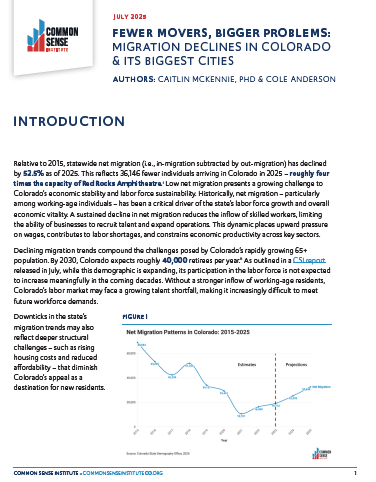
Relative to 2015, statewide net migration (i.e., in-migration subtracted by out-migration) has declined by 52.5% as of 2025. This reflects 36,146 fewer individuals arriving in Colorado in 2025 – roughly four times the capacity of Red Rocks Amphitheatre.i Low net migration presents a growing challenge to Colorado’s economic stability and labor force sustainability. Historically, net migration – particularly among working-age individuals – has been a critical driver of the state’s labor force growth and overall economic vitality. A sustained decline in net migration reduces the inflow of skilled workers, limiting the ability of businesses to recruit talent and expand operations. This dynamic places upward pressure on wages, contributes to labor shortages, and constrains economic productivity across key sectors. Declining migration trends compound the challenges posed by Colorado’s rapidly growing 65+ population. By 2030, Colorado expects roughly 40,000 retirees per year.ii As outlined in a CSI report released in July, while this demographic is expanding, its participation in the labor force is not expected to increase meaningfully in the coming decades. Without a stronger inflow of working-age residents, Colorado’s labor market may face a growing talent shortfall, making it increasingly difficult to meet future workforce demands.  According to a recent study by the Bureau of Economic Analysis (BEA), Colorado ranks 14th (not including the District of Columbia) in terms of regional price parities relative to all other states (a measurement that evaluates the differences in price levels across states for a given year).iii If these issues remain unaddressed, they could have long-term consequences for the state’s economic competitiveness and growth prospects. Evidence suggests this scenario is already emerging: Colorado’s economic growth is slowing, with job growth projected to increase by only 1.2% in 2025. During the first quarter of 2025, Colorado’s job growth ranked 26th in the nation. This deceleration is suggested to be linked to decreased net migration and an aging population, both of which pose risks to the state’s labor force capacity and overall economic dynamism.

Greenwood Village, CO: Common Sense Institute, 2025. 10p.   

The Politics of Violence Reduction: Making and Unmaking the Salvadorean Gang Truce 

By Chris van der Borgh and Wim Savenije

This paper analyses a government-facilitated truce, begun in 2012, between El Salvador’s three principal street gangs. Using field theory and securitisation theory, it maps the evolution of the truce, distinguishing between the three related processes of making the deal, keeping the truce, and resisting it. It analyses the complex and intriguing political processes in which various actors, such as gang leaders, government officials and international organisations, interacted with each other and made deals about the use and visibility of violence and ways of diminishing, preventing or hiding it.  

  Journal of Latin American Studies (2019), 51, 905–928 doi:1

Justice at a Crossroads in New York City Studying Crimes in New York City Using the National Crime Victimization Survey (NCVS) By Min Xie, Preeti Chauhan, Michael Rempel, and Jeremy Travis

By Min Xie, Preeti Chauhan, Michael Rempel, and Jeremy Travis 

This study relies on data from the National Crime Victimization Survey (NCVS) and presents trends from 1996 to 2022 in crime victimization, rates at which victims report crimes to the police, confidence in the police, and victims’ use of services in New York City. This is one of two studies falling under the umbrella of the Crossroads Project. Its goal is to trace New York City’s trends in crime victimization, enforcement, incarceration, and racial disparities from the 1990s to the early 2020s in the hopes that empirical data over a long timeframe might provide a much-needed perspective capable of informing future policy. Both of the two resulting reports and a joint executive summary may be found at the project landing page. What is the NCVS, and why is it important for studying crime? Crime data for cities and communities across the country relies primarily on criminal complaints reported to local police agencies. The many crimes that victims never report to law enforcement are omitted. However, by collecting data directly from crime victims, the National Crime Victimization Survey (NCVS) can provide estimates of both reported and unreported crime. The NCVS is the world’s largest and oldest national victimization survey (Xie, Lynch, & Lauritsen, 2025). It has provided information on the criminal victimization of the U.S. household population for over 50 years (1973 to present). It surveys persons aged 12 years or older from a nationally representative sample of U.S. households randomly selected from a stratified multistage cluster sampling design, with the goal of getting an accurate and representative count of crime victimization in the United States (Cantor, 2025). The U.S. Census Bureau administers the interviews for the Bureau of Justice Statistics (BJS). The primary information from the NCVS includes nonfatal violent crimes (rape or sexual assault, robbery, aggravated assault, and simple assault) and household property crimes (i.e., burglary, motor vehicle theft, and other types of theft), both reported and not reported to the police. Therefore, the estimates for nonfatal violence crimes are by persons, and the estimates for property crimes are by households. The NCVS data is an important complement to the Uniform Crime Reporting (UCR) Summary program and the National Incident-Based Reporting System (NIBRS). The UCR and NIBRS databases, which rely on crimes reported to the police, are often used to follow crime trends by policymakers, journalists, and the general public, and to guide public safety decision making. But nationwide, the NCVS shows that more than 50% of crimes are NOT reported to the police (Xie, Ortiz Solis, & Chauhan, 2024). This is known as the dark figure of crime and shows that relying on police-recorded crimes provides an incomplete picture of crime trends (Lynch & Addington, 2007). The NCVS also provides critical information such as why the crime was not reported to the police. Much information in the NCVS is not available from the UCR summary program or NIBRS, such as the circumstances of crimes based on the victims’ descriptions, the consequences of the victimizations, the victims’ responses to victimization, and their interaction with the criminal justice or victim service systems or lack thereof. These data are critical to policymakers as they think of responses to crime and how to enhance public safety.  

New York: Data Collaborative for Justice, at John Jay College, 2025. 18p.   

Characterizing Violence Intervention Street Outreach Participants and Service Dosage: Implications for Measurement and Evaluation

By Marisa Ross, Susan Burtner, and Andrew Papachristos

Community violence intervention street outreach (CVI-SO) is gaining in popularity as a way to prevent gun violence. There is a growing need to better understand these interventions, which starts with documenting their full scope. Analyzing CVI outreach in Chicago from 2017–2023, the researchers find that organizations specialized in long-term mentoring and adjusted services based on participants’ risk levels, providing higher-risk individuals with more frequent and extended support.


Introduction: Community violence intervention street outreach (CVI-SO) strategies are growing in popularity as non-punitive approaches to solving the public health problem of community gun violence. Evidence on the effectiveness of CVI-SO on rates of violence is mixed and faces challenges due to concerns with documentation and data privacy, intentional selection bias in program design, and variation in participant risk and needs. Effective evaluation requires methods that accurately capture the scope and delivery of services, starting with a greater understanding of the services CVI participants receive and how they vary based on individual characteristics.Methods: This study explores the services that participants received from a coalition of Chicago CVI organizations from 2017–2023. Considering administrative and programmatic data from over 4,000 participants’ nearly 200,000 interactions with providers, the researchers examine patterns in demographics, network-based risk factors, and service provision and dosage. They then use descriptive and latent profile analyses to characterize the “typical” participant in Chicago.Results: Results show that CVI work relies heavily on long-term mentoring relationships. Service patterns show that latent groups exist with varying dosage: higher dosage participants with higher risk for gun violence receive more frequent contacts over longer periods, demonstrating how organizations adjust their approach based on participant needs. Profiles that primarily receive behavioral or social supports-related services also emerge.Conclusions: Findings underscore the need for evaluation frameworks that capture both the strategic variation in service delivery and the multiple pathways through which CVI programs influence participant outcomes.Evanston, IL: Northwestern University, Institute for Policy Research, 2025. 36p.

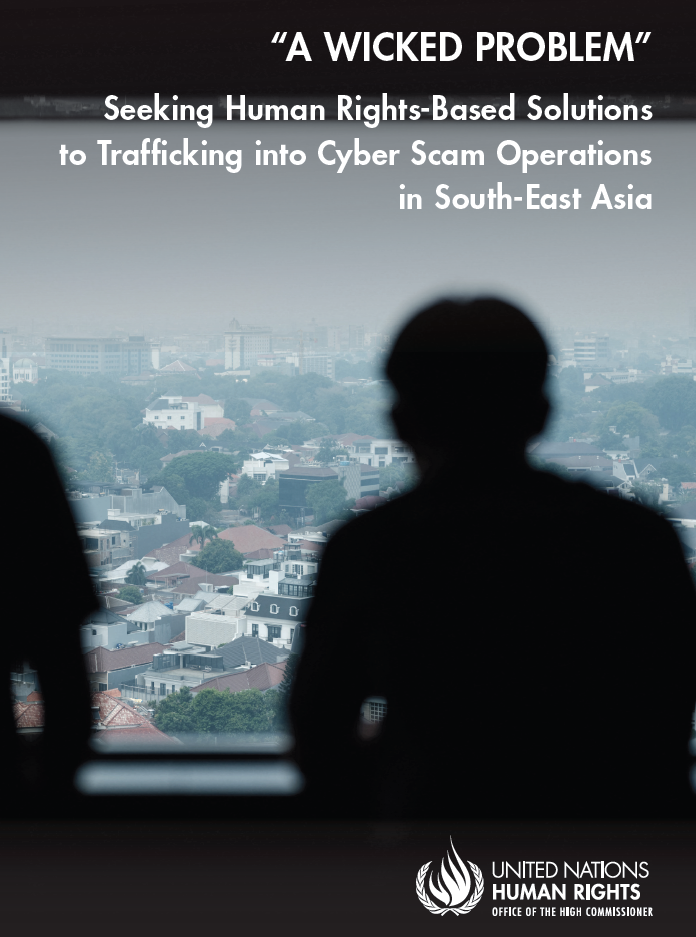
A "wicked problem" - Seeking human rights-based solutions to trafficking into cyber-scam operations in South-East Asia

By the United Nations.  High Commissioner for Human Rights

UN Human Rights is calling urgent attention to the continuing and critical need for a human rights solution to a particularly “wicked problem” - the complex crisis of trafficking in persons, slavery and other serious human rights violations and abuses that are taking place in South-East Asia in the context of extensive criminal operations set up to perpetrate cyber-enabled fraud. This report centers the lived experience of victims subjected to abuses within these scam operations and who in many cases continue to suffer human rights harms after their release. Through a behavioural science and systems analysis lens, the report also seeks to understand the barriers and enablers that lead victims into these operations through fraudulent recruitment pathways. The report concludes with key messages which call on States, and where relevant other stakeholders, to ensure a human rights-based response to this multidimensional issue, placing the rights, dignity, safety, and well-being of victims of trafficking at its core including through ensuring full respect of the non-punishment principle.

Sentencing and Human Rights: The Limits on Punishment

By Sarah J Summers.

From the introduction:

Sentencing law and theory is closely bound up with the justification of punishment. 1 It is thus unsurprising that sentencing theory is generally perceived as falling squarely within the domain of moral philosophy. 2 Much of the debate has focused on whether retribution or consequentialist notions of deterrence or rehabilitation should serve as the principal aim on which the sentencing system is based. There are numerous articles by proponents of the various theories explaining why their theory should provide the primary basis for the determination of the sentence. 3 The importance of the moral philosophical discussion transcends national boundaries. Despite considerable diversity in the legal cultures and traditions of the various legal systems, ‘[p]rinciples of uniformity and retributive proportionality are now recognised to some extent in almost all systems, but sentences in these systems are also designed to prevent crime by means of deterrence, incapacitation and rehabilitation’.4 Whereas broadly ‘correctionalist’ accounts of punishment underpinned the penal welfare model of punishment for much of the twentieth century, 5 the ‘just deserts’ movement 6 of the 1980s was in line with a transfer of focus away from the individualized treatment of offenders and towards a vision of punishment which not only favoured a more standardized approach to the treatment of offenders, but which also expressly legitimized retributivist penalties and practices…..

London Oxford. 2022. 280p.

Dostoyevsky's Crime and Punishment

MAY CONTAIN MARKUP

By John D. Simons.

Dostoyevsky's Crime and Punishment offers a gripping exploration of the psychological complexities of a young man named Rodion Raskolnikov, who rationalizes a brutal murder in pursuit of his own twisted sense of justice. Set against the backdrop of 19th-century St. Petersburg, the novel delves into themes of morality, guilt, and redemption, inviting readers to contemplate the fine line between good and evil. As Raskolnikov navigates the consequences of his crime and grapples with his conscience, Dostoyevsky weaves a narrative that is as thought-provoking as it is timeless.

NY. Monarch. 1976. 105p.

Unbuttoning America: A Biography of "Peyton Place"

By Ardis Cameron

Published in 1956, Peyton Place became a bestseller and a literary phenomenon. A lurid and gripping story of murder, incest, female desire, and social injustice, it was consumed as avidly by readers as it was condemned by critics and the clergy. Its author, Grace Metalious, a housewife who grew up in poverty in a New Hampshire mill town and had aspired to be a writer from childhood, loosely based the novel’s setting, characters, and incidents on real-life places, people, and events. The novel sold more than 30 million copies in hardcover and paperback, and it was adapted into a hit Hollywood film in 1957 and a popular television series that aired from 1964 to 1969. More than half a century later, the term ""Peyton Place"" is still in circulation as a code for a community harboring sordid secrets. In Unbuttoning America, Ardis Cameron mines extensive interviews, fan letters, and archival materials including contemporary cartoons and cover images from film posters and foreign editions to tell how the story of a patricide in a small New England village circulated over time and became a cultural phenomenon. She argues that Peyton Place, with its frank discussions of poverty, sexuality, class and ethnic discrimination, and small-town hypocrisy, was more than a tawdry potboiler. Metalious’s depiction of how her three central female characters come to terms with their identity as women and sexual beings anticipated second-wave feminism. More broadly, Cameron asserts, the novel was also part of a larger postwar struggle over belonging and recognition. Fictionalizing contemporary realities, Metalious pushed to the surface the hidden talk and secret rebellions of a generation no longer willing to ignore the disparities and domestic constraints of Cold War America. ; Published in 1956, Peyton Place became a bestseller and a literary phenomenon. A lurid and gripping story of murder, incest, female desire, and social injustice, it was consumed as avidly by readers as it was condemned by critics and the clergy. Its author, Grace Metalious, a housewife who grew up in poverty in a New Hampshire mill town and had aspired to be a writer from childhood, loosely based the novel's setting, characters, and incidents on real-life places, people, and events. The novel sold more than 30 million copies in hardcover and paperback, and it was adapted into a hit Hollywood film in 1957 and a popular television series that aired from 1964 to 1969. More than half a century later, the term "Peyton Place" is still in circulation as a code for a community harboring sordid secrets.In Unbuttoning America, Ardis Cameron mines extensive interviews, fan letters, and archival materials including contemporary cartoons and cover images from film posters and foreign editions to tell how the story of a patricide in a small New England village circulated over time and became a cultural phenomenon. She argues that Peyton Place, with its frank discussions of poverty, sexuality, class and ethnic discrimination, and small-town hypocrisy, was more than a tawdry potboiler. Metalious's depiction of how her three central female characters come to terms with their identity as women and sexual beings anticipated second-wave feminism. More broadly, Cameron asserts, the novel was also part of a larger postwar struggle over belonging and recognition. Fictionalizing contemporary realities, Metalious pushed to the surface the hidden talk and secret rebellions of a generation no longer willing to ignore the disparities and domestic constraints of Cold War America.

Ithaca, NY: Cornell University Press, 2015.

The Life And Times Of Winston Churchilll

By Malcolm Thomson

From Winston Churchill's speech made in the House of Commons on June 4th, 1940: “Even though large tracts of Europe and many old and famous States have fallen, or may fall, into the grip of the Gestapo and all the odious apparatus of Nazi rule, we shall not flag or fail, we shal go on ot the end, we shal fight in France, we shallfight on the seas and oceans, we shall fight with growing confidence and strength in the air, we shall defend our island whatever the cost may be, we shall fight on the beaches, we shall fight on the landing grounds, we shall fight in the fields and in the streets, we shall fight in the hills, we shall never surrender, and even if, which I do not for a moment believe, this island, or a large part of it, were subjugated and starving, then our Empire beyond the seas, armed and guarded by the British Fleet, would carry on the struggle until in God's good time the New World, with all its power and might, steps forth to the rescue and liberation of the Old.”

London. Odhams Press. 1945. 324p. USED BOOK. MAY CONTAIN MARK-UP.

Box Man: A Professional Thief's Journey

By Harry King . As told to and edited by Bill Chambliss

FROM THE INTRODUCTION: “From approximately 1910 until 1960 Harry King lived a life of crime. For the better part ofthose years he was a professional thief specializing in safe-cracking. This is his story. Through it we are provided a glimpse into a life style, a philosophy and a pattern of living that is ordinarily obscured from our vision. By coming to grips with Harry's life we learn a great deal more about America, Law, Order and Being.”

NY. Harper & Row. 1972. 186p. USED BOOK. MAY CONTAIN MARK-UP

Life and Crimes of Bridget Durgan

By Rev. Mr. Brendan

The book is a short pamphlet of only 36 pages, and it tells the story of Bridget Durgan, a notorious criminal and murderess who was executed in Philadelphia in 1867. The book is written in a sensational and melodramatic style, and it describes the crimes committed by Bridget Durgan in detail, including the murder of her husband and attempted murder of her own children.

Philadelphia. C. W. Alexander. 1867. 36p.