
By Capt. Kennedy.
A true and authentic life history of the most noted bandit that ever lived. A man who has overthrown the government of Mexico and defied the United States.
Baltimore, MD: I. and M. Ottenheimer, 1916. 145p.

By Capt. Kennedy.
A true and authentic life history of the most noted bandit that ever lived. A man who has overthrown the government of Mexico and defied the United States.
Baltimore, MD: I. and M. Ottenheimer, 1916. 145p.
By Henry Berry Lowrie.
The great North Carolina bandit, with biographical sketch of his associates by Mary C. Norment. Being a Complete History of the Modern Robber Band in the County of Robeson and State of North Carolina. “It will be remembered that the facts recorded in this book were written by one who knew the cause and result of this unfortunate period of Robeson's history, having lived "through the thick or the fight", and gained the information recorded by actual experience.”
Lumberton, N.C. : Lumbee Pub. Co.,1909. 192p.
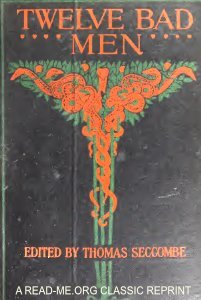
Edited by Thomas Seccombe.
Original Studies of Eminent Scoundrels by Various Hands. CONTENTS. 1. Alice Perrers Favourite of King Henry III. 2. Alice Arden Murderess. 3. Moll Cutpurse Thief and Receiver. 4. Frances Howard Countess of Somerset. 5. Barbara Villiers Duchess of Cleveland6. Jenny Diver Pickpocket 7. Teresia Constantia Phillips. 8. Elizabeth Brownrigg Cruelty personified. 9. Elizabeth Canning Imposter. 10. Elizabeth Chudleigh Duchess of Kingston 11. Mary Bateman “ The Yorkshire Witch" 12. Mary Anne Clarke.
London: T.F. Urwin, 1911. 373p.
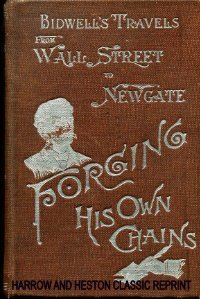
By George Bidwell.
Bidwell’s Travels: Forging his own chains. “Freed a human wreck, a wonderful survival and a more wonderful rise in the world. To-day he has a national reputation as a writer, speaker and is considered an authority on all social problems. He was tried at the Old Bailey and sentenced for life. charged with the £1,000,000 forgery on the bank of England. This story shows that the events of his life surpass the imaginations of our famous novelists, its thrilling scenes, hair-breadth escapes and marvelous adventures are not a record of crime, but are proofs of that in the world of wrongdoing success is failure.
Bidwell publishing Hartford (1897) 295 pages.
By H. B. Irving.
This is an exhaustive account of the infamous Judge , “1st Baron… (15 May 1645 – 18 April 1689), also known as "the Hanging Judge", was a Welsh judge. He became notable during the reign of King James II, rising to the position of Lord Chancellor (and serving as Lord High Steward in certain instances). His conduct as a judge was to enforce royal policy, resulting in an historical reputation for severity and bias.”
London William Heinemann (ca. 1898) 383 pages.
By Fred D. Pasley.
The Biography of a Self-Made Man. “Im getting sick of fellows like Hughes using me to attract glory to themselves,” said Al.
Harrow and Heston Classic Reprint. (1930) 208 pages.
By Thomas Furlong.
Late Chief of the Secret Service of the Missouri Pacific Railway, known as the Gould System; the Allegheny Valley Railway of Pennsylvania, and first Chief of Police of Oil City, Pa. 35 real detective stories, hitherto unpublished facts connected with some of Mr. Furlong's greatest cases—Other interesting incidents of his long and strenuous career which really began on September 14, 1862, when he was detailed from his company, (Co. G., 1st Pennsylvania Rifles, better known as the Pennsylvania Bucktails) for special service.
Harrow and Heston Classic Reprint. (ca. 1870) 284 pages.
By Anthony Trollope
A spirited defense by bright and friendly story-teller Anthony Trollope, of Cicero up to the peak of his career and during the dying days of the Roman Republic. Whose side was he on? Trollope was certainly on Cicero’s. But Cicero?
Harrow and Heston Classic Reprint. NY. Harper. 1881. 330p.
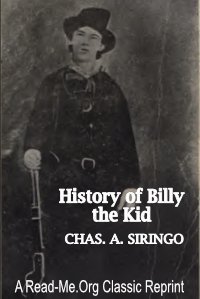
By Chas. A. Siringo.
The true life of the most daring young outlaw of the age. He was the leading spirit in the bloody Lincoln County, New Mexico, war. When a bullet from Sheriff Pat Garett's pistol pierced his breast he was only twenty-one years of age, and had killed twenty-one men, not counting Indians. His six years of daring young outlawry has never been equalled in the annals of criminal history.
Read-Me.Org Classic Reprint. (1920) 145p.
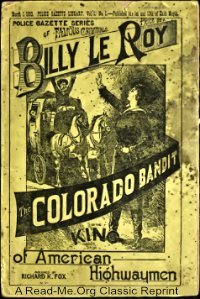
By Thomas F. Daggett.
Or, The King of American Highwaymen. A complete and authentic history of this famous young desperado, his crimes and adventures.
New York: R.K. Fox, Franklin Square, (1881). 124p.
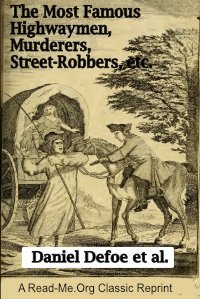
By Daniel Defoe et al.
Murderers, Street-Robbers, etc.by Daniel Defoe. Charles Johnson, and Alexander Smith. Birmingham: Printed by R. Walker. (1742) 453p.
By Joseph A. Dacus.
“In that dreadful ebullition of human hatreds, Frank and Jesse James played no laggard's part. As boys, they accepted service under Quantrell, and became renowned for caution and daring even in the days of their youth. Members of a partisan organization, famed even in the early days of the strife for daring deeds and extraordinary activity; a band, every man of which was a desperado of great cunning and prowess, these two callow-youths, taken from a country farm, speedily rose to the eminence of leading spirits among the most daring of men. Both sides in the border counties of Missouri and Kansas prosecuted war with a vindictive fury unparalleled in modern history. The scene of the operations of the Guerrillas was at first confined to the limits of Clay, Platte, Jackson, Bates, Henry, Johnson, and Lafayette counties, in Missouri, and along the Kansas border.”
St. Louis: W.S. Bruan; Chicago, J.S. Goodman, 1880. 396p.
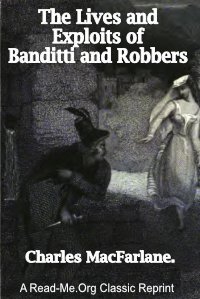
by Charles MacFarlane.
The Lives and Exploits of Banditti and Robbers in All Parts of the World, Vol.1.. “Neither the fullness of years nor maturity of experience and worldly wisdom can render us as insensible to tales of terror such as fascinated our childhood, nor preserve us from a ‘creeping of the flesh’ as we read or listen to the narrative containing the daring exploits of some robber-chief, his wonderful address, his narrow escapes, and his prolonged crimes…”
London: T. Tegg and Son, 1837. 360p.
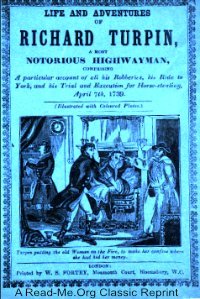
By W.S. Fortey.
A Most Notorious Highwayman. “Richard Turpin was born at Hampstead, in Essex, where his father kept the sign of the Bell; and after being the usual time at school, he was bound to apprentice to a butcher in Whitechapel, but did not serve out his time, for his master discharged him for impropriety of conduct, which was not in the least diminished by his parents' indulgence in supplying him with money, which enabled him to cut a figure round the town, among the blades of the road and the turf, whose company he usually kept.”
London: W.S. Fortey, 1860. 12p.
By A. Moore.
A brief historical account of the lives of the six notorious street-robbers, executed at Kingston viz. William Blewet, Edward Bunworth, Emanuel Dickenson, Thomas Berry, John Higges, and John Legee.
London: Printed for A. Moore, (1726). 52p.
By Richard S. Graves.
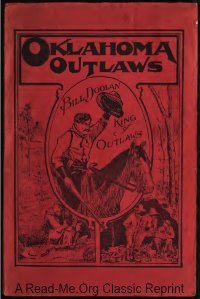
A Graphic History of the Early Days in Oklahoma; the Bandits who Terrorized the First Settlers and the Marshals who Fought them to Extinction; Covering a Period of Twenty-five Years .
Oklahoma City: State Printing & Publishing, Co., (1915?) 141p.
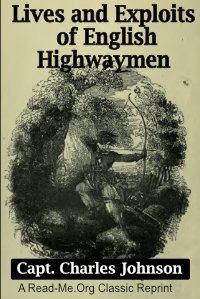
By Capt. Charles Johnson.
Pirates and Robbers, drawn from the most authentic sources, with additions by C. Whitehead. “He alone is a truly brave man, who, being powerful, for brave in it disgraceful to insult the feeble : many who pass the estimation of the world, are yet cowardly enough to commit base and barbarous actions : what else can be said of those, who possessing strength of mind and vigour of body, employ their faculties to rob and oppress the weak and ignorant ? It is an easy matter to assume the semblance of fortitude and resolution; but few, very few, are the individuals who really possess those noble qualities : particularly such hardened villains whose lives and exploits are so faithfully recorded in the following work.”
London Booksellers (1883) 452 pages.
By Harry Hawkeye.
A narrative of the thrilling adventures of the most daring and resourceful bandit ever recorded in the criminal annals of the world.
Ottenheimer (1908) 196 pages.
By James Allen.
Alias Jonas Pierce.. The front cover of the famous skin-bound copy has a label which reads "HIC LIBER WALTONIS CUTE COMPACTUS EST" ("This book is bound in the skin of Walton"); Walton was one of the author's aliases. Some claim that books were bound in the skin of criminals. The narrative is a combination of autobiography and confession, transcribed by the warden, as the author himself was unable to write. It details Allen's life, beginning from childhood and laying out his struggles to find honest work as a teenager.[5] Allen explains how he moved from breaking into shops to highway robbery, and how he attempted to escape imprisonment many times. The book ends with a note from the warden, regarding Allen's state of mind toward the end of his life — Wikipedia.
Boston: Harrington & Co., 1837. 32p.
By Wendy S. Hesfor.
Violent Exceptions turns to the humanitarian figure of the child-in-peril in twenty-first-century political discourse to better understand how this figure is appropriated by political constituencies for purposes rarely to do with the needs of children at risk. Wendy S. Hesford shows how the figure of the child-in-peril is predicated on racial division, which, she argues, is central to both conservative and liberal logics, especially at times of crisis when politicians leverage humanitarian storytelling as a political weapon. Through iconic images and stories of child migrants, child refugees, undocumented children, child soldiers, and children who are victims of war, terrorism, and state violence, Violent Exceptions illustrates how humanitarian rhetoric turns public attention away from systemic violations against children’s human rights and reframes this violence as exceptional—erasing more gradual forms of violence and minimizing human rights potential to counteract these violations and the precarious conditions from which they arise.
Columbus, OH: Ohio State University Press, 2021. 282p.