Open Access Publisher and Free Library
HUMAN RIGHTS.jpeg

HUMAN RIGHTS

Human Rights-Migration-Trafficking-Slavery-History-Memoirs-Philosophy

Border Penality as Antagonistic Politics

By Mattia Pinto

This article examines the socio-political implications of using criminal law to address migration issues in Italy. It delves into the polarised political debate characterised by crimmigration, on the one hand, and calls to criminalise border violence to protect migrants, on the other hand. It argues that both uses of penality reflect and foster penal antagonism, whereby both sides of the debate seek to impose their views using punishment. Penal antagonism leads to more migrants being incarcerated and forecloses possibilities for more political changes to the prevailing anti-immigration paradigm. Drawing on Chantal Mouffe's work, the article proposes agonistic politics as an alternative approach: a political confrontation to assert one's vision about migration, but where the opponent is an adversary to engage politically rather than an enemy to be delegitimised through penality. Moving from penal antagonism to political agonism could help decouple migration from penality and remove a central source of harm for migrants.

 Theoretical Criminology, Forthcoming,

Download
Read-Me.Org
World Migration Report 2024

By The International Organisation for Migration

“The World Migration Report 2024 helps demystify the complexity of human mobility through evidence-based data and analysis,” IOM Director General Amy Pope said at the launch. “In a world grappling with uncertainty, understanding migration dynamics is essential for informed decision-making and effective policy responses, and the World Migration Report advances this understanding by shedding light on longstanding trends and emerging challenges.” The report highlights that international migration remains a driver of human development and economic growth, highlighted by a more than 650 per cent increase in international remittances from 2000 to 2022, rising from USD 128 billion to USD 831 billion. The growth continued despite predictions from many analysts that remittances would decrease substantially because of COVID-19.  Of that 831 billion in remittances, 647 billion were sent by migrants to low– and middle-income countries. These remittances can constitute a significant portion of those countries' GDPs, and globally, these remittances now surpass foreign direct investment in those countries. Highlighting key findings, the report reveals that while international migration continues to drive human development, challenges persist. With an estimated 281 million international migrants worldwide, the number of displaced individuals due to conflict, violence, disaster, and other reasons has surged to the highest levels in modern-day records, reaching 117 million, underscoring the urgency of addressing displacement crises.  Migration, an intrinsic part of human history, is often overshadowed by sensationalized narratives. However, the reality is far more nuanced than what captures headlines. Most migration is regular, safe, and regionally focused, directly linked to opportunities and livelihoods. Yet, misinformation and politicization have clouded public discourse, necessitating a clear and accurate portrayal of migration dynamics.  International Organisation for Migration. 2024. 

Download
Read-Me.Org
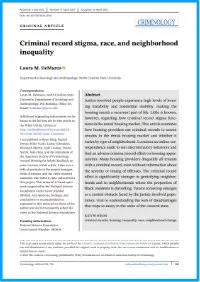
Criminal record stigma, race, and neighborhood inequality

By Laura DeMarco

Justice-involved people experience high levels of hous-ing instability and residential mobility, making the housing search a recurrent part of life. Little is known,however, regarding how criminal record stigma func-tions in the rental housing market. This article examines how housing providers use criminal records to screen tenants in the rental housing market and whether it varies by type of neighborhood. I conduct an online cor-respondence audit to test discriminatory behaviors and find an adverse criminal record effect on housing oppor-tunities. Many housing providers disqualify all tenants with a criminal record, even without information about the severity or timing of offenses. The criminal record effect is significantly stronger in gentrifying neighbor-hoods and in neighborhoods where the proportion ofBlack residents is dwindling. Tenant screening emerges as a central obstacle faced by the justice-involved popu-lation, vital to understanding the web of disadvantages that traps so many in the wake of the carceral state.K E Y W O R D Criminal records, housing, inequality, race, neighborhood change

.Criminology. 2023;61:705–730. 

Download
Read-Me.Org
‘Death, Despair and Destitution: The human costs of the EU's migration policies’.

By Bianca Benvenuti, Chloe Marshall-Denton, Sophie McCann

This report considers the health and humanitarian consequences of violent policies and practices on people moving along EU migration routes. It details findings from MSF medical humanitarian operations in 12 countries in Europe and Africa, as well as in the Central Mediterranean Sea. Taking stock of MSF operational experiences between August 2021 and September 2023, and drawing upon routine medical and operational data from MSF project and accounts from MSF patients and medical teams during that period, the report highlights how, at every step of people’s migration journey towards and within the EU, their health, wellbeing and dignity have been systematically undermined by the interlinking violent policies and practices embedded in EU and EU member state policies

2024. 44p.

Médecins Sans Frontières (MSF) , 2024. 85p.

Download
Read-Me.Org
EU migration and borders: Key facts and figures

By The European Parliamentary Research Service

Is the EU facing a migration crisis? Are the EU's borders on the brink of collapse because of increased irregular migration? Would border fences help to stop or reduce irregular migration? How many of the world's refugees and asylum seekers are headed towards the EU? Are the protection claims of asylum seekers genuine, or is subterfuge used to gain access to the EU? And what happened with the Ukrainian citizens fleeing the war into the EU? These are among the most common and important questions shaping the current discussion around migration and borders in the EU. This briefing provides an overview of key trends and figures on migration, borders and asylum in the EU. The analysis critically situates these topics in the broader global and historical context, providing a synthetic, data rich and accessible presentation of major issues. The analysis leads to several interesting findings that may challenge common perceptions about migration and borders in the EU, including the following.  The majority of migrants enter the EU through legitimate legal channels.  Most irregular migrants do not cross the EU's external borders irregularly.  There are significantly more legal migrants than irregular migrants in the EU.  Building fences at the EU's external borders does not seem to reduce irregular entries.  The view of a dramatic increase in the number of migrants and refugees is contested.  The EU's share of the world's refugees and asylum seekers remains limited.  Reducing or stopping immigration would worsen the EU's demographic challenges.  The EU's temporary protection scheme showed the Union's capacity to provide protection swiftly to a significant number of people in need.

Briefing Brussels: EPRS, 2024. 12p.

Download
Read-Me.Org
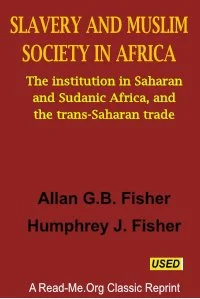
Slavery and Muslim Society in Africa

By Allen G.B. Fisher & Humphrey J. Fisher

The book discusses the institution of slavery in Saharan and Sudanic Africa and the trans-Saharan trade. The authors, Allan G.B. Fisher and Humphrey J. Fisher, provide insights into the size of the slave population, slave status and religion, domestic treatment of slaves, slave exports and marketing, and the role of slaves in African society. The document also includes references to specific incidents

C. Hurst & Co. Publishers, 1970, 219 pages

read
United States, Slavery and the Slave Trade in the Nile Valley

By El-Bashir, Ahmed E.

The book discusses the history of slavery and the slave trade in the Nile Valley, focusing on the United States’ involvement. It examines public reactions, the role of American travelers in shaping opinions, and the official response to the issue. The author acknowledges the assistance of various individuals and institutions in conducting his research.

University Press of America, 1983, 189 pages

read
Dark webs: Uncovering those behind forced labour on commercial fishing fleets

By Alfonso Daniels, Matti Kohonen, Eloy Aroni, Mariama Thiam

Forced labour in the fisheries sector is increasingly being recognised as a widespread human r1 The ILO provides a framework of 11 forced labour crisis. Forced labour is defined by the International Labour Organization (ILO) – the UN agency that sets up labour standards to ensure decent working conditions – as “all work or service which is exacted from any person under the menace of any penalty and for which the said person has not offered himself voluntarily.”0rced labour risk indicators that apply to the fishing sector, including indicators such as debt-bonded labour, and abusive working and living conditions.02

Boston: Financial Transparency Coalition , 2023. 74p.

download
Labour exploitation and other work-related crime: a problem analysis and prevention framework.

By Stijn Aerts

Key takeaways 1. Work-related crime refers to all infractions of laws and regulations regarding salary and employment, benefits, taxes and duties. This includes labour exploitation, forced labour, and trafficking in human beings for labour exploitation, as well as all criminal activities that may be related to, or indicative of, these crimes: benefit fraud, tax evasion and money laundering, breaching workplace safety regulations, salary extortion, and so on. 2. Labour exploitation is a particularly harmful crime. First, there is the direct harm (physical, psychological and economic) to victims. Second, exploitation creates unfair competition, having a negative effect on the legal economy and labour market. Third, unfair competition in trade and labour markets, and illegally acquired wealth, may erode trust in institutions and European values. 3. Exploiters make profit through a series of cost-cutting and revenue-generating actions. They save on wages, a safe work environment, taxes and social benefit contributions. Revenue is generated by asking inflated prices for recruitment and housing, by committing different types of benefit fraud, and by out-competing competitors. 4. Offenders use (seemingly) legal business structures and labour mobility options (including posted labour) to create intricate, often international, subcontracting chains that serve to hide illegal activity from plain sight and hamper investigations. 5. There are different prevention strategies, each with their own benefits and disadvantages. Victim-oriented approaches include awareness programmes for potential victims, as well as victim identification and assistance. Buyer-oriented strategies target both personal and corporate buyers, and aim to shrink the market for services and goods produced by exploited labour. Offender-oriented approaches have the objective to create an environment that is risky and unrewarding for offenders to operate in. The latter may be achieved by a mix of criminal justice and administrative probes that benefits from increased information sharing between authorities and across borders.

Brussels: European Crime Prevention Network - EUCPN. 2023. 40p.

download
Roles and Relations in Biblical Law: A Study of Participant Tracking, Semantic Roles, and Social Networks in Leviticus 17-26

By Christian Canu Højgaard 

Leviticus 17–26, an ancient law text known as the Holiness Code, prescribes how particular persons are to behave in concrete, everyday situations. The addressees of the law text must revere their parents, respect the elderly, fear God, take care of their fellow, provide for the sojourner, and so on. The sojourner has his own obligations, as do the priests. Even God is said to behave in various ways towards various persons. Thus, the law text forms an intricate web of persons and interactions. There is a growing awareness that ancient law texts were not arbitrary collections of legal paragraphs but articulations of certain world views. The laws were rational in their own respect and were based on the lawgiver’s ethos. However, since the ethical values of the lawgiver rarely—if ever—surface in the text itself, it has proven difficult to grasp with traditional, exegetical methods. This study offers a novel approach to mapping out the ethos of an ancient law text like Leviticus 17–26. By employing social network analysis, the participants and their interactions are mapped to scrutinize the ethical roles embodied by the persons of the law. To accomplish this, the study undertakes meticulous research into both the participants and the interactions of Leviticus 17–26. The book investigates a semi-automatic approach to extracting participant information from a text and offers new methods for analysing Hebrew interactions (realised as verbal predicates) in terms of dynamicity, causation, and agency. 

Cambridge: Open Book Publishers, 2024. 464p.

Download
Read-Me.Org
The Emergence of European Society through Public Law: A Hegelian and Anti-Schmittian Approach

By ARMIN VON BOGDANDY Translated by NAOMI SHULMAN Revised by THEODOR SHULMAN  

Many Europeans struggle to understand where European Union-centred Europeanization has led them. The standard response—that their situation is sui generis, one of a kind—no longer holds. Brexit, conflicts over European financial transfers, immigration, or dubious judicial reforms in some Member States demand a more substantial answer. Against that background, this book frames European integration by reconstructing European public law in the light of Article 2 of the Treaty on European Union (TEU). According to Article 2 TEU, all Europeans are today part of one society. European integration may not have produced a European state or people, but it has helped to create a European society. This society is interwoven with European public law as the Treaty characterizes it with 12 constitutional principles. The book interprets this statement as the manifesto, identity, and constitutional core of a democratic society. Thus, Europeans should understand that European integration has ushered in a European democratic society. This approach takes the bull by the horns because democracy represents the key concept in the struggle to understand and develop our society. On that basis, the book goes through many of the great debates of European public law and presents them in a new and forward-looking light.

OA Open. Oxford, UK: Oxford University Press, 2024. 337p.

Download
Read-Me.Org
Managing Cross-Border Projects: Towards More Resilient Cooperation in Borderlands. The Post-Pandemic Perspective

By Joanna Kurowska-Pysz Eduardo Medeiros Hynek Böhm

The authors of this monograph were driven to delve into the challenges facing cross-border cooperation amidst crises and disruptions spurred by the adverse impacts witnessed during the COVID-19 pandemic. This included challenges to the implementation of cross-border projects, the activities of Euroregions, and the development of partnerships based on INTERREG programs, as well as other issues related to territorial cooperation.The confluence of the pandemic crisis and broader international geopolitical issues, such as illegal migration to the EU and geopolitical tensions like Russian aggression against Ukraine, underscores the imperative to explore new research avenues focused on bolstering the resilience of cross-border cooperation within the EU.With a focus on identifying key factors shaping the management of cross-border projects co-financed by INTERREG programs, as well as factors influencing partner cooperation, this study aims to fortify cross-border cooperation in the face of future crises and disruptions.The monograph offers valuable insights for institutions and organizations operating in border regions, catering specifically to theoreticians and practitioners engaged in cross-border cooperation. By distilling lessons learned from the COVID-19 pandemic period, it provides a roadmap for integrating resilience into future cross-border activities and endeavours.

OA. Open. Logos Verlag Berlin, 2024. 258p.

Download
Read-Me.Org
The Sources of Anti-Slavery Constitutionalism in America, 1760-1848

By William M. Wiecek

This ambitious book examines the constitutional and legal doctrines of the antislavery movement from the eve of the American Revolution to the Wilmot Proviso and the 1848 national elections. Relating political activity to constitutional thought, William M. Wiecek surveys the antislavery societies, the ideas of their individual members, and the actions of those opposed to slavery and its expansion into the territories. He shows that the idea of constitutionalism has popular origins and was not the exclusive creation of a caste of lawyers. In offering a sophisticated examination of both sides of the argument about slavery, he not only discusses court cases and statutes, but also considers a broad range of "extrajudicial" thought—political speeches and pamphlets, legislative debates and arguments.


Ithaca, NY: Cornell University Press, 1977.

Download
Read-Me.Org
Law in Conflict: The Judicialization of Mining Disputes in Peru

By Angela Lindt

Peru's industrial mining sector is highly conflictual and characterized by social disputes. Many of these conflicts are fought not only in politics but also in the courts, as activists attempt to hold corporate and state actors liable for human rights violations. At the same time, they face an increasing criminalization of their protests. Law is thus both an emancipatory tool for activists to access justice and an instrument for political and economic elites to prevent social change. Based on ethnographic field work, Angela Lindt sheds light on various mining disputes in Cajamarca and Piura and examines the role of law in resolving these conflicts.

Bielefeld: transcript Verlag, 2023. 261p.

Download
Read-Me.Org
Slavery & Identity

By Mieko Nishida

●Thematic Focus: The book offers a new interpretation of urban slaveryin Salvador, Brazil, from 1808 to 1888, exploring the self-perceptions and identities of enslaved Africans and their descendants during theslavery regime, emphasizing factors like ethnicity, gender, and race.

●Structural Overview: It is divided into three parts, each examiningdifferent aspects of identity creation among African-born and Brazilian-born individuals, with chapters detailing the creation, representation,convergence, and re-creation of identities within the historical contextof New World slavery.

●Research Foundation: Nishida's work is grounded in primary sources and reflects her personal journey of identity search, paralleling the experiences of her subjects who navigated their identities amidst socio-political transitions in Brazil, such as the end of the transatlantic slave trade and the abolition of slavery.

Indiana University Press, 2003, 255 pages

read
Slavery in Dutch South Africa

By Nigel Worden

This book provides a comprehensive study of slavery in Dutch SouthAfrica, covering various aspects such as the historical context, the role of the Dutch East India Company (VOC), the economic impact of slavery, and the social dynamics between slaves and their masters. Here are some key insights.It details the establishment and growth of a slave society in South Africa under Dutch colonial rule from 1652 to 1795, and examines the economic aspects of slavery, including the profitability of slave labor and its integration into the colonial mercantilist system.It explores the relationships between slaves and their masters, the legal framework governing slavery, and the mechanisms of control and resistance within the slave society. The study places Cape slavery within a broader comparative framework, challenging traditional views and highlighting the complexities of the slave system at the Cape.These insights provide a nuanced understanding of the institution of slavery in Dutch South Africa and its implications for the region's history and development

Cambridge University Press, 1985 , 107 pages

read
The Slave Trade of Eastern Africa

By R.W Beachy

This book provides a comprehensive historical account of the EasternAfrican slave trade, tracing its origins from ancient times to the 19th century. It covers the extensive geographical area involved in the slavetrade, including the East African coast, Arabian Peninsula, and beyond.The influence of Portuguese, French, and British involvement in the region is discussed, highlighting their roles in the trade dynamics.Evidentiary documents include treaties, historical records and personal accounts that offer a glimpse into the realities of the slave trade in East Africa during different periods.

Rex Collings London, 1976, 140 pages

Read
Negro Slavery In The Sugar Plantations of Veracruz And Pernambuco 1550-1680

By Gerald Cardoso

Certainly! Here are the key insights from the document:

Historical Context: The study examines the institution of slavery in the sugar plantations of Veracruz and Pernambuco between 1550-1680, comparing the Spanish and Portuguese colonial systems.

Economic Impact: Slavery was crucial for the economic development of the colonies, influencing labor practices and contributing to the prosperity generated by the sugar industry.

Cultural Influence: The interaction between the ruling and subservient groups, as well as between whites and people of color, shaped a multitude of cultural mores and attitudes[^1^][1].

Resistance and Rebellion: The document highlights the persistent struggle for freedom by enslaved individuals, including the formation ofquilombos (maroon communities) and the notable resistance led byfigures like Zumbi in Palmares.This summary captures the essence of the document's exploration of slavery'srole in colonial Latin America.

University Press of America, 1983, 211 pages

read
Human Cargoes

By Calin A. Palmer

●Series Overview: The document lists a series of books under the title "Blacks in the New World," which explore various aspects of AfricanAmerican history and the African diaspora, including topics like black business, colonization, politics, and slavery.

●Specific Focus:One book, "Human Cargoes: The British Slave Trade toSpanish America, 1700-1739" by Colin Palmer, is highlighted, detailingthe British slave trade's impact on Spanish America and the experiences of African slaves[^1^][1].

●Research Significance: The work emphasizes empirical research to shed light on lesser-known aspects of black history, particularly the formative years of African presence in the Americas.

●Methodological Approach: The author, Colin Palmer, uses original archival research to analyze the organization, structure, and profitability of the British slave trade during the asien to years, focusing on the SouthSea Company's role.The document provides a comprehensive look at the historical context and the intricate details of the slave trade, reflecting a deep exploration into this dark chapter of history.

University of Illinois Press, 1981, 183 pages

READ
Kevin Pico
Humanitarian Imperialism : The Politics of Anti-Slavery Activism 1880-1940

By Amalia Ribi Forclaz

Humanitarian Imperialism examines anti-slavery activism between 1880-1940 and its entanglement with religious and political powers, diplomatic affairs, and military actions. It highlights the emergence of Catholic anti-slavery organizations in Europe, their efforts to raise awareness about African slavery, and their collaboration with established British societies to influence public and political spheres. The book provides an in-depth analysis of the campaign against slavery in Ethiopia, illustrating the complex interactions between British and Italian activists, missionaries, colonial authorities, and the League of Nations.. Finally, it reveals a transition in anti-slavery activism, influenced by the rise of totalitarian regimes and the changing international context during the interwar years, leading to a critical assessment of the relationship between humanitarian internationalism and imperialism.

Oxford University Press, 2015, 243 pages

read