Open Access Free Library
PUNISHMENT.jpeg

PUNISHMENT

PUNISHMENT-PRISON-HISTORY-CORPORAL-PUNISHMENT-PAROLE-ALTERNATIVES. MORE in the Toch Library Collection

Posts in history
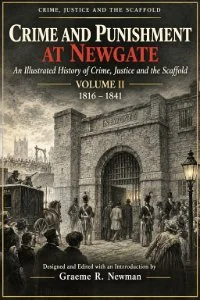
Crime And Punishment At Newgate.: An Illustrated History of Crime, Justice and the Scaffold. Volume II.

By Graeme R. Newman

Murderers and highwaymen, pirates and forgers, thieves and traitors, duelists and rebels—the men and women who passed through the British criminal justice system between 1700 and 1816 inhabited a world in which punishment was intended not merely to penalize the offender, but to be seen.

Crime and Punishment at Newgate brings that world vividly back to life through nearly 190 illustrated cases drawn from Camden Pelham’s celebrated nineteenth-century Chronicles of Crime; or, The New Newgate Calendar. Each case has been newly designed and presented as a compact illustrated narrative, combining the story of the crime with arrest, trial, conviction and, above all, punishment.

The punishments could be extraordinary. Men and women were hanged for offences that today might result in imprisonment. Others were whipped, branded, transported, imprisoned, mutilated or exposed to public humiliation. Bodies might be dissected after execution or displayed in chains. Yet the system was not uniformly merciless: pardons, reprieves, escapes, reduced verdicts and differences of wealth, gender and social rank produced striking variations in who was punished—and how.

Among these pages are murder, piracy, robbery, treason, duelling, forgery, riot, domestic killing and political crime. But this is more than a collection of sensational criminal stories. It is an illustrated history of the changing meaning of punishment itself.

In a substantial new Introduction, criminologist Graeme R. Newman asks questions that remain surprisingly modern: Did the punishment fit the crime? Who deserved punishment? Was justice applied equally to rich and poor? How fair were criminal trials? Why did governments make punishment a public spectacle? And how different are modern societies, which have moved punishment behind prison walls while turning crime and criminal trials into mass entertainment?

The scaffold, the prison, the courtroom and the crowd become parts of the same history. As Newman observes, the eighteenth-century spectator travelled to the punishment; today the spectacle travels to the spectator.

Richly illustrated throughout and supplemented by a Thematic Guide to Crime and Punishment and a Selected Bibliography, this first volume transforms the traditional Newgate Calendar into a modern visual history of crime, justice and society.

For readers interested in criminal justice, criminology, the history of punishment, capital punishment, Newgate Prison, British social history, true crime, and the darker side of eighteenth- and early nineteenth-century life.

Read-Me.Org Inc. New York-Philadelphia-Australia. 2026. p.204.
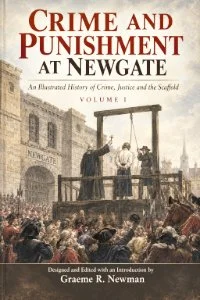
Crime And Punishment At Newgate.: An Illustrated History of Crime, Justice and the Scaffold. Volume I.

By Graeme R. Newman

Murderers and highwaymen, pirates and forgers, thieves and traitors, duelists and rebels—the men and women who passed through the British criminal justice system between 1700 and 1816 inhabited a world in which punishment was intended not merely to penalize the offender, but to be seen.

Crime and Punishment at Newgate brings that world vividly back to life through nearly 190 illustrated cases drawn from Camden Pelham’s celebrated nineteenth-century Chronicles of Crime; or, The New Newgate Calendar. Each case has been newly designed and presented as a compact illustrated narrative, combining the story of the crime with arrest, trial, conviction and, above all, punishment.

The punishments could be extraordinary. Men and women were hanged for offences that today might result in imprisonment. Others were whipped, branded, transported, imprisoned, mutilated or exposed to public humiliation. Bodies might be dissected after execution or displayed in chains. Yet the system was not uniformly merciless: pardons, reprieves, escapes, reduced verdicts and differences of wealth, gender and social rank produced striking variations in who was punished—and how.

Among these pages are murder, piracy, robbery, treason, duelling, forgery, riot, domestic killing and political crime. But this is more than a collection of sensational criminal stories. It is an illustrated history of the changing meaning of punishment itself.

In a substantial new Introduction, criminologist Graeme R. Newman asks questions that remain surprisingly modern: Did the punishment fit the crime? Who deserved punishment? Was justice applied equally to rich and poor? How fair were criminal trials? Why did governments make punishment a public spectacle? And how different are modern societies, which have moved punishment behind prison walls while turning crime and criminal trials into mass entertainment?

The scaffold, the prison, the courtroom and the crowd become parts of the same history. As Newman observes, the eighteenth-century spectator travelled to the punishment; today the spectacle travels to the spectator.

Richly illustrated throughout and supplemented by a Thematic Guide to Crime and Punishment and a Selected Bibliography, this first volume transforms the traditional Newgate Calendar into a modern visual history of crime, justice and society.

For readers interested in criminal justice, criminology, the history of punishment, capital punishment, Newgate Prison, British social history, true crime, and the darker side of eighteenth- and early nineteenth-century life.

Read-Me.Org Inc. New York-Philadelphia-Australia. 2026. p.206.

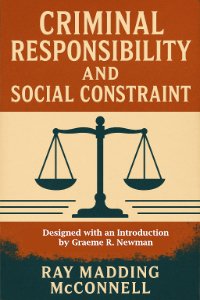
Criminal Responsibility And Social Constraint

By Ray  Madding  Mcconnell

Ray Madding McConnell’s Criminal Responsibility and Social Constraint first appeared in 1912 as one of the more philosophically ambitious works of the American Progressive Era. Though rarely cited today, the book occupies a fascinating place in the early twentieth-century dialogue between philosophy, criminology, and legal reform. Its author, who died shortly before the book’s publication, taught social ethics at Harvard and belonged to a generation deeply convinced that clearer thought could repair the accumulating confusions of modern criminal law. His book is therefore both a legacy and an argument: a legacy of Progressive rationalism and an argument for reconsidering the foundations of punishment in an age increasingly aware of causation, psychology, and social science.

More than a century after its publication, Criminal Responsibility and Social Constraint offers a valuable perspective for scholars, legal theorists, and reformers. It is a window into the moment when American thought on crime and punishment began to absorb scientific psychology, social statistics, and philosophical determinism. It presents an early, coherent version of a consequentialist theory of punishment that still structures major parts of modern practice. And it invites readers to confront the perennial tension between causation and accountability: how can a society committed to science and determinism still punish, censure, and regulate?

McConnell’s answer is that responsibility is a socially constructed tool—one that must be justified by its utility rather than by metaphysical claims about freedom. Whether one accepts or contests that answer, it remains a stimulus to deeper thinking about the moral and practical foundations of the criminal law. In that sense, McConnell’s book continues to speak forcefully to our age, reminding us that the architecture of justice must rest on reasons we can defend, not merely on traditions we have inherited.

Read-Me.Org Inc. New York-Philadelphia-Australia. 2025. p.234.

The History of the Death Penalty in Colorado

MICHAEL L. RADELET

"The History of the Death Penalty in Colorado" delves into the complex and controversial practice of capital punishment within the state. Revealing the evolution of laws, cases, and sentiments surrounding the death penalty, this book provides a comprehensive examination of its impact on Colorado's justice system and society. From landmark legal battles to public opinion shifts, this thorough exploration offers valuable insights into a contentious aspect of Colorado's history."

UNIVERSITY PRESS OF COLORADO. Boulder. 2017. 300p.

GUILLOTINE: IT'S LEGEND AND LORE

MAY CONTAIN MARKUP

DANIEL GEROULD

Guillotine: It's Legend and Lore delves into the history, cultural impact, and myths surrounding the infamous device that became the symbol of the French Revolution. This comprehensive book examines the origins of the guillotine, its evolution, and the significant historical events it was associated with. Through meticulous research and captivating storytelling, the author explores the diverse perspectives on the guillotine, shedding light on its enduring legacy in both history and popular culture. Whether you are a history enthusiast or simply curious about this macabre yet fascinating subject, Guillotine: It's Legend and Lore is a compelling read that offers a fresh look at one of history's most notorious inventions.

BLAST BOOKS • NEW YORK. 1992. 332p.