
Open Access Free Library
PUNISHMENT.jpeg

PUNISHMENT

PUNISHMENT-PRISON-HISTORY-CORPORAL-PUNISHMENT-PAROLE-ALTERNATIVES. MORE in the Toch Library Collection

Posts tagged Death Penalty
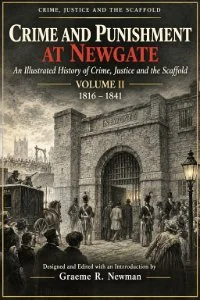
Crime And Punishment At Newgate.: An Illustrated History of Crime, Justice and the Scaffold. Volume II.

By Graeme R. Newman

Murderers and highwaymen, pirates and forgers, thieves and traitors, duelists and rebels—the men and women who passed through the British criminal justice system between 1700 and 1816 inhabited a world in which punishment was intended not merely to penalize the offender, but to be seen.

Crime and Punishment at Newgate brings that world vividly back to life through nearly 190 illustrated cases drawn from Camden Pelham’s celebrated nineteenth-century Chronicles of Crime; or, The New Newgate Calendar. Each case has been newly designed and presented as a compact illustrated narrative, combining the story of the crime with arrest, trial, conviction and, above all, punishment.

The punishments could be extraordinary. Men and women were hanged for offences that today might result in imprisonment. Others were whipped, branded, transported, imprisoned, mutilated or exposed to public humiliation. Bodies might be dissected after execution or displayed in chains. Yet the system was not uniformly merciless: pardons, reprieves, escapes, reduced verdicts and differences of wealth, gender and social rank produced striking variations in who was punished—and how.

Among these pages are murder, piracy, robbery, treason, duelling, forgery, riot, domestic killing and political crime. But this is more than a collection of sensational criminal stories. It is an illustrated history of the changing meaning of punishment itself.

In a substantial new Introduction, criminologist Graeme R. Newman asks questions that remain surprisingly modern: Did the punishment fit the crime? Who deserved punishment? Was justice applied equally to rich and poor? How fair were criminal trials? Why did governments make punishment a public spectacle? And how different are modern societies, which have moved punishment behind prison walls while turning crime and criminal trials into mass entertainment?

The scaffold, the prison, the courtroom and the crowd become parts of the same history. As Newman observes, the eighteenth-century spectator travelled to the punishment; today the spectacle travels to the spectator.

Richly illustrated throughout and supplemented by a Thematic Guide to Crime and Punishment and a Selected Bibliography, this first volume transforms the traditional Newgate Calendar into a modern visual history of crime, justice and society.

For readers interested in criminal justice, criminology, the history of punishment, capital punishment, Newgate Prison, British social history, true crime, and the darker side of eighteenth- and early nineteenth-century life.

Read-Me.Org Inc. New York-Philadelphia-Australia. 2026. p.204.
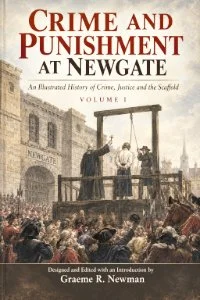
Crime And Punishment At Newgate.: An Illustrated History of Crime, Justice and the Scaffold. Volume I.

By Graeme R. Newman

Murderers and highwaymen, pirates and forgers, thieves and traitors, duelists and rebels—the men and women who passed through the British criminal justice system between 1700 and 1816 inhabited a world in which punishment was intended not merely to penalize the offender, but to be seen.

Crime and Punishment at Newgate brings that world vividly back to life through nearly 190 illustrated cases drawn from Camden Pelham’s celebrated nineteenth-century Chronicles of Crime; or, The New Newgate Calendar. Each case has been newly designed and presented as a compact illustrated narrative, combining the story of the crime with arrest, trial, conviction and, above all, punishment.

The punishments could be extraordinary. Men and women were hanged for offences that today might result in imprisonment. Others were whipped, branded, transported, imprisoned, mutilated or exposed to public humiliation. Bodies might be dissected after execution or displayed in chains. Yet the system was not uniformly merciless: pardons, reprieves, escapes, reduced verdicts and differences of wealth, gender and social rank produced striking variations in who was punished—and how.

Among these pages are murder, piracy, robbery, treason, duelling, forgery, riot, domestic killing and political crime. But this is more than a collection of sensational criminal stories. It is an illustrated history of the changing meaning of punishment itself.

In a substantial new Introduction, criminologist Graeme R. Newman asks questions that remain surprisingly modern: Did the punishment fit the crime? Who deserved punishment? Was justice applied equally to rich and poor? How fair were criminal trials? Why did governments make punishment a public spectacle? And how different are modern societies, which have moved punishment behind prison walls while turning crime and criminal trials into mass entertainment?

The scaffold, the prison, the courtroom and the crowd become parts of the same history. As Newman observes, the eighteenth-century spectator travelled to the punishment; today the spectacle travels to the spectator.

Richly illustrated throughout and supplemented by a Thematic Guide to Crime and Punishment and a Selected Bibliography, this first volume transforms the traditional Newgate Calendar into a modern visual history of crime, justice and society.

For readers interested in criminal justice, criminology, the history of punishment, capital punishment, Newgate Prison, British social history, true crime, and the darker side of eighteenth- and early nineteenth-century life.

Read-Me.Org Inc. New York-Philadelphia-Australia. 2026. p.206.

The Palace of Death

By H. M. Fogle. Intrdosction by Graeme Newman

At once a chronicle and a funeral dirge, The Palace of Death stands as a haunting testament to early twentieth-century American penal culture. Published in 1909 by an Ohio penitentiary official, H. M. Fogle's volume compiles 59 firsthand accounts of incarceration and execution—each rendered with chilling precision and accompanied by stark photographic documentation. The period covers the execution by hanging and the transition to the electric chair, all in considerable detail. These narratives propel the reader through the twilight of life, revealing how society confronts its most extreme judgments. Yet, behind the factual veneer lies a provocative tension: does Fogle intend to expose the tragedy of fallen humanity, or to feed a voyeuristic appetite for death? In this liminal space between documentation and spectacle, the work demands not only attention, but moral inventory.

Read-Me.Org Inc. New York-Philadelphia-Australia. 2025. p.229.

Delay in the Shadow of Death

By Lee Kovarsky

There is a widely held belief that to delay executions, American death-row prisoners strategically defer litigation until the eleventh hour. After all, the logic goes, that the incentives for prisoners who face the death penalty differ from those who do not. Noncapital prisoners typically try to move the terminal point of a sentence (release) forward, and capital prisoners typically try to push that point (execution) back. This theory of litigant behavior—what I call the “Strategic Delay Account,” or the “SDA”—underwrites an extraordinarily harsh institutional response. It primes courts to discount real constitutional grievances and to punish participating lawyers, and it spurs legislatures to restrict crucial remedies. In this article, I explain that the SDA inaccurately describes condemned prisoner behavior, both because it assumes a non-existent incentive structure and because it ignores the major structural causes of delayed litigation. First, deferred litigation is risky, and fortune disfavors the bold. Procedural doctrines that operate across post-conviction law strongly incentivize the promptest conceivable presentation of claims. Second, prisoners often omit challenges from early rounds of litigation not because they have done so strategically, but instead because some claims are inherently incapable of being asserted at that time. Third, the volume of end-stage litigation reflects the comprehensive failure of American jurisdictions to provide adequate legal services; condemned prisoners are often functionally unrepresented from the moment early-stage proceedings conclude until the state sets an execution date.

New York University Law Review Issue: Volume 95, Number 5, November 2020

The Lena Baker Story

By Lela Bond Phillips

"The Lena Baker Story" by Lela Bond Phillips is a compelling account of the life of Lena Baker, a Black woman wrongfully convicted of murder in Georgia in the 1940s. This book delves into the injustices Lena faced as she navigated a racially charged legal system and tells the story of her fight for justice in the face of insurmountable odds. Through meticulous research and poignant storytelling, Lela Bond Phillips sheds light on a forgotten chapter of American history and brings Lena Baker's courageous struggle for truth and dignity to the forefront."

Wings Publishers, 2001, 103 pages

The History of the Death Penalty in Colorado

MICHAEL L. RADELET

"The History of the Death Penalty in Colorado" delves into the complex and controversial practice of capital punishment within the state. Revealing the evolution of laws, cases, and sentiments surrounding the death penalty, this book provides a comprehensive examination of its impact on Colorado's justice system and society. From landmark legal battles to public opinion shifts, this thorough exploration offers valuable insights into a contentious aspect of Colorado's history."

UNIVERSITY PRESS OF COLORADO. Boulder. 2017. 300p.

GUILLOTINE: IT'S LEGEND AND LORE

MAY CONTAIN MARKUP

DANIEL GEROULD

Guillotine: It's Legend and Lore delves into the history, cultural impact, and myths surrounding the infamous device that became the symbol of the French Revolution. This comprehensive book examines the origins of the guillotine, its evolution, and the significant historical events it was associated with. Through meticulous research and captivating storytelling, the author explores the diverse perspectives on the guillotine, shedding light on its enduring legacy in both history and popular culture. Whether you are a history enthusiast or simply curious about this macabre yet fascinating subject, Guillotine: It's Legend and Lore is a compelling read that offers a fresh look at one of history's most notorious inventions.

BLAST BOOKS • NEW YORK. 1992. 332p.