by Luigi Villari (Author), Graeme Newman (Introduction)
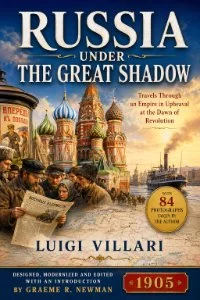
In 1905, a young Italian journalist and future diplomat set out across the Russian Empire in the immediate aftermath of a war that had just humiliated a great power and cracked open a century of imperial certainty. What he found — and photographed — became this book.
Luigi Villari traveled from the drawing rooms of St. Petersburg to the bazaars of Moscow, from the great fair at Nizhny Novgorod to the ironworks of the Donets basin, from monasteries outside Kiev to the tenements of factory towns, capturing a country lurching between old-world autocracy and the raw pressures of industrial change. He wrote about labor unrest and railway barons, about corrupt charity and courageous doctors, about the peasant's world and the aristocrat's, without ever losing the outsider's eye for telling detail. His account of Russian public opinion after the war — written before anyone could know how the story would end — reads today as a snapshot of a future still genuinely undecided.
This Read-Me.Org edition brings Villari's 1905 classic back into print for modern readers: fully re-edited and corrected, with US spelling and punctuation modernized throughout, Russian place and personal names standardized to current usage, and all 84 of Villari's original photographs restored in their original positions. A new introduction by Graeme R. Newman situates the book within the Russo-Japanese War, the 1905 Revolution, and the wave of foreign travel writing that tried to make sense of an empire already sliding toward collapse.
For readers of Russian history, travel literature, and the long run-up to 1917 — a firsthand report from a country that didn't yet know what was coming.
Read-Me.Org Inc. New York-Philadelphia-Australia. 2026. p.