
Open Access Publisher and Free Library
SOCIAL SCIENCES.jpeg

SOCIAL SCIENCES

Social sciences examine human behavior, social structures, and interactions in various settings. Fields such as sociology, psychology, anthropology, and economics study social relationships, cultural norms, and institutions. By using different research methods, social scientists seek to understand community dynamics, the effects of policies, and factors driving social change. This field is important for tackling current issues, guiding public discussions, and developing strategies for social progress and innovation.

Posts tagged aging
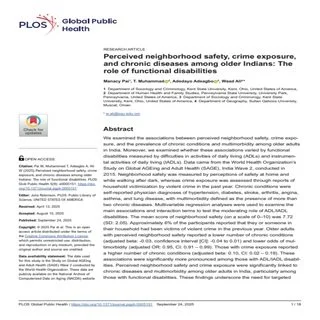
Perceived Neighborhood Safety, Crime Exposure, and Chronic Diseases Among Older Indians: The Role of Functional Disabilities

By Manacy Pai, T. Muhammad, Adedayo Adeagbo, and Waad Ali

We examined the associations between perceived neighborhood safety, crime exposure, and the prevalence of chronic conditions and multimorbidity among older adults in India. Moreover, we examined whether these associations varied by functional disabilities measured by difficulties in activities of daily living (ADLs) and instrumental activities of daily living (IADLs). Data came from the World Health Organization’s Study on Global AGEing and Adult Health (SAGE), India Wave 2, conducted in 2015. Neighborhood safety was measured by perceptions of safety at home and while walking after dark, whereas crime exposure was assessed through reports of household victimization by violent crime in the past year. Chronic conditions were self-reported physician diagnoses of hypertension, diabetes, stroke, arthritis, angina, asthma, and lung disease, with multimorbidity defined as the presence of more than two chronic diseases. Multivariable regression analyses were used to examine the main associations and interaction terms to test the moderating role of ADL/IADL disabilities. The mean score of neighborhood safety (on a scale of 0–10) was 7.72 (SD: 2.05). Approximately 6% of the participants reported that they or someone in their household had been victims of violent crime in the previous year. Older adults with perceived neighborhood safety reported a lower number of chronic conditions (adjusted beta: -0.03, confidence interval [CI]: -0.04 to 0.01) and lower odds of multimorbidity (adjusted OR: 0.95, CI: 0.91 – 0.99). Those with crime exposure reported a higher number of chronic conditions (adjusted beta: 0.10, CI: 0.02 – 0.19). These associations were significantly more pronounced among those with ADL/IADL disabilities. Perceived neighborhood safety and crime exposure were significantly linked to chronic diseases and multimorbidity among older adults in India, particularly among those with functional disabilities. These findings underscore the need for targeted strategies to improve neighborhood safety and support among older Indians with functional disabilities

PLOS Global Public Health 2025,

download
School Racial Segregation and Late-Life Cognition

By Zhuoer Lin, Yi Wang, Thomas M. Gill, Xi Chen:

Disparities in cognition persist between non-Hispanic Black (hereafter, Black) and non-Hispanic White (hereafter, White) older adults, and are possibly influenced by early educational differences stemming from structural racism. However, the relationship between school racial segregation and later-life cognition remains underexplored. We examined a nationally sample of older Americans from the Health and Retirement Study. Utilizing childhood residence data and cognitive assessment data (1995-2018) for Black and White participants aged 65 and older, Black-White dissimilarity index for public elementary schools measuring school segregation, multilevel analyses revealed a significant negative association between school segregation and later-life cognitive outcomes among Black participants, but not among White participants. Potential mediators across the life course, including educational attainment, explained 58-73% of the association, yet the associations remained large and significant among Black participants for all outcomes. Given the rising trend of school segregation in the US, educational policies aimed at reducing segregation are crucial to address health inequities. Clinicians can leverage patients' early-life educational circumstances to promote screening, prevention, and management of cognitive disorders.

IZA DP No. 17466

Bonn: IZA – Institute of Labor Economics. 2024. 64p.

Download