
Open Access Publisher and Free Library
SOCIAL SCIENCES.jpeg

SOCIAL SCIENCES

Social sciences examine human behavior, social structures, and interactions in various settings. Fields such as sociology, psychology, anthropology, and economics study social relationships, cultural norms, and institutions. By using different research methods, social scientists seek to understand community dynamics, the effects of policies, and factors driving social change. This field is important for tackling current issues, guiding public discussions, and developing strategies for social progress and innovation.

Posts tagged cognitive decline
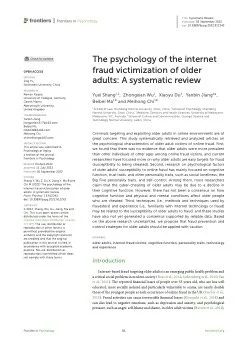
The Psychology of Internet Fraud Victimization of Older Adults: A Systematic Review

By Yuxi Shang , Zhongxian Wu , Xiaoyu Du3, Yanbin Jiang , Beibei Ma , Meihong Chi

Criminals targeting and exploiting older adults in online environments are of great concern. This study systematically retrieved and analyzed articles on the psychological characteristics of older adult victims of online fraud. First, we found that there was no evidence that older adults were more prevalent than other individuals of other ages among online fraud victims, and current researchers have focused more on why older adults are easy targets for fraud (susceptibility to being cheated). Second, research on psychological factors of older adults' susceptibility to online fraud has mainly focused on cognitive function, trust traits, and other personality traits, such as social loneliness, the Big Five personality traits, and self-control. Among them, most researchers claim that the cyber-cheating of older adults may be due to a decline in their cognitive function. However, there has not been a consensus on how cognitive function and physical and mental conditions affect older people who are cheated. Third, techniques (i.e., methods and techniques used by fraudsters) and experience (i.e., familiarity with internet technology or fraud) may be related to the susceptibility of older adults to fraud, and these studies have also not yet generated a consensus supported by reliable data. Based on the above research uncertainties, we propose that fraud prevention and control strategies for older adults should be applied with caution.

Front Psychol. 2022 Sep 5;13:912242. doi: 10.3389/fpsyg.2022.912242. PMID: 36132192; PMCID: PMC9484557

download
School Racial Segregation and Late-Life Cognition

By Zhuoer Lin, Yi Wang, Thomas M. Gill, Xi Chen:

Disparities in cognition persist between non-Hispanic Black (hereafter, Black) and non-Hispanic White (hereafter, White) older adults, and are possibly influenced by early educational differences stemming from structural racism. However, the relationship between school racial segregation and later-life cognition remains underexplored. We examined a nationally sample of older Americans from the Health and Retirement Study. Utilizing childhood residence data and cognitive assessment data (1995-2018) for Black and White participants aged 65 and older, Black-White dissimilarity index for public elementary schools measuring school segregation, multilevel analyses revealed a significant negative association between school segregation and later-life cognitive outcomes among Black participants, but not among White participants. Potential mediators across the life course, including educational attainment, explained 58-73% of the association, yet the associations remained large and significant among Black participants for all outcomes. Given the rising trend of school segregation in the US, educational policies aimed at reducing segregation are crucial to address health inequities. Clinicians can leverage patients' early-life educational circumstances to promote screening, prevention, and management of cognitive disorders.

IZA DP No. 17466

Bonn: IZA – Institute of Labor Economics. 2024. 64p.

Download