Open Access Free Library
SOCIAL SCIENCES.jpeg

SOCIAL SCIENCES

Social sciences examine human behavior, social structures, and interactions in various settings. Fields such as sociology, psychology, anthropology, and economics study social relationships, cultural norms, and institutions. By using different research methods, social scientists seek to understand community dynamics, the effects of policies, and factors driving social change. This field is important for tackling current issues, guiding public discussions, and developing strategies for social progress and innovation.

Posts in Social Science
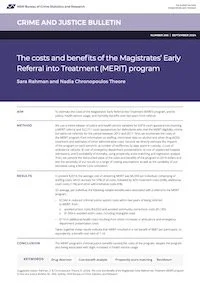
The Costs and Benefits of the Magistrates’ Early Referral into Treatment (MERIT) Program

By Sara Rahman and Nadia Chronopoulos Theore

The Magistrates’ Early Referral into Treatment (MERIT) program is a voluntary, pre-plea program for adults in 62 NSW Local Courts. Participants have their court matters deferred for 12 weeks while they undergo drug and/or alcohol treatment. The program aims to improve participant health and reduce their risk of reoffending. It may also help participants demonstrate their potential for rehabilitation before sentencing.

We use justice, mortality, emergency department, hospital admissions, and ambulance data for 9,874 court appearances involving a MERIT referral and 322,711 court appearances for eligible defendants not referred to MERIT between 2012 and 2017. We then compare the outcomes for a matched group of MERIT and non-MERIT defendants against the cost of MERIT staffing, administration, and outpatient treatment in 2019 dollars.

Key findings

Figure 1 shows our estimates of the average costs and benefits in the two years after referral to the program. Our findings estimate the key benefits of a referral to MERIT to include:

  • $4,552 in avoided prison costs over two years, from those referred to MERIT spending 22 fewer days in custody than those not referred to MERIT

  • $1,185 in avoided community corrections costs and $1,069 in avoided victim costs, from those referred to MERIT committing 0.32 fewer reoffences in the first year after referral compared to those not referred to the program

  • $116 in additional ambulance and emergency department costs.

Comparing these benefits to the estimated cost of MERIT of $6,339, the program results in a net present value of $887, equivalent to a return of $1.14 per dollar spent on the program. These results are robust to choices of discount rate and uncertainty in our statistical estimates.

  • Publication series: Crime and justice bulletin. no. 266

Sydney:  NSW BUREAU OF CRIME STATISTICS AND RESEARCH -2024. 40p.

Understanding Gambling Harms in the Digital Age

By Kate Holland, Kieran McGuinness, Kerry McCallum

This report documents findings and recommendations from the ‘Understanding Gambling Harms in the Digital Age’ research project (2022-2024) funded by the ACT Gambling and Racing Commission’s Harm Prevention and Mitigation Fund. The research aimed to explore community knowledge and awareness of gambling harms and to develop an evidence base for public communication strategies to inform the Commission’s work in educating the public about gambling harm. 

Structure of the report
Section 2 reviews contemporary national and international research on gambling harm and the shift from what has been a focus on ‘problem gambling’ and ‘problem gamblers’ as the evidence base for the harmful effects of gambling, to a public health approach that recognises the full spectrum of gambling harms within the community. This includes any negative outcomes of gambling behaviour impacting on financial, relationship, health, emotional, work, cultural or criminal circumstances of the gambler or those associated with the gambler. The report discusses evidence regarding the prevalence and types of harms of different modes of gambling, attitudes and beliefs about gambling and gambling harm, gambling advertising and different harm prevention and communication strategies.Sections 3 and 4 focus on the research findings which show many participants view gambling as harmful to the community but they also recognise that gambling is a normalised activity and part of everyday life, work, social and family relationships for many people. Many believe gambling advertising normalises gambling as a fun and social activity and support further restrictions in this area. Participants tend to associate harm from gambling with financial and relationship harms, extreme consequences and addiction. Stereotypes about who experiences gambling harm were evident and stigma was seen as a barrier that may prevent people from recognising harm, talking about it and seeking help. Section 5 of the report details findings of the final phase of the research, which involved developing and testing messages about gambling harm based on findings from earlier research phases. The themes ‘gambling harm can affect anyone’ and ‘gambling products, services and advertising are designed to keep you spending’ had the most engagement, resonance and impact with focus group participants. We discuss elements of gambling harm messages that worked and why. The final section of the report synthetises the research findings and provides 10 recommendations and advice on messaging content, design and implementation to assist the Commission in its efforts to reduce gambling harm through public health communication and education activities.

Canberra: University of Canberra, 2024.

Small Arms Survey Annual Report 2023

By Katie Lazaro with Luigi De Martino, Olivia Denonville, Nathalie Fauvarque, Nicolas Florquin, and Lionel Kosirnik, with inputs from Small Arms Survey staff members and consultants.

The year 2023 was significant for a number of reasons. It saw the conclusion of Daniel de Torres’ successful stewardship as director of the Small Arms Survey, and so we thank him for his dedicated service to the Survey over the last four years. This year also marked the final year of the Survey’s five-year strategy and the completion of significant projects such as Strengthening Implementation and Enforcement of the Arms Embargo on North Korea, as well as the announcement of Mark Downes' appointment as the Survey’s new director.  For the Survey, it was a year underlined by innovation, with in-depth regional studies on the socio-economic costs of armed violence in the Caribbean, the trafficking of improvised explosive device components in West Africa, and arms proliferation in Afghanistan, as well as an update to the Global Violent Deaths database. More worryingly for the arms control and armed violence reduction agendas, 2023 saw the reversal of progress towards Sustainable Development Goal 16.1. With increases in conflict-related deaths around the world (including in occupied Palestinian territory, Sudan, and Ukraine), ongoing challenges to real-world implementation of legal arms control measures designed to prevent gender-based violence in parts of Latin America, and the ever-increasing threat of privately made firearms—ranging from artisanal weapons to 3D printed firearms—this past year could be described as a turning point for our agenda.

Geneva, SWIT: Small Arms Survey, 2024. 23p.

Distributed Blackness: African American Cybercultures

By André Brock, Jr.

From BlackPlanet to #BlackGirlMagic, Distributed Blackness places Blackness at the very center of internet culture. André Brock Jr. claims issues of race and ethnicity as inextricable from and formative of contemporary digital culture in the United States. Distributed Blackness analyzes a host of platforms and practices (from Black Twitter to Instagram, YouTube, and app development) to trace how digital media have reconfigured the meanings and performances of African American identity. Brock moves beyond widely circulated deficit models of respectability, bringing together discourse analysis with a close reading of technological interfaces to develop nuanced arguments about how “Blackness” gets worked out in various technological domains.

As Brock demonstrates, there’s nothing niche or subcultural about expressions of Blackness on social media: internet use and practice now set the terms for what constitutes normative participation. Drawing on critical race theory, linguistics, rhetoric, information studies, and science and technology studies, Brock tabs between Black-dominated technologies, websites, and social media to build a set of Black beliefs about technology. In explaining Black relationships with and alongside technology, Brock centers the unique joy and sense of community in being Black online now.

New York: NYU Press, 2020 266p.

The Sexual Politics of Meat: A Feminist-Vegetarian Critical Theory

May Contain Markup

By Carol J. Adams

Feminist-Vegetarian Connection: The book explores the interconnections between feminism and vegetarianism, arguing that both movements challenge patriarchal structures and the oppression of animals and women.

Patriarchal Culture: It discusses how patriarchal culture authorizes the eating of animals and links this to male dominance and control.

Historical Context: The book provides a historical analysis of vegetarianism and its ties to feminist movements, particularly from the1790s to the present.

Cultural Critique: It critiques how meat consumption is embedded in cultural norms and language, reinforcing gender roles and violence.

Continuum, 2000, 256 pages

Skid Row: As a Way of Life

May Contain Markup

By Samuel E. Wallace

Two Ways of Living: The document contrasts two lifestyles within the economic system: one bound by societal obligations and the other, amore carefree, nomadic existence.

Skid Row Research: The author conducted extensive research on skidrow, including participant observation and interviews, to understand the community's way of life.

Historical Context: Skid row has been a subject of study for over a century, with numerous empirical studies, biographies, and programmatic statements documenting its existence and the lives of its inhabitants.

References: The document contains many references to previous studies, reports, and literature on skid row and related topics.

Bedminster Press, 1965, 219 pages

Covid-19 Impacts On Violent Extremist Organizations (VEOS) and Counterterrorism (CT) Operations

By Pamela G. Faber, Megan K. McBride, Sarah Fusco, and Cheryl B. Rosenblum

The unfolding COVID-19 pandemic has shed light on the wide-ranging disruption that nontraditional threats such as pandemics can have on the US economy, military, diplomatic corps, and national security apparatus. The US, its partners, and its competitors have tried to curb the spread of the virus by closing schools, workplaces, social gathering spots, and borders. Militaries have scaled back operations, postponed exercises, and curtailed engagements. Economic futures remain uncertain. Low‑income workers in industrialized countries have been disproportionately affected by rolling shutdowns and stay-at-home orders, and wealth inequality is increasing. Social interactions, such as religious gatherings, family celebrations, athletic activities, and concerts have been forced online or suspended. For many, extended periods of isolation and loneliness are a hidden side effect of the virus, with experts predicting a mental health crisis to come. Although the vaccine rollout is underway in many parts of the world, it will be many more months—possibly years—before the entire global population is vaccinated and a return to “normal” becomes possible. The pandemic, moreover, has affected both violent extremist organization (VEO) operations and US capacity to conduct counterterrorism (CT)  intelligence gathering, analysis, and activities. It has increased global instability—political, economic, and social—which will almost certainly benefit terrorist and extremist groups. Jihadi movements such as ISIS and far-right groups such as the Russian Imperial Movement thrive in environments of uncertainty and chaos. COVID-19 has contributed to instability and expanded opportunities for VEOs to recruit and operate. Accordingly, there has been an observable uptick in VEO activity in places such as sub-Saharan Africa, West Africa, Iraq, and Syria; in addition, movements such as ISIS and Jama’at Nasr al-Islam wal Muslimin (JNIM) have adjusted their rhetoric by claiming that the virus is divine punishment for unbelievers. In the US, citizen frustration with COVID-19 mitigation efforts drove (thwarted) attacks against public officials in New Mexico, a hospital in Missouri, and police headquarters in Orlando, Florida, and extremists have also encouraged followers to disrupt National Guard activities. In addition to COVID-related violence in the US, rising political unrest, including the January 6, 2021, storming of the US Capitol, has drawn attention to domestic security issues.

Arlington, VA: CNA, 2021. 26p.

Online Signals of Extremist Mobilization

By Olivia Brown , Laura G. E. Smith, Brittany I. Davidson, Daniel Racek, and Adam Joinson

Psychological theories of mobilization tend to focus on explaining people’s motivations for action, rather than mobilization (“activation”) processes. To investigate the online behaviors associated with mobilization, we compared the online communications data of 26 people who subsequently mobilized to right-wing extremist action and 48 people who held similar extremist views but did not mobilize (N = 119,473 social media posts). In a three-part analysis, involving content analysis (Part 1), topic modeling (Part 2), and machine learning (Part 3), we showed that communicating ideological or hateful content was not related to mobilization, but rather mobilization was positively related to talking about violent action, operational planning, and logistics. Our findings imply that to explain mobilization to extremist action, rather than the motivations for action, theories of collective action should extend beyond how individuals express grievances and anger, to how they equip themselves with the “know-how” and capability to act.  

Personality and Social Psychology Bulletin 1–20, 2024.  

Racing the Great White Way: Black Performance, Eugene O’Neill, and the Transformation of Broadway

By Katie N. Johnson

The early drama of Eugene O’Neill, with its emphasis on racial themes and conflicts, opened up extraordinary opportunities for Black performers to challenge racist structures in modern theater and cinema. By adapting O’Neill’s dramatic writing—changing scripts to omit offensive epithets, inserting African American music and dance, or including citations of Black internationalism--theater artists of color have used O’Neill’s texts to raze barriers in American and transatlantic theater. Challenging the widely accepted idea that Broadway was the white-hot creative engine of U.S. theater during the early 20th century, author Katie N. Johnson reveals a far more complex system of exchanges between the Broadway establishment and a vibrant Black theater scene in New York and beyond to chart a new history of American and transnational theater.  In spite of their dichotomous (and at times problematic) representation of Blackness, O’Neill’s plays such as The Emperor Jones and All God’s Chillun Got Wings make ideal case studies because of the way these works stimulated traffic between Broadway and Harlem—and between white and Black America. These investigations of O’Neill and Broadway productions are enriched by the vibrant transnational exchange found in early to mid-20th century artistic production. Anchored in archival research, Racing the Great White Way recovers not only vital lost performance histories, but also the layered contexts for performing bodies across the Black Atlantic and the Circum-Atlantic.

Ann Arbor: University of Michigan Press, 2923.  271p.

The Challenge of Radicalization and Extremism: Integrating Research on Education and Citizenship in the Context of Migration

Edited by Eveline Gutzwiller-Helfenfinger, Hermann J. Abs, and Kerstin Göbel

This interdisciplinary volume on The Challenge of Radicalization and Extremism: Integrating Research on Education and Citizenship in the Context of Migration addresses the need for educational researchers to place their work in a broader social and political context by connecting it to the current and highly relevant issue of extremism and radicalization. It is just as important for researchers of extremism and radicalization to strengthen their conceptual links with educational fields, especially with education for democratic citizenship, as for researchers in education to get more familiar with issues of migration. This book meets a current shortage of research that addresses these issues across subjects and disciplines to inform both scientific and professional stakeholders in the educational and social sectors. The volume is divided into three parts. The first part, Foundations, provides fundamental research on radicalization and the rejection of democratic values. In the second part, Analysis of Preconditions within the Educational Context, key risk and protective factors against radicalization for young people are explored. Finally, the third part, Approaches for Prevention and Intervention, offers concrete suggestions for prevention and intervention methods within formal and informal educational contexts. The contributions show how new avenues for prevention can be explored through integrating citizenship education’s twofold function to assimilate and to empower.

Leiden; Boston: Brill, 2022. 380p.

Come Out and Play: Public Space  Recovery, Social Capital, and Citizen Security

By Matías Braun,  Francisco Gallego,  Rodrigo R. Soares

This paper explores the effects of upgrading deteriorated public squares on economic and social outcomes. We implemented an experiment whereby public squares were randomly selected to be renovated in 28 fragile neighborhoods of the metropolitan area of Santiago, Chile. We find that, after the intervention, households in treated neighborhoods increased their use and maintenance of public space and experienced an increased sense of ownership over their neighborhoods. Treated neighborhoods also experienced improvements in public security both in the public square and in the neighborhood. There is also evidence of an impact on trust and participation in community organizations and a reduction in leisure outside the neighborhood. The results are stronger in neighborhoods with low initial levels of public security but with relatively higher initial levels of social capital. We find that certain physical features (the presence of public lighting, the presence of a close public transportation stop, and the absence of economic activities related to alcohol consumption) affect the strength of the treatment. All these suggest that the effect of upgrading public spaces is highly dependent on other characteristics of local communities. JEL: K42, O18, R53 Keywords: public space recovery, crime, social capital, urban infrastructure

IZA Discussion Papers, No. 16269, Bonn:  Institute of Labor Economics (IZA), 2023. 48p.