Open Access Publisher and Free Library
SOCIAL SCIENCES.jpeg

SOCIAL SCIENCES

Social sciences examine human behavior, social structures, and interactions in various settings. Fields such as sociology, psychology, anthropology, and economics study social relationships, cultural norms, and institutions. By using different research methods, social scientists seek to understand community dynamics, the effects of policies, and factors driving social change. This field is important for tackling current issues, guiding public discussions, and developing strategies for social progress and innovation.

Posts in Gender studies
“No man’s land? Focusing on Men to Reduce Global Armed Violence”, 

By Adam Baird

Globally, 90% of firearms homicides are committed by men, and men also make up the vast majority of the victims. The highest rates of homicide are mainly found in cities in the Americas (including the Caribbean) and southern Africa, mainly in cities. “Men killing men” disproportionately affects young people in the Global South who live in precarious economic circumstances. This has been the consistent demographic of lethal armed violence for decades.

If men are at the centre of the global armed violence epidemic, it clearly has something to do with their gender. The report explains that when frustrated young men in contexts of persistent poverty gain easy access to small arms and ammunition, it creates a significant risk of an epidemic of lethal violence. This prompts the question: What work is being undertaken with men using a masculinities focus to prevent armed violence? The answer, in short, is none. Efforts to reduce armed violence that do not consider masculinities  will only have a limited effect.

The report suggests that greater debate about this issue is required and that the United Nations can lead progress by developing initiatives in collaboration with Member States, academia and civil society partners. However, to achieve this goal, greater advocacy, political support and funding are vital. 

UNIDIR, Geneva, 2025. 36p.

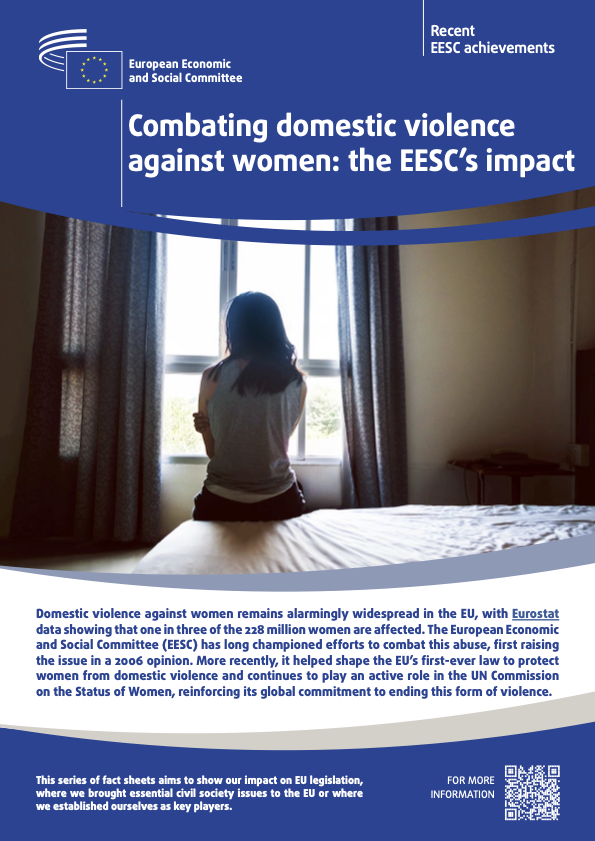
Combating Domestic Violence Against Women: The EESC’s impact

Domestic violence against women remains alarmingly widespread in the EU, with Eurostat data showing that one in three of the 228 million women are affected. The European Economic and Social Committee (EESC) has long championed efforts to combat this abuse, first raising the issue in a 2006 opinion. More recently, it helped shape the EU’s first-ever law to protect women from domestic violence and continues to play an active role in the UN Commission on the Status of Women, reinforcing its global commitment to ending this form of violence.

The first ever EU-wide legislation to fight violence against women and domestic violence.

In 2024, the EU adopted the first ever law to combat violence against women. The EESC directly contributed to this EU directive, which incorporated key provisions of our opinion:

  • a comprehensive definition of violence: the directive criminalises various forms of violence against women, such as female genital mutilation and cyber violence, aligning with the EESC’s call for a broad definition;

  • adopting an intersectional approach: the directive acknowledges the greater vulnerability of certain groups, including women with disabilities and migrant women, and calls for tailored support measures;

  • enhanced support services: the directive provides for specialised support services for victims, in line with the EESC’s emphasis on comprehensive victim support.

In addition, the EU set up the 116 016 EU-wide helpline number for victims of violence against women.

The EU directive not only criminalises various forms of violence, but also provides for the creation of victim support services and mandatory training for law enforcement, along with preventive measures such as awareness campaigns and educational programs. It also ensures cross-border cooperation and protection for victims, with legal procedures that are harmonised across EU Member States.

Member States will have until 14 June 2027 to transpose the directive into their national law and policy.

Strengthening EU measures:

The EESC recently adopted a further opinion, which identifies shortcomings in the directive and seeks to further strengthen EU-wide measures. It calls for:

  • a broader definition of violence against women (institutional violence, prostitution, chemical submission, pornography, etc.);

  • violence against women to be added to the list of EU crimes;

  • comprehensive sexuality education at all stages of education;

  • specific focus on women with disabilities and other vulnerable groups.

Taking action on the global stage

The Committee’s participation in the 69th session of the UN Commission on the Status of Women (UNCSW) provided an opportunity to reiterate the EESC’s position and recommendations on the issue of equality of women and the fight against gender-based violence. The EESC called for the direct involvement of civil society organisations in shaping national and regional plans to end violence against women. The political declaration adopted at the end of the session reaffirmed the global commitment to gender equality, including the commitment to end gender-based violence.

Looking ahead

The EESC remains committed to combating domestic violence and violence against women in general. It will continue its efforts to have newly emerging forms of violence recognised in the EU, such as ‘sexual digital forgeries’ or ‘deepfakes’. In June 2025, the EESC also adopted a resolution on Supporting the Declaration of principles for a gender-equal society, backing the European Commission’s Roadmap for Women’s Rights. This will guide the Committee’s policy agenda on gender equality in the long term.

  European Economic and Social Committee, 2025. 2p.

Origins of Mendelism

By Robert C. Olby

From the cover:

"At last, a book about genetics has been written as a science to be reckoned with. Mr. Olby, a librarian of the Cotany School, Ixford, England, has written the whole story with remarkable ease. The text has a clarity which is not found too often in a book of this kind. This is partly because of the excellent notes and bibliography at the end of each chapter. The appendixes give further proof that a book such as this has never been written before-the work cited in each chapter is quoted as originally written by the scientists doing the work in this complicated field." -Library Journal

"Significant contribution to the history of genetics.... After reading this account, one cannot but have greater esteem and appreciation for Mendel as a scientist, a mathematician, a keen observer, and a keeper of careful records. The work and lives of the early hybridists are included in an informing manner with many accounts.... A large appendix includes original findings and writings of the early hybridists. ...Laymen as well as geneticists will appreciate this book." -Choice

Copyright © 1966, 1966 by Robert C. Olby. Schocken. 1967. 209p.

Woman And Socialism

By August Bebel (Author), Colin Heston (Introduction)

August Bebel’s Woman and Socialism is one of the most influential and enduring works in the history of socialist and feminist thought. First published in 1879 as Die Frau und der Sozialismus, the book represents a groundbreaking synthesis of Marxist theory and the struggle for women’s emancipation. Bebel, a co-founder of the German Social Democratic Party and a leading figure in the international socialist movement, sought to demonstrate that the liberation of women was not only compatible with socialism but essential to its realization. His work remains a foundational text for understanding the intersection of class and gender oppression, and it continues to resonate in contemporary debates about equality, labor, and social justice.

Woman and Socialism is not merely a critique; it is also a vision of transformation. Bebel outlines how a socialist society would fundamentally alter the conditions of women’s lives. In such a society, he argues, the means of production would be collectively owned, and both men and women would participate equally in productive labor. The state would assume responsibility for many of the functions traditionally relegated to women—such as childcare, education, and elder care—thus freeing women from the confines of domestic servitude. Marriage would become a voluntary and egalitarian union, based on mutual affection rather than economic necessity.

Bebel’s work is notable for its breadth and depth. He addresses a wide range of issues, including education, reproductive rights, prostitution, and the role of women in political movements. He also engages with contemporary debates within the socialist movement, challenging those who viewed the “woman question” as secondary or divisive. For Bebel, the emancipation of women is not a peripheral concern but a central pillar of socialist theory and practice. He argues that a society cannot be truly free or just if half its population remains oppressed. Bebel explores a wide range of themes that connect the struggle for women’s emancipation with the broader goals of socialism.

Bebel’s introduction itself serves as both a historical overview and a political manifesto. It invites readers to reconsider the roots of gender inequality and to imagine a future in which social and economic structures support, rather than hinder, human flourishing. Bebel’s synthesis of feminism and socialism was ahead of its time, and his insistence on the inseparability of class and gender struggles remains a powerful and relevant message. His work continues to inspire activists, scholars, and readers committed to building a more equitable world.

There are a number of editions and translations each edition slightly different. For example, sometime the title is written as Woman Under Socialism. The extensive use of tables of statistics also varies form one edition to another. This edition has been reformatted, designed, abridged and annotated with an Introduction by renowned novelist and story writer Colin Heston to remove errors and other distracting content that occurred in the original edition, making the book more accessible for the present day reader.

Read-Me.Org Inc. New York-Philadelphia-Australia. 2025. 359p.

The Long View: Papers and Addresses

By Mary E. Richmond

“The Long View” serves both as a historical document and as a critique of the limitations and challenges facing social work in the early 20th century. The title itself suggests her forward-thinking approach, urging practitioners to consider the long-term effects of their interventions rather than focusing solely on immediate relief. In this sense, the book represents a call for a more holistic and preventive approach to social work rather than a reactive or crisis-driven model. A key strength of her work is Richmond’s insistence on the importance of professionalization in social work. She argues for a rigorous, research-informed approach to casework, emphasizing the need for training, standardization, and ethical responsibility. This argument anticipates later debates in the field about the tension between bureaucratic efficiency and personalized, client-centered care. Richmond’s work in this book also highlights her concern with the social and structural determinants of poverty, distinguishing her from social workers who focus primarily on individual moral failings.

Originally published 1930 Russell Sage Fdn. Read-Me.Org Inc. 2025. 411p.

The Second Twenty Years at Hull-House

By Jake Addams

Social Service and Progressive Party: The document discusses the role of Hull-House in social reform and its connection to larger movements,including the Progressive Party and various social surveys.

Efforts for Peace: It highlights efforts for peace during World War I,including the Woman's International Peace Congress and the FordPeace Ship.

Immigration and Quota Acts: The document examines the impact of immigration policies and quota acts on families and communities,emphasizing the challenges faced by immigrants.

Education and Integration: It underscores the importance of education in integrating immigrants and the role of settlements in providing educational opportunities.

Macmillan, 1930, 413 pages

The Sexual Politics of Meat: A Feminist-Vegetarian Critical Theory

May Contain Markup

By Carol J. Adams

Feminist-Vegetarian Connection: The book explores the interconnections between feminism and vegetarianism, arguing that both movements challenge patriarchal structures and the oppression of animals and women.

Patriarchal Culture: It discusses how patriarchal culture authorizes the eating of animals and links this to male dominance and control.

Historical Context: The book provides a historical analysis of vegetarianism and its ties to feminist movements, particularly from the1790s to the present.

Cultural Critique: It critiques how meat consumption is embedded in cultural norms and language, reinforcing gender roles and violence.

Continuum, 2000, 256 pages