Open Access Publisher and Free Library
SOCIAL SCIENCES.jpeg

SOCIAL SCIENCES

Social sciences examine human behavior, social structures, and interactions in various settings. Fields such as sociology, psychology, anthropology, and economics study social relationships, cultural norms, and institutions. By using different research methods, social scientists seek to understand community dynamics, the effects of policies, and factors driving social change. This field is important for tackling current issues, guiding public discussions, and developing strategies for social progress and innovation.

Posts in social sciences
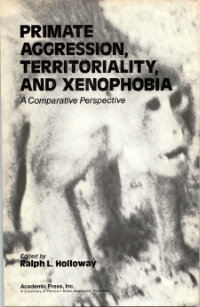
Primate Aggression, Territoriality, And Xenophobia: A Comparative Perspective

Edited By Ralph L. Holloway

From the Cover: This book is a truly wide-ranging comparative account of primate aggression. It covers the a gressive behavior of all primate taxa - from tree shrews to man - and incorporates not only social, behavioral, and physiological (i.e., endo- crinological and neurological) data, but also the broader ecological and evolutionary approaches. Each contributor is active in research in hisfield, and each fully develops his own particular view- point rather than attempting an artificial "syn- thesis of the whole field. The book will be of great interest and value to those in all of the behavioral sciences, e.g., psychobiology, anthropology, primatology, eth- ology, and psychology, as well as those in many of the life sciences, such as neurobiology, endocrinology, and zoology.

NY. Academic Press. 1974. 509p. CONTAINS MARK-UP.

READ
Antisemitism in North America: New World, Old Hate

Edited by Steven K. Baum, Neil J. Kressel, Florette Cohen-Abady and Steven Leonard Jacobs

In Antisemitism in North America, leading scholars offer a wide variety of perspectives on why the Jews in North America have sometimes faced considerable bigotry but have, in general, found a home far more hospitable than the ones they left behind in Europe. ; Readership: Those who are interested in a scholarly understanding of prejudice antisemitism, Jewish studies, hate studies, religious studies, cultural studies, Holocaust and genocide studies, social psychology and social sciences.

Leiden; Boston:  Brill: 2016. 476p.

download
Ideology and Utopia: An Introduction to the Sociology of Knowledge

By Karl Mannheim

Translated from the German by Louis Wirth and Edward Shils. From the Preface: The original German edition of Ideology and Utopia ap. peared in an atmosphereof acute intellectual tension marked by widespread discussion which subsided only with the exile or enforced silence of those thinkers who sought an honest and tenable solution to the problems raised. Since then the conflicts which in Germany led to the destruction of the liberal Weimar Republic have been felt in various countries all over the world, especially in Western Europe and the United States. The intellectual problems which at one time were considered the peculiar preoccupation of German writers have enveloped virtually the whole world. What was once regarded as the esoteric concern of a few intellectuals in a single country has become t h ecommon plight of the modern man.In response to this situation there has arisen an extensive literature which speaks of the "end," the "decline," the " crisis," the " decay," or the " death " of Western civilization. But despite the alarm….

NY. Harcourt Brace Jovanovich. 1936. 381p. CONTAINS MARK-UP

read
Narkomania: Drugs, HIV, and Citizenship in Ukraine

By Jennifer J. Carroll

Against the backdrop of a post-Soviet state set aflame by geopolitical conflict and violent revolution, Narkomania considers whether substance use disorders are everywhere the same and whether our responses to drug use presuppose what kind of people those who use drugs really are. Jennifer J. Carroll's ethnography is a story about public health and international efforts to quell the spread of HIV. Carroll focuses on Ukraine where the prevalence of HIV among people who use drugs is higher than in parts of sub-Saharan Africa and unpacks the arguments and myths surrounding medication-assisted treatment (MAT) in Ukraine. What she presents in Narkomania forces us to question drug policy, its uses, and its effects on "normal" citizens. Carroll uses her findings to explore what people who use drugs can teach us about the contemporary societies emerging in post-Soviet space. With examples of how MAT has been politicized, how drug use has been tied to ideas of "good" citizenship, and how vigilantism towards people who use drugs has occurred, Narkomania details the cultural and historical backstory of the situation in Ukraine. Carroll reveals how global efforts supporting MAT in Ukraine allow the ideas surrounding MAT, drug use, and HIV to resonate more broadly into international politics and echo into the heart of the Ukrainian public.

Ithaca, NY: Cornell University Press, 2019. 251p.

download
Totemism

By Claude Levi-Strauss

From the cover: 'This work is significant not only for students of anthropolgy but for students of philosophy and psychology as well. The distinguished anthropologist Claude Lévi-Strauss examines here the great variety of beliefs encompassed by totemism, the attacks to which it has been subject, and the constant attempts to restore useful meaning to it. His account deals with the views of such renowned anthropologists as Boas, van Gennep, Elkin, Fortes, Firth, Evans-Pritchard, and Radcliffe- Brown; it also brings to light some neglected observations by Bergson and Rousseau. In reviewing the major theories about totemism, the author notes that ti has gradually come to be understood not as a distinctive institution, but as a way of thinking which is as characteristic of our own thinking as it is of the "primitives" for whom totemism was an integral part of life.

London. Beacon Press. 1963. 120p . CONTAINS MARK-UP.

read
Marginal People in Deviant Places: Ethnography, Difference, and the Challenge to Scientific Racism

By Janice M. Irvine

Marginal People in Deviant Places revisits early- to mid-twentieth-century ethnographic studies, arguing that their focus on marginal subcultures—ranging from American hobos, to men who have sex with other men in St. Louis bathrooms, to hippies, to taxi dancers in Chicago, to elderly Jews in Venice, California—helped produce new ways of thinking about social difference more broadly in the United States. Irvine demonstrates how the social scientists who told the stories of these marginalized groups represented an early challenge to then-dominant narratives of scientific racism, prefiguring the academic fields of gender, ethnic, sexuality, and queer studies in key ways. In recounting the social histories of certain American outsiders, Irvine identifies an American paradox by which social differences are both despised and desired, and she describes the rise of an outsider capitalism that integrates difference into American society by marketing it.

Ann Arbor, MI: University of Michigan Press, 2022. 349p.

download
Antiracism Inc. Why the Way We Talk about Racial Justice Matters

Edited by Felice Blake Paula Ioanide and Alison  Reed

"Antiracism Inc. traces the ways people along the political spectrum appropriate, incorporate, and neutralize antiracist discourses to perpetuate injustice. It also examines the ways organizers continue to struggle for racial justice in the context of such appropriations. Antiracism Inc. reveals how antiracist claims can be used to propagate racism, and what we can do about it. While related to colorblind, multicultural, and diversity discourses, the appropriation of antiracist rhetoric as a strategy for advancing neoliberal and neoconservative agendas is a unique phenomenon that requires careful interrogation and analysis. Those who co-opt antiracist language and practice do not necessarily deny racial difference, biases, or inequalities. Instead, by performing themselves conservatively as non-racists or liberally as ‘authentic’ antiracists, they purport to be aligned with racial justice even while advancing the logics and practices of systemic racism. Antiracism Inc. therefore considers new ways of struggling toward racial justice in a world that constantly steals and misuses radical ideas and practices. The collection focuses on people and methods that do not seek inclusion in the hierarchical order of gendered racial capitalism. Rather, the collection focuses on aggrieved peoples who have always had to negotiate state violence and cultural erasure, but who work to build the worlds they envision. These collectivities seek to transform social structures and establish a new social warrant guided by what W.E.B. Du Bois called “abolition democracy,” a way of being and thinking that privileges people, mutual interdependence, and ecological harmony over individualist self-aggrandizement and profits. These aggrieved collectivities reshape social relations away from the violence and alienation inherent to gendered racial capitalism, and towards the well-being of the commons. Antiracism Inc. articulates methodologies that strive toward freedom dreams without imposing monolithic or authoritative definitions of resistance. Because power seeks to neutralize revolutionary action through incorporation as much as elimination, these freedom dreams, as well as the language used to articulate them, are constantly transformed through the critical and creative interventions stemming from the active engagement in liberation struggles."

Brooklyn, NY: Punctum Books, 2019. 382p.

download
Post-Digital Cultures of the Far Right: Online Actions and Offline Consequences in Europe and the US

Edited by Maik Fielitz and Nick Thurston

How have digital tools and networks transformed the far rights strategies and transnational prospects? This volume presents a unique critical survey of the online and offline tactics, symbols and platforms that are strategically remixed by contemporary far-right groups in Europe and the US. It features thirteen accessible essays by an international range of expert scholars, policy advisors and activists who offer informed answers to a number of urgent practical and theoretical questions: How and why has the internet emboldened extreme nationalisms? What counter-cultural approaches should civil societies develop in response?How have digital tools and networks transformed the far rights strategies and transnational prospects? This volume presents a unique critical survey of the online and offline tactics, symbols and platforms that are strategically remixed by contemporary far-right groups in Europe and the US. It features thirteen accessible essays by an international range of expert scholars, policy advisors and activists who offer informed answers to a number of urgent practical and theoretical questions: How and why has the internet emboldened extreme nationalisms? What counter-cultural approaches should civil societies develop in response?How have digital tools and networks transformed the far rights strategies and transnational prospects? This volume presents a unique critical survey of the online and offline tactics, symbols and platforms that are strategically remixed by contemporary far-right groups in Europe and the US. It features thirteen accessible essays by an international range of expert scholars, policy advisors and activists who offer informed answers to a number of urgent practical and theoretical questions: How and why has the internet emboldened extreme nationalisms? What counter-cultural approaches should civil societies develop in response?

Bielefeld, Germany:  transcript Verlag, 2019. 210p.

download
The Clash of Civilizations: Remaking of World Order

By Samuel P. Huntington

From the Preface: “In the summer of 1993 the journal Foreign Affairs published an article of mine titled “The Clash of Civilizations?”. That article, according to the Foreign Affairs editors, stirred up more discussion in three years than any other article they had published since the 1940s. It certainly stirred up more debate in three years than anything else I have written. The responses and comments on it have come from every continent and scores of countries. People were variously impressed, intrigued, outraged, frightened, and perplexed by my argument that the central and most dangerous dimension of the emerging global politics would be conflict between groups from differing civilizations. Whatever else it did, the article struck a nerve in people of every civilization.

Given the interest in, misrepresentation of, and controversy over the article, it seemed desirable for me to explore further the issues it raised. One construc­tive way of posing a question is to state an hypothesis. The article, which had a generally ignored question mark in its title, was an effort to do that. This book is intended to provide a fuller, deeper, and more thoroughly documented answer to the articles question…”

NY. Touchstone. 1996. 350p. CONTAINS MARK-UP

read
Artificial Intelligence Index Report 2023

By Stanford University. Human-Centered Artificial Intelligence

From the document: "Welcome to the sixth edition of the AI [artificial intelligence] Index Report! This year, the report introduces more original data than any previous edition, including a new chapter on AI public opinion, a more thorough technical performance chapter, original analysis about large language and multimodal models, detailed trends in global AI legislation records, a study of the environmental impact of AI systems, and more. The AI Index Report tracks, collates, distills, and visualizes data related to artificial intelligence. Our mission is to provide unbiased, rigorously vetted, broadly sourced data in order for policymakers, researchers, executives, journalists, and the general public to develop a more thorough and nuanced understanding of the complex field of AI. The report aims to be the world's most credible and authoritative source for data and insights about AI."

Stanford University. 2023. 386p.

download
Antisemitism Worldwide Report for 2022

By Anti-Defamation League

From the document: "The Antisemitism Worldwide Report for 2022 informs of both increases and decreases, some more meaningful than others, in the number of antisemitic incidents in different countries. The United States, where the largest Jewish minority in the world lives, saw a particularly alarming rise in anti-Jewish violence and slander. These data are not encouraging. The record-levels of 2021 were attributed in part to the exceptional social tensions created by the Covid-19 epidemic and the political tensions created by the Guardian of the Walls operation in Gaza. The data for 2022 suggest that the motivations for present-day antisemitism are not transient as some may have hoped. Despite the investment of substantial legal, educational, and political efforts, thousands of antisemitic incidents took place across the globe in 2022, including hundreds of physical assaults. Everyone who cares about human dignity and justice must recognize the need to prevent this reality from becoming normalized."

Tel-Aviv. University. Kantor Center For The Study Of Contemporary European Jewry; 2023. 86p.

download
Catharsis in Healing, Ritual and Drama

By T.J. Scheff

From the preface: “About nine years ago, after a decade of research on mental hospitals, I became convinced by the flaws I saw in existing programs that any system of treatment would be incomplete if it were based entirely upon professional therapists. Such a system, I thought, would need to be augmented by the development of a large group of lay therapists. These therapists would be trained and supervised by professionals. I had in mind relatively brief, simple training and supervision. My thought was that lay therapists coulddeal with many of the most frequently occurring types of emotional crises. Under these conditions, mental health professionals could be used as specialists, particularly as trainers and supervisors, and as therapists only for complex, difficult, or intractable cases…”

Berkeley. University Of California Press . 1979. 246p. This book contains mark-up

read
Gill's Journey: The Tattooist of Auschwitz

By Heather Morris

London. Echo Publishing. 2019. 441p.

The novel tells the story of Gill, a young woman who is transported to Auschwitz along with her family. While in the camp, she meets Lale, who becomes her tattooist and develops a romantic relationship with her. The novel follows Gill and Lale's struggles to survive in the harsh conditions of the camp, as well as their efforts to maintain their humanity and hold on to hope in the face of unimaginable suffering.

Through the character of Gill, the novel explores the experiences of women in the concentration camp system, including their vulnerability to sexual violence and exploitation. It also highlights the role of resistance and solidarity among prisoners, as well as the courage and resilience of those who fought for survival and dignity in the face of extreme adversity.

read
Endeavour: The ship and the attitude that changed the world.

By Peter Moore.

Sydney. Penguin. 2018. 438p.

Moore provides a detailed account of the construction and design of the Endeavour, as well as the scientific instruments and equipment carried on board. He describes Cook's journey to Tahiti to observe the transit of Venus, and his subsequent exploration of the Pacific, including the discovery of New Zealand and the east coast of Australia.

The book also explores the social and cultural dimensions of Cook's voyage, including the encounters between European explorers and the indigenous peoples of the Pacific. Moore discusses the impact of Cook's voyage on European perceptions of the world and the development of scientific knowledge, including the study of botany, astronomy, and geography.

Throughout the book, Moore emphasizes the importance of the Endeavour as a symbol of the scientific and technological advances of the 18th century, and the spirit of curiosity and exploration that drove Cook and his crew. He also discusses the legacy of Cook's voyage and its impact on the history of the Pacific region.

read
Fall of the Ottomans: The great war in the Middle East

By Eugene Rogan

NY. Basic Books. 2015. 504p.

Rogan begins by describing the state of the Ottoman Empire on the eve of World War I, including its political, economic, and military weaknesses. He then examines the Ottoman Empire's decision to enter the war on the side of Germany, and the subsequent military campaigns in the Middle East, including the battles of Gallipoli, Kut, and Gaza.

The book also explores the political and social consequences of the war in the Middle East, including the emergence of nationalist movements and the rise of new states such as Turkey, Iraq, and Syria. Rogan discusses the impact of the war on religious and ethnic minorities in the region, including the Armenians, Assyrians, and Kurds, who suffered greatly during the conflict.

Throughout the book, Rogan emphasizes the complexity of the Middle Eastern theater of World War I, including the diverse range of actors involved and the multiple layers of conflict and rivalry. He also highlights the impact of the war on the wider geopolitical landscape of the region, including the role played by European powers such as Britain and France in shaping the post-war order.

read
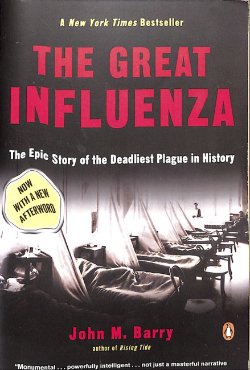
The Great Influenza: The epic story of the deadliest plague in history

By John M. Barry

London.. Penguin. 2005. 554p.

Barry provides a detailed account of the pandemic, including its origins, spread, and impact on various parts of the world. He explores the scientific and medical aspects of the pandemic, including the efforts of doctors and researchers to understand and control the disease.

The book also examines the social and political dimensions of the pandemic, including the ways in which it affected the course of World War I and the response of governments and public health officials to the crisis. Barry discusses the role of media coverage in shaping public perceptions of the pandemic and the response to it.

Throughout the book, Barry emphasizes the human toll of the pandemic, highlighting the stories of individual victims and their families. He also explores the long-term impact of the pandemic on society, including its influence on medical research, public health policy, and the development of the modern healthcare system.

read
On Pandemics: Deadly diseases from Bubonic Plague to Coronavirus

By Daic Walter-Toews

Carlton Aus. Schwartz Books. 2020. 270p

Waltner-Toews argues that pandemics are not just medical crises, but also social, economic, and political events that have profound effects on human societies. He examines the ways in which pandemics have shaped human history, from the Black Death in the 14th century to the Spanish Flu in the early 20th century.

The book also explores the scientific and medical aspects of pandemics, including the biology of the viruses and bacteria that cause them, as well as the challenges of developing effective treatments and vaccines. Waltner-Toews discusses the role of public health interventions, such as quarantine and social distancing measures, in controlling the spread of pandemics.

In addition, the book examines the social and cultural responses to pandemics, including the ways in which they have been represented in art, literature, and popular culture. Waltner-Toews also explores the political and economic dimensions of pandemics, including the impact of pandemics on trade, travel, and global politics.

Throughout the book, Waltner-Toews emphasizes the need for a One Health approach to pandemics, which recognizes the interconnectedness of human, animal, and environmental health. He argues that pandemics are a reminder of the importance of protecting and promoting the health of all living beings, and that we must work together to prevent and control future pandemics.

read
The Fatal Impact: An account of the invasion of the South Pacific 1767-1840

By Alan Moorehead

London. Penguin. 1966. 289p.

Moorehead argues that the arrival of Europeans had a catastrophic impact on the indigenous peoples of the South Pacific, leading to the destruction of traditional cultures, the loss of land and resources, and widespread disease and violence. He examines the motivations of the European explorers and colonizers, as well as the impact of their actions on the people and societies they encountered.

The book begins with the arrival of the British navigator Samuel Wallis in Tahiti in 1767, and follows the subsequent voyages of other explorers, including James Cook, Jean-Francois de La Perouse, and William Bligh. Moorehead describes how these explorers brought with them new technologies, ideas, and diseases, and how they often saw the indigenous peoples they encountered as primitive and inferior.

Moorehead also explores the impact of European colonization on the South Pacific, focusing on the experiences of the Maori people in New Zealand and the Aborigines in Australia. He describes how these peoples were forced to adapt to a new way of life, and how they often suffered from violence, disease, and displacement as a result of European settlement.

read
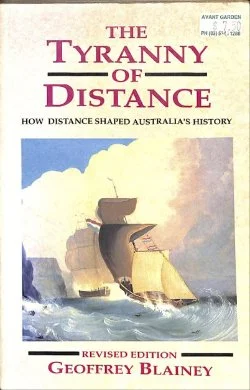
The Tyranny of Distance: How distance shaped Australian history.

By Geoffrey Blainey

Australia. Sun Books. 1966. 206p.

Blainey argues that the tyranny of distance has been a defining characteristic of Australian history, impacting everything from exploration and settlement to politics and economics. He notes that Australia is the most isolated continent on earth, and that its distance from other major world powers has both insulated it from external threats and limited its opportunities for growth and development.

The book traces the history of Australia from its earliest days as a British penal colony to its emergence as a modern, prosperous nation. Blainey examines the challenges that early settlers faced in adapting to a harsh and unfamiliar landscape, as well as the role that transportation and communication technologies played in bridging the vast distances between Australia and the rest of the world.

Blainey also explores how distance has shaped Australian identity and culture, arguing that it has fostered a sense of self-reliance and resilience in the face of adversity. He notes that Australians have often had to rely on their own ingenuity and resourcefulness to overcome the challenges posed by their isolation, and that this has helped to forge a distinct national character.

Overall, "The Tyranny of Distance" is a thought-provoking and insightful exploration of how geography has influenced the course of Australian history. It offers a unique perspective on the challenges and opportunities that come with living in a remote and isolated part of the world, and sheds light on the ways in which these factors have shaped Australian society and culture over time.

read
What happened on the Bounty

By Bengt Danielsson. Trans. Alan Topull

London. Allen and Unwin. 1962. 221p.

In April 1789, the Bounty left Tahiti to begin its journey back to England. However, just a few weeks into the voyage, the crew mutinied against Captain Bligh. The reasons for the mutiny are complex and have been the subject of much debate and speculation over the years. Some have suggested that it was due to Bligh's harsh treatment of the crew, while others have argued that it was a result of tensions between the officers and the lower-ranked crew members.

Regardless of the reasons, the mutiny was successful, and Bligh and a small group of loyal crew members were set adrift in a small boat while the mutineers, led by Fletcher Christian, took control of the ship. Bligh and his companions were eventually rescued after a harrowing journey across thousands of miles of open ocean.

Danielsson's book provides a first-hand account of the events leading up to the mutiny, as well as the aftermath. He describes the tensions between the crew members and the officers, and the growing discontent that eventually boiled over into mutiny. He also offers insights into the culture and customs of the Tahitian people, who were encountered by the crew during their stay on the island.

Overall, "On the Bounty" is a fascinating and engaging account of one of the most famous episodes in maritime history, written by someone who was there to witness it firsthand.

read