Open Access Publisher and Free Library
TERRORISM.jpeg

TERRORISM

Terrorism-Domestic-International-Radicalization-War-Weapons-Trafficking-Crime-Mass Shootings

Posts in criminal justice
The Second Amendment on Board: Public and Private Historical Traditions of Firearm Regulation

By Joshua Hochman

 In New York State Rifle & Pistol Association v. Bruen, the Supreme Court reaffirmed that laws prohibiting the carrying of firearms in sensitive places were presumptively constitutional. Since Bruen, several states and the District of Columbia have defended their sensitive-place laws by analogizing to historical statutes regulating firearms in other places, like schools and government buildings. Many judges, scholars, and litigants appear to have assumed that only statutescan count as evidence of the nation’s historical tradition of firearm regulation. This Note is the first expansive account since Bruen to challenge this assumption. It argues that courts should consider sources of analogical precedent outside of statutory lawmaking when applying the Court’s Second Amendment jurisprudence. Taking public transportation as a case study, the Note surveys rules and regulations promulgated by railroad corporations in the nineteenth century and argues that these sources reveal a historical tradition of regulating firearm carriage on public transportation. Bruen permits courts to engage in more nuanced analogical reasoning when dealing with unprecedented concerns or dramatic changes. One such change is the shift in state capacity that has placed sites that were privately or quasi-publicly operated before the twentieth century under public control in the twenty-first century. As in the case of schools, which the Court has already deemed sensitive, a substantial portion of the nation’s transportation infrastructure in the nineteenth century was not entirely publicly owned and operated. For this reason, courts should consider evidence of historical firearm regulations enacted not just by legislatures but by quasi-public or private corporations. This case study instructs that courts and litigants can best honor Bruen’s history-based test by considering all of the nation’s history of firearm regulation.

Yale Law Review,  133:1676 2024
The Case for More Equitable and Community-Engaged Research to Address FirearmRelated Violence in Black and Brown Communities 

By Shani Buggs, Sheyla Delgado, Jocelyn Fontaine, Stephanie Hawkins, Talib Hudson, Tanya Sharpe

This report makes the case for the importance of more equitable and community-engaged research to address gun violence and the need to invest in and grow the field of Black, Brown, and historically underrepresented scholars committed to centering equity in the research process.

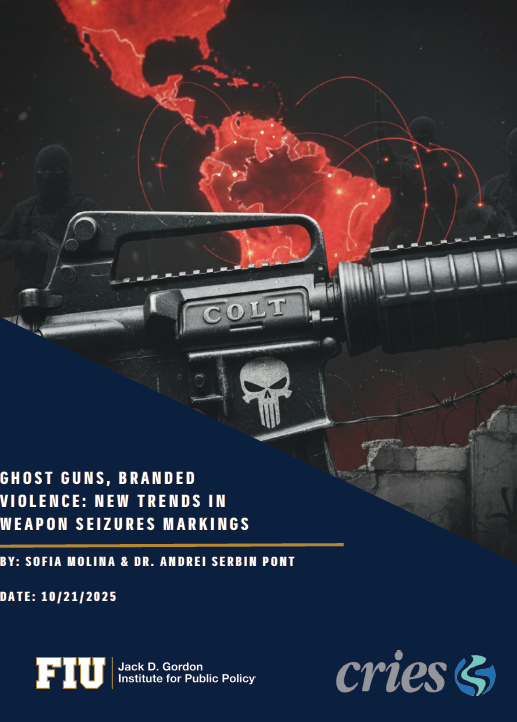
Ghost Guns, Branded Violence: New Trends in the Weapons Seizures Markings

By Sofia Molina, Andrei Serbin Pont

The enduring proliferation of illicit Small Arms and Light Weapons (SALW) remains a critical factor in the security and stability challenges facing Latin America. These armaments fuel organized crime, exacerbate violence, and empower non-state armed actors, thereby undermining governance and public safety. The foundational analysis presented by Andrei Serbin Pont and Alex Miller in the "Small Arms and Light Weapons Black Markets in Latin America" story map established a comprehensive framework for understanding these dynamics (Serbin Pont & Miller, 2022). This report builds upon that essential work, leveraging a new database of open-source seizure incidents to provide a current and granular update on the state of the illicit arms market.

The data analyzed, derived from police operations and journalistic reports compiled in the SALW dashboard from Brazil, Argentina, Panama, and Guatemala, reveals a market that is not only robust but also increasingly sophisticated and adaptive. A rigorous examination of the new dataset uncovers two significant phenomena that represent an evolution in the illicit arms trade. First, there is a proliferation of fake Colt markings on assault rifles. Second, the presence of other specific markings such as the "Punisher" skull, on seized firearms introduces another layer of analysis, indicating that weapons are not merely tools of violence but are also powerful symbols of criminal identity and ideology.

Miami: Florida International University, 2025. 9p.

Firearm access, storage practices, and suicide risk factors among Colorado adults during 2020–2022

By Leslie M. Barnard , Wei Perng ,, Ashley Brooks-Russell,, Talia L. Spark,

Background: Firearms are the most common and lethal method of suicide. Previous studies showed that households with firearms have a higher risk of suicide. It is unclear whether this is due to higher underlying risk of suicide among groups who have firearms or those who store their firearms securely. Methods: This cross-sectional analysis used Colorado Behavioral Risk Factor Surveillance System data from the period 2020–2022, which is weighted to represent the Colorado population. We used survey-weighted Poisson regression to calculate adjusted prevalence ratios (aPR) for associations of selected suicide risk factors (depressive disorder, excessive alcohol use, poor mental health, poor physical health) with firearm presence and storage practices. Results: One-third (36.5%; 95% CI: 35.8–37.7) of respondents said that they kept at least one firearm in/around their home; of those, 15.0% (95% CI 13.8–16.2) said at least one firearm was loaded and unlocked. Overall, 13.7% (95% CI 13.0–14.4) of adult Colorado residents reported poor mental health, 9.5% (95% CI 8.9–10.0) reported poor physical health, 20.4% (95% CI 19.6–21.2) reported a depressive disorder, and 30.5% (95% CI 29.4–31.7) reported excessive alcohol use. Only excessive alcohol use was more common among those keeping a firearm in/around the home compared to those not doing so (aPR 1.09 [95% CI 1.01–1.17]), and none were associated with unsecure firearm storage. Conclusions: These findings suggest that the association between household firearms and suicide is not explained by an increase in suicidality among those with firearms but rather may be explained by the presence or unsecure storage of a firearm.

2025, Academia Mental Health and Well-Being Volume 2; Issue 4