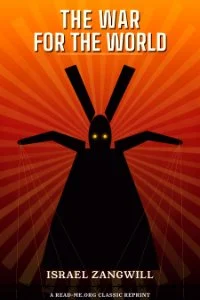
by Israel Zangwill (Author), Graeme R. Newman (Introduction)
A forgotten wartime witness from the author of Children of the Ghetto
In the summer of 1916, with Europe two years into a war that had already devoured a generation, Israel Zangwill — one of the most celebrated and contentious literary voices of his day — sat down to argue with his moment. The War for the Worldis the result: forty-six essays, poems, and public letters that refuse every easy wartime position on offer.
Zangwill was no propagandist. A lifelong admirer of German culture forced to reckon with German militarism, he wrote as a man arguing with himself as much as with his readers — skeptical of slogans from every side, unable to leave a comfortable opinion alone when it could be pushed to its uncomfortable conclusion.
Inside this collection:
The mechanics and psychology of modern warfare, from the armaments trade to the illusions of security through escalation
Sharp, often self-implicating essays on British and German militarism alike
Culture conscripted for war — the stage, the novel, even the slogan, examined as propaganda in disguise
The wartime suffrage movement, and what happens when a nation asks its women to labor for a vote it still won't give them
Urgent, anguished reporting on Jewish communities caught between empires at war — conscripted into armies that, in Russia's case, were also complicit in pogroms against their own families
Written with the same close observation that made Children of the Ghetto a landmark of its era, The War for the Worldis Zangwill at his most combative and most human — a writer refusing to let wartime do his thinking for him.
About this edition: This Read-Me.Org Classic Reprint has been newly typeset from a digitized copy of the 1916 Macmillan first edition held by HathiTrust, with OCR correction and light editorial standardization for the modern reader.
Read-Me.Org Inc. New York-Philadelphia-Australia. 2026. p245.