
Open Access Publisher and Free Library
TERRORISM.jpeg

TERRORISM

Terrorism-Domestic-International-Radicalization-War-Weapons-Trafficking-Crime-Mass Shootings

Posts tagged cybercrime
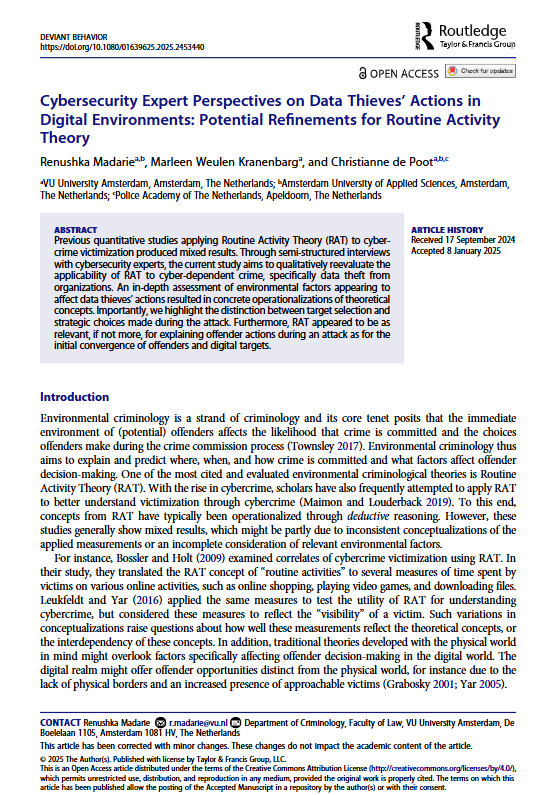
Cybersecurity Expert Perspectives on Data Thieves’ Actions in Digital Environments: Potential Refinements for Routine Activity Theory

By Renushka Madarie, Marleen Weulen Kranenbarg&Christianne de Poot


Previous quantitative studies applying Routine Activity Theory (RAT) to cybercrime victimization produced mixed results. Through semi-structured interviews with cybersecurity experts, the current study aims to qualitatively reevaluate the applicability of RAT to cyber-dependent crime, specifically data theft from organizations. An in-depth assessment of environmental factors appearing to affect data thieves’ actions resulted in concrete operationalizations of theoretical concepts. Importantly, we highlight the distinction between target selection and strategic choices made during the attack. Furthermore, RAT appeared to be as relevant, if not more, for explaining offender actions during an attack as for the initial convergence of offenders and digital targets.


DEVIANT BEHAVIOR 2025

Social Opportunity Structures in Hacktivism: Exploring Online and Offline Social Ties and the Role of Offender Convergence Settings in Hacktivist Networks 

 By Marco Romagna & Rutger Erik Leukfeldt  

  Hacktivism represents the promotion in the cyber landscape of ideologically motivated agendas using hacking techniques. Despite research on the topic has provided some clues on how hacktivist networks develop, the processes behind their evolution remain mostly unknown. This gap in the literature prompted us to research the role of online/offline social relationships and of the offender convergence settings in the creation, recruitment process and development of hacktivist networks. This study is based on 30 interviews with hacktivists, and it uses the social opportunity structures framework to analyze the development of 21 hacktivist networks. The results show that said networks can be divided in sub-categories based on the type of connections used to create them. Online social relationships and online convergence settings (particularly social media platforms and IRC channels) seem to play a key role in the development of hacktivist networks, while offline contacts are limited. For the recruitment process, hacktivists use comparable strategies to any organization, but three different categories were identified when discussing

VICTIMS & OFFENDERS Published online: 01 Jul 2024

The evolving nexus of cybercrime and terrorism: A systematic review of convergence and policy implications

By Shai Farber

  This systematic review unveils significant convergence between cybercriminals and terrorists over the past decade, characterized by substantial overlap in tactics, capabilities, and infrastructure exploitation. Key findings illuminate the adoption of cybercriminal methods by terrorist organizations, the engagement of cybercriminal groups in terrorist activities, the proliferation of enabling technologies such as cryptocurrencies and the dark web, and the role of social media in facilitating knowledge exchange between diverse threat actors. While direct terrorist involvement in proftdriven cybercrime appears limited, the escalating convergence underscores urgent imperatives for enhanced cooperation, legal refinement, the establishment of flexible counter-threat authorities, and collaboration with the private sector. Continuous monitoring of this rapidly evolving landscape is crucial to inform effective policies and interventions in an increasingly interconnected digital world.

Security Journal (2025), 23p.

Digital Weaponry of Radicalisation: AI and the Recruitment Nexus

SHAH, MARIAM

The following excerpt from the document contains multiple links embedded in the original text: "Islamic State (IS) recently released a powerful recruitment message for 'distracted Muslim youth' to travel and join IS territories across the world. It highlights a disturbing trend in how terrorist organisations are using technology to recruit and mobilise members through a single message. It also shows that contemporary terror groups and extremist organisations are adapting fast to emerging technologies. This Insight aims to highlight an alarming reality: the exploitation of Artificial Intelligence (AI) technology by terrorist and violent extremist groups to strengthen recruitment efforts. These groups proficiently manipulate online platforms, leveraging sophisticated AI tools to disseminate tailored propaganda content to exploit psychological vulnerabilities and amplify divisive narratives, thereby fostering radicalisation and recruitment. From using encrypted messaging apps like Telegram and WhatsApp to seeking refuge in the anonymity of the Dark Web, these groups employ various tactics to evade AI detection and exploit vulnerabilities. By leveraging AI tools, these groups engage in personalised messaging, rapid distribution, and exploitation of social media algorithms to amplify their reach and influence susceptible individuals."

GLOBAL NETWORK ON EXTREMISM AND TECHNOLOGY (GNET). 4 JUL, 2024. 8p.