

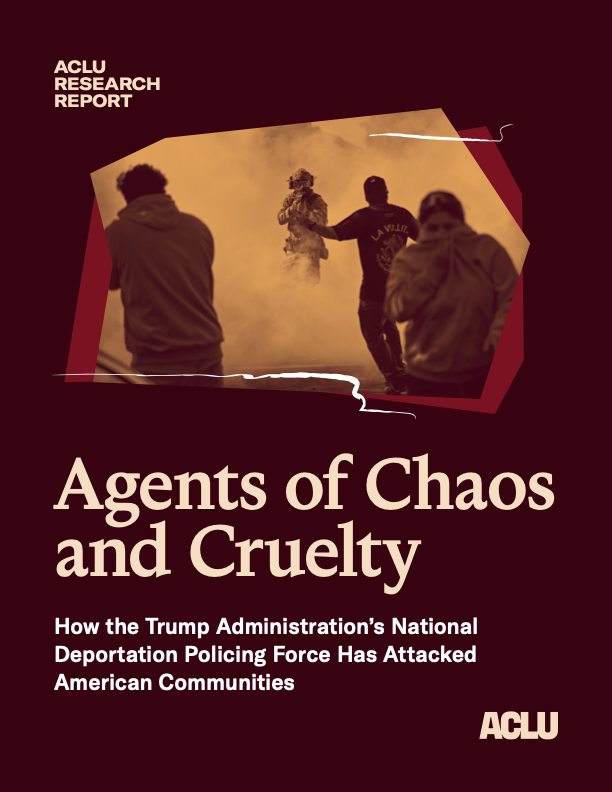
By American Civil Liberties Union
This ACLU research report, Agents of Chaos and Cruelty, documents widespread civil rights violations carried out by immigration agents during the first year of President Trump’s second term. The report examines immigration enforcement incidents in eight states – representing a cross-section of the country and reflecting varying degrees of federal law enforcement presence and personnel surges – and found that over 400 of the more than 1,200 immigration enforcement incidents examined involved misconduct by immigration agents. The report ends with detailed recommendations urging policymakers to call for transformative change to our immigration system, in recognition that it is broken and dangerous to human rights.
By Rashad James
For community advocates, policymakers, and law enforcement agencies (LEAs) interested in exploring alternatives, this document outlines how federal immigration authorities can—and cannot—compel state and local LEAs to cooperate. It also proposes four strategies that state and local jurisdictions can adopt to resist the growing push for a uniform law enforcement system under executive authority. Specifically, jurisdictions can 1) name the actions currently underway; 2) claim their moral vision through proactive legislation; 3) restrain the use of local funding for immigration enforcement; and 4) reframe these initiatives as measures that strengthen public safety. Community members and elected leaders are encouraged to share this document as a pathway toward a more just and equitable future.
By The American Immigration Council
Across several presidential administrations, the federal government has used American businesses to enforce immigration law through worksite enforcement. Worksite-specific immigration enforcement encompasses a wide variety of activities, including criminal investigations, business audits, and administrative arrests.1 This includes high-profile operations primarily conducted by U.S. Immigration and Customs Enforcement (ICE), where the agency targets one or more businesses to both investigate employers and to arrest employees as a means to deter unauthorized employment. While there is not a common term used for this tactic, it is often referred to as worksite or workplace immigration “enforcement action” or “raid.”2 This factsheet provides a brief history of worksite raids, discusses the agencies involved and the legal authorities relied upon by these agencies to conduct them, reviews legal challenges and issues related to worksite raids, and briefly summarizes the economic and humanitarian consequences of these raids.
By: Christian Ambrosius Juliana Quigua Andrea Velásquez
By 2020, one in four Salvadorans lived abroad, with 88 percent residing in the United States. The remittances to GDP ratio was about 25 percent, highlighting the country’s dependence on migration. This paper examines the effects of a major U.S. immigration enforcement program—Secure Communities—on migration and labor market outcomes in El Salvador. Using a shift-share identification strategy, we find that larger exposure to the program decreases the likelihood that a household includes a migrant, consistent with increased forced returns. These effects lead to lower income among male workers, particularly low-educated, informal workers, and those in agriculture. We also document a decline in the probability of receiving remittances. The findings suggest that a closure of migration opportunities can increase labor market competition and strain local economies. Effects are most pronounced in municipalities with limited absorptive capacity, underscoring the unintended consequence s that U.S. immigration enforcement generates abroad.