


By The American Immigration Council
In the spring and summer of 2018, the first Trump administration sought to deter migrants from coming to the United States through the cruel practice of separating children from their parents. To do this, they implemented the zero-tolerance policy, which aimed to prosecute all adults who crossed the southern border without inspection. If a family was apprehended, the parents were taken into custody by the Department of Homeland Security, while their children were taken into custody by the U.S. Department of Health and Human Services.
In many cases, these kids were sent to shelters thousands of miles away from their parents, without a way to contact them. Later, the government struggled to reunite families, in part because there was no centralized database of where the children had been sent or who their parents were. Years later, some of the nearly 3,000 children taken by the government during the zero-tolerance period had still not been reunited with their parents.
The American Immigration Council and partners filed a request under the Freedom of Information Act for records to better understand how the government implemented these separations. After the Council sued to obtain these records, the government began producing them on a monthly basis. In 2020, the Council published a tranche of documents highlighting the harms and trauma to children caused by the separations. After years of continuing litigation, the Council received tens of thousands of additional pages from government documents about this policy.
This site showcases a new subset of the records obtained. It reveals how journalists, attorneys and members of Congress fought to expose this horrific policy and hold the government accountable for the pain and havoc it created. Visitors to this site can review never-before-published government records, read analysis by the Council, and hear celebrated actors read first-person accounts by the journalists, attorneys and Congressmen who fought family separations on the front lines.
By Steven Blaakman
The European Union increasingly relies on cooperation with non-EU countries to tackle irregular migration, an issue of increasing political importance. However, sending irregular migrants back to their countries of origin or to a transit country depends on the other country agreeing to accept the migrant's readmission. In the 2000s, the EU started concluding readmission agreements with non-EU countries. From 2016, it started to focus on informal readmission deals. These non-legally binding agreements were easier to conclude, but did not lead to higher readmission rates. There was also less transparency about how they were negotiated and carried out, leading to human rights concerns. The European Parliament called for more transparency and scrutiny on several occasions. In 2025, the European Commission proposed a return regulation in a bid to boost migrant returns. Following the 2015 migration crisis, the EU also pursued non-binding agreements with third countries to prevent irregular migrants from arriving in the EU. This involved the EU offering incentives such as funding and visa liberalisation in exchange for non-EU countries doing more to stop migrants from travelling to the EU. As these are not legally binding, there is a lack of transparency and no clear role for the Parliament to check how these are being implemented. This has also led to concerns over human rights.The EU is updating rules on safe countries of origin and safe third countries to facilitate asylum application processing and setting up return hubs in non-EU countries.The Commission has made cooperation with non-EU countries an important part of its strategy for migration management to 2031 and is proposing extra funding to make this possible in the EU's budget for 2028-2034.

By Valerie Lacarte and Colleen Putzel-Kavanaugh
Maine’s immigrant population, though small, is distinct in its origins and characteristics compared to immigrants in other states and the nation at large. Due to a long history of movement across a shared border, Canadians have a notable presence in the state. At the same time, immigrants in Maine come from many parts of the world, and nearly half have lived in the United States for 20 years or more.
With the state working-age population projected to shrink in the coming years, immigrants are poised to play an increasingly important role in the state workforce. And in fact, foreign-born workers already contribute to many key industries in Maine—from health care and manufacturing to agriculture and aquaculture.
This report presents a profile of the demographic and socioeconomic characteristics of Maine’s immigrants, based primarily on MPI analysis of U.S. Census Bureau data. MPI researchers also interviewed staff of nine immigrant-serving organizations in Maine to better understand the types of services some immigrants need some related to challenges shared with U.S.-born Mainers, while others are more specific to this population.
By Nicholas D. E. Mark, Abigail Weitzman and Julia Behrman
Heightened partisan rhetoric surrounding immigration, combined with increasingly punitive immigration policies, has the potential to affect how children interact with their social environment, with implications for racially and spatially variegated developmental processes. In this data visualization, the authors use data from the 2009 to 2017 waves of the National Crime Victimization Survey’s School Crime Supplement to show that Hispanic students in Texas reported a significant increase in fear of harm in 2017, a change that was not observed among among non-Hispanic white students in Texas, or among either group in California. Despite increased fear, Hispanic students in Texas did not report corresponding increases in bullying, indicating that their rising fear was attributable to something beyond peer interaction. Together, these findings highlight emergent changes in Hispanic youth’s perceived hostility alongside changes in the surrounding political and legal landscape.

By Alessandro Cigno, Alessandro Gioffré, Annalisa Luporini
We derive the immigration policy that maximizes the residents' expected welfare, taking into account the cost of keeping immigrants out, and the expected benefits of letting immigrants in, under different hypotheses concerning the risk that some of the immigrants' children will become radicalized. We find that a certain amount of immigration is generally optimal. If education directly or indirectly reduces the risk of radicalization, the optimal policy may include also an educational subsidy for the immigrants' children.

By Konrad Buczkowski, Paulina Wiktorska
This book presents a synthesis of selected trends in the dynamics and structure of crime in Poland over the past 30 years, in the context of ongoing social transformations in the wider region. The book explores
the impact of the deep systemic transformation of the late 1980s and early 1990s on the phenomenon of crime, its structure and dynamics, and the policy of its control in the following decades. It also examines the impact of changes resulting from the dynamic development of Polish society in the 21st century in the context of global changes towards the emergence of a new form of collective life, a mobile information society based on modern technologies. The focus is primarily on those deviant behaviours that can most obviously be linked to social changes, primarily political, economic, legal, and technological. The work examines disclosed crime figures available in official statistics. It also looks to the future considering the global societal changes caused by the outbreak of the COVID-19 pandemic. Based on preliminary observations made in selected
countries, the authors describe associated changes in criminal behaviour and identify some pivotal developments that may influence future trends. The book will be of interest to academics and researchers working in the areas of criminal law, criminology, sociology and criminal policy.
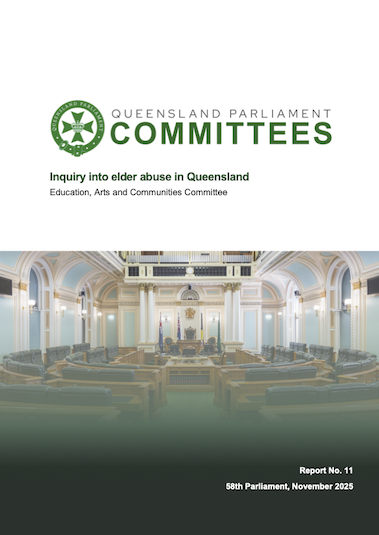
By Queensland Parliament. Education, Arts and Communities Committee
Responses to elder abuse, and opportunities to improve responses to elder abuse within the government, broader community, non-government and private sectors. The report provides 16 recommendations.
Key findings
Elder abuse often occurs in private settings, frequently within families, and remains underreported due to victims’ reluctance or lack of awareness. Evidence indicates that elder abuse stems from a complex and evolving environment, marked by ambiguous definitions and diverse causes. Contributing factors include family stress, social isolation and financial pressures. The committee noted pervasive ageism, whereby older people are at once undervalued yet expected to share their assets with younger generations. Data collection by government and funded services was found to be inadequate, inconsistent and poorly integrated across agencies. In addition to recommending that the Legislative Assembly note the report, the committee made 15 recommendations around the following key themes, to: improve data collection, management and reporting strengthen Queensland’s elder abuse prevention and response frameworks collaborate at a national level to ensure consistent reform.
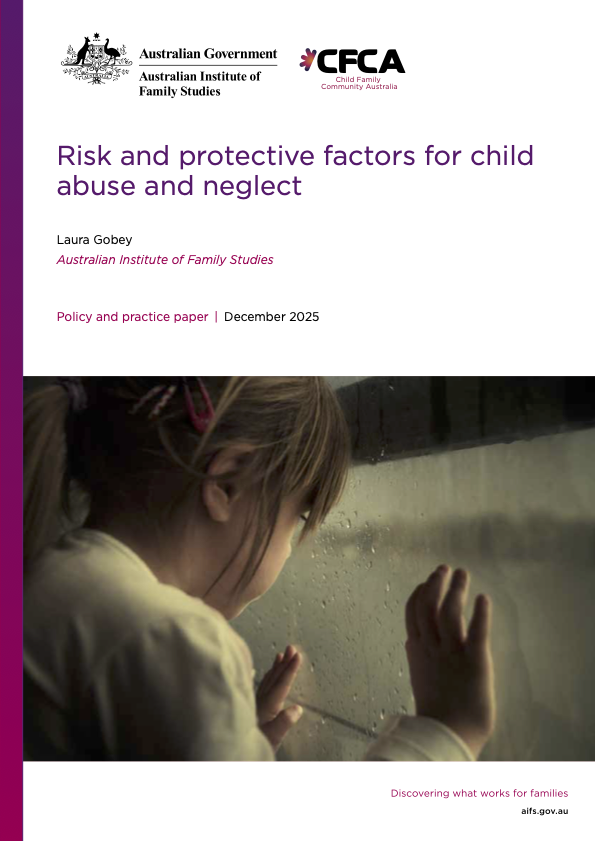
By Laura Gobey
Child abuse and neglect is a major problem in Australia. This policy and practice paper provides an overview of recent research evidence on the risk and protective factors for child abuse and neglect in families. It also discusses how knowledge of risk and protective factors can inform practice for practitioners and other professionals working with children and families.
By Rashad James
For community advocates, policymakers, and law enforcement agencies (LEAs) interested in exploring alternatives, this document outlines how federal immigration authorities can—and cannot—compel state and local LEAs to cooperate. It also proposes four strategies that state and local jurisdictions can adopt to resist the growing push for a uniform law enforcement system under executive authority. Specifically, jurisdictions can 1) name the actions currently underway; 2) claim their moral vision through proactive legislation; 3) restrain the use of local funding for immigration enforcement; and 4) reframe these initiatives as measures that strengthen public safety. Community members and elected leaders are encouraged to share this document as a pathway toward a more just and equitable future.

by Graeme R. Newman
In 1862, Henry Mayhew and John Binny walked into eleven of London's most notorious institutions — Newgate, Millbank, Pentonville, Brixton, the prison hulks at Woolwich, Coldbath Fields, Tothill Fields, Wandsworth, Holloway, the House of Detention at Clerkenwell, and Horsemonger Lane — and wrote down exactly what they saw: the governors, the warders, the chaplains, and the prisoners themselves, in their own words.
This edition brings that record back to life. Each chapter has been fully rewritten in modern prose while preserving every fact, every interview, and every argument the original authors made — from their case against purposeless hard labour to their unflinching accounts of the convict nursery, the condemned cell, and the boy discharged from prison with no one waiting at the gate.
A new introduction and retrospective, written for this edition, follows these institutions into the present: which ones were demolished, which became galleries, cathedrals, and post offices — and which are still open today, cited in current inspection reports for the very same overcrowding and neglect that Victorian reformers were fighting a century and a half ago.
What you'll find inside: • Eleven Victorian prisons, reconstructed room by room, cell by cell • Real testimony from governors, chaplains, and prisoners — first offenders and lifelong professionals alike • A frank, often moving record of Victorian London's poorest and most desperate • A new historical retrospective connecting each institution to its fate today
Part social history, part true crime, part uncomfortable mirror — London Prisons: A Retrospective is a door-by-door tour of a city's conscience, then and now.
Read-Me.Org Inc. New York-Philadelphia-Australia. 2026. p.339.

by Nettly Lucas (Author), Graeme Newman (Introduction)
Step into the hidden London of the 1920s—a city of fashionable hotels and crowded streets, respectable suburbs and shadowy back rooms, Scotland Yard detectives and professional criminals who made deception, burglary, fraud and blackmail their trade.
First published in 1926, London and Its Criminals is Netley Lucas’s remarkable journey through the criminal underworld of interwar London. Rather than simply recounting celebrated crimes, Lucas sets out to describe criminals themselves: how they lived, where they gathered, the methods they used, the slang they spoke, and the elaborate machinery of policing that pursued them.
The result is an extraordinary period portrait of crime and criminal justice.
Lucas takes his readers inside Scotland Yard and its Criminal Record Office, explaining the growing importance of fingerprints, criminal records and systematic detection. From there he ventures into a very different London—the world of professional burglars, pickpockets, confidence tricksters, jewel thieves, forgers, blackmailers and criminal gangs. He introduces his readers to figures he describes as the “Kings” and “Queens” of the Underworld: men and women who move between cheap public houses, prosperous suburban homes, exclusive restaurants and fashionable hotels while living secret criminal lives.
Among the book’s most striking chapters are Lucas’s accounts of “master criminals” and “crooked women.” His characters include expert burglars, ingenious forgers, sophisticated jewel thieves and accomplished confidence tricksters. Some are frightening, some ingenious, some surprisingly ordinary. Again and again Lucas emphasizes the unsettling proximity of the criminal world to respectable society.
Yet London and Its Criminals is more than a gallery of rogues. Lucas was writing at a moment when attitudes toward crime and punishment were beginning to change. He opens the book by discussing the emerging scientific study of crime, criminal psychology, rehabilitation and the limitations of imprisonment—questions that remain central to debates about criminal justice a century later.
Lucas is also an unusually provocative guide. He claims familiarity with criminals themselves and repeatedly describes conversations, meals and encounters with people operating on the wrong side of the law. His London is consequently not the London of official police reports alone. It is a city observed from its restaurants, streets, clubs, pubs, courtrooms and criminal meeting places.
Modern readers should approach some of Lucas’s language, assumptions and sweeping judgments as products of their time. That is also part of the historical importance of the book. It provides a vivid primary-source window into how crime, policing, punishment, class and the urban underworld were represented during the 1920s.
This new Read-Me.Org Classic Reprint presents Lucas’s fascinating account to a new generation of readers, accompanied by a detailed new Introduction by Graeme Newman that places the work in its historical and criminological context.
For readers interested in true crime, criminology, Scotland Yard, policing, criminal history, London history, organized crime and the social history of the 1920s, London and Its Criminals offers a fascinating journey into a vanished—but sometimes surprisingly familiar—criminal world
Read-Me.Org Inc. New York-Philadelphia-Australia. 2026. p.194.
By William Downs
Police disciplinary proceedings are brought in cases where it is agreed, following an investigation, that a police officer has a case to answer for: • misconduct (meaning a breach of the standards of professional behaviour that justifies disciplinary action of at least written), or • gross misconduct (meaning a breach of the standards of professional behaviour that is so serious to justify dismissal) A decision on whether there is a case to answer is based on whether there is sufficient evidence upon which a misconduct panel “could make a finding on the balance of probabilities” that an officer’s behaviour amounted to misconduct or gross misconduct. The Commons Library briefings Police standards: Complaints and Police Standards: Conduct explain in more detail how allegations of police wrongdoing are investigated.
London: UK Parliament. House of commons Library.. 2025. 19p.
By Mary Holper
The United States once authorized only border-based mandatory detention. However, immigration detention is now like an enormous fortress that has grown two mandatory detention turrets: status-based mandatory detention and crime-based mandatory detention. Status-based mandatory detention sees its only doctrinal foundations in the detention of those physically standing at the border. Yet, it has grown to reach both physically and temporally beyond those stopped at the border. Status-based mandatory detention first grew to include those stopped within 100 miles of a land border and under fourteen days in the U.S., whom immigration enforcement agents placed in expedited removal. Then, status-based mandatory detention grew further to include those stopped anywhere in the U.S. and under two years in the U.S., whom immigration enforcement agents placed in expedited removal. Most recently, status-based mandatory detention has grown to include persons who entered the U.S. at any time and whom immigration enforcement agents never placed in expedited removal.
This article documents each of the blocks that have been placed in the massively-growing turret of status-based mandatory detention, and analyzes the strength of each block to hold up the turret. The article argues that broad status-based detention is inconsistent with the intent of Congress in passing what traditionally has been border-based mandatory detention. Under principles of statutory interpretation, this excessively large status-based mandatory detention turret cannot hold up.
Boston College Law School Legal Studies Research Paper No. 65653 Fordham Urb. L. J. ___ (forthcoming 2026)44 Pages Posted: 16 Aug 2025 Last revised: 9 Sep 2025
By Ichiro Iwasaki and Kocenda, Evzen
We examine the corporate criminal records of 18,187 firms operating in 17 European emerging markets and empirically analyze the effects of board composition and national institutions on crime deterrence. Our analysis reveals that 872 firms (about 5% of the sample) committed 1,734 crimes over 2020-2023. We show that firms with larger boards and greater board independence are associated with higher incidences of corporate crime, suggesting that larger or nominally independent boards may not function effectively in emerging market contexts. In contrast, female leadership and board gender diversity do not exhibit significant deterrent effects, implying that gender inclusion alone may not suffice in these environments. In banks with an outside board chairman, the occurrence of corporate crime increases substantially. Importantly, stronger national institutions consistently correlate with lower crime rates, a pattern observed universally across European emerging markets, and boards in countries with stronger institutions appear more effective in deterring crime
CESifo Working Paper No. 12132 54 Pages Posted: 23 Sep 2025
By Graeme R. Newman
This essay critiques a study by Copes and Vieraitis regarding the "bounded rationality" of identity thieves, arguing that a focus on offender psychology and rationalizations is insufficient for developing effective crime reduction policies[cite: ]Newman contends that current criminal justice approaches rely too heavily on punishment and victim vindication, which, while politically satisfying, fail to reduce the prevalence of identity theft.
The author advances the following arguments regarding the development of effective policy:
* Policies based on the "deep psychology" of offenders or their denial of victims are largely fruitless because these rationalizations are often unconscious defense mechanisms. Instead of asking “why” offenders commit crimes, policy should focus on “how” they are accomplished.
* Newman distinguishes between crime mitigation (reducing damage to victims) and crime prevention (reducing the number of crimes)[cite:. While legislation and credit reporting agencies have improved mitigation efforts for victims, these measures do not address the root causes of the crime.
* Effective prevention must target the technological and business arrangements that create opportunities for theft. This involves shifting focus from the offender to the "significant players" (businesses) who can implement standard security procedures, such as the use of PINs for credit cards, to harden targets.
* The essay concludes that businesses often view fraud merely as a cost of doing business rather than a crime to be prevented[cite:. Therefore, the government must establish policies that compel businesses to accept responsibility for crime reduction and eliminate the opportunities they create through their products and services[cite.
Criminology and Public Policy Vol. 8. Issue 2.
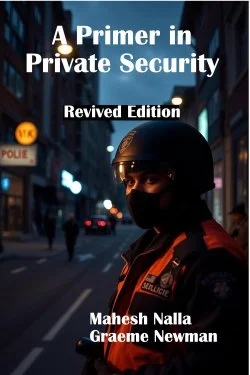
By Mahesh Nalla and Graeme Newman
When the first edition of A Primer in Private Security was published, its principal purpose was to demonstrate that private policing was not a mere auxiliary to public law enforcement but a robust and rapidly growing institution with its own organizational forms, priorities, and traditions. At that time, the Hallcrest Report had just confirmed that private security personnel outnumbered public police officers in the United States, a landmark finding that set the tone for debates about the privatization of policing .
Nearly four decades later, the central argument remains as relevant as ever, but the field itself has changed dramatically. Private security is now not only a supplement to public policing but a global, technologically sophisticated industry involved in nearly every sector of modern life. While we think that the original book still remains relevant to security today, we suggest in this preface that the reader approach the content from the point of view of four major perspectives that dominate security (the word “private” seems old fashioned and less appropriate given that what is public and what is private have become incredibly and interwoven largely as a result of media, especially social media).
The four perspectives are:
1. the domestic sphere of home and family,
2. the economic sphere of business,
3. the public sphere of local and state government, and
4. the international sphere of global security and climate-related risk.
Read-Me.Org Inc. New York-Philadelphia-Australia. 2025. 183p.

ByThomas D. Akoensi, Justice Tankebe
Using an experimental vignette design, the study inves-tigates the effects of criminal records on the hiring deci-sions of a convenience sample of 221 human resource(HR) managers in Ghana. The HR managers were ran-domly assigned to read one of four vignettes depicting job seekers of different genders and criminal records:male with and without criminal record, female with and without criminal record. The evidence shows that a criminal record reduces employment opportunities for female offenders but not for their male counter-parts. Additionally, HR managers are willing to offer interviews to job applicants, irrespective of their crim-inal records, if they expect other managers to hire ex-convicts. The implications of these findings are dis-cussed.
The Howard Journal of Crime and Justice, online first, May 2024

By Matthew Bonn, Chelsea Cox, Marilou Gagnon. et al.
The International Guidelines on Human Rights and Drug Policy recommend that States commit to adopting a balanced, integrated, and human rights-based approach to drug policy through a set of foundational human rights principles, obligations arising from human rights standards, and obligations arising from the human rights of particular groups. Following two years of consultation with stakeholders, including people who use drugs, NGOs, legal and human rights experts, UN technical agencies and Member States, the Guidelines “do not invent new rights. Rather, they apply existing human rights law to the legal and policy context of drug control to maximise human rights protections, including in the interpretation and implementation of the drug control conventions.” In respect of the Guidelines and its obligations under UN human rights treaties, Canada must adopt stronger and more specific commitments for a human rights-based, people centered and public health approach.3 This approach must commit to the removal of criminal penalties for simple possession and a comprehensive health-based approach to drug regulation.
Ottawa, ONT: Royal Society of Canada, 2024. 52p.
By Ben Grunwald and Jeffrey Fagan
In 2000, the Supreme Court held in Illinois v. Wardlow that a suspect’s presence in a “high-crime area” is relevant in determining whether an officer has reasonable suspicion to conduct an investigative stop. Despite the importance of the decision, the Court provided no guidance about what that standard means, and over fifteen years later, we still have no idea how police officers understand and apply it in practice. This Article conducts the first empirical analysis of Wardlow by examining data on over two million investigative stops conducted by the New York Police Department from 2007 to 2012. Our results suggest that Wardlow may have been wrongly decided. Specifically, we find evidence that officers often assess whether areas are high crime using a very broad geographic lens; that they call almost every block in the city high crime; that their assessments of whether an area is high crime are nearly uncorrelated with actual crime rates; that the suspect’s race predicts whether an officer calls an area high crime as well as the actual crime rate; that the racial composition of the area and the identity of the officer are stronger predictors of whether an officer calls an area high crime than the crime rate itself; and that stops are less or as likely to result in the detection of contraband when an officer invokes high-crime area as a basis of a stop. We conclude with several policy proposals for courts, police departments, and scholars to help address these problems in the doctrine.
California Law Review 345-404 (2019

By Damon L. Perry
In Britain, no one has the right not to be offended. Words or actions that are taken by some as offensive – whether they relate to religion, sexuality or race – are not criminal as long as they are not intentionally hostile and meant, or likely, to incite hatred. The statutory guidance on Non Crime Hate Incidents, revised in March 2023, is consistent with the law in this regard. It states: “Fundamentally, offending someone is not, in and of itself, a criminal offence. To constitute an offence under hate crime legislation, the speech or behaviour in question must be threatening, abusive or insulting and be intended to, or likely to, stir up hatred”. Yet, this does not seem to be fully acknowledged in Britain’s schools. As this revealing survey of over a thousand teachers from YouGov and Policy Exchange demonstrates, since the Batley Grammar School protests, a small but significant proportion of British teachers have self-censored to avoid offence on religious grounds – 16%. (That proportion is slightly higher for teachers of certain subjects, including almost a fifth of all English teachers and art teachers – 19%). In areas with the largest Muslim populations, around 10% fewer teachers do not self-censor than those in areas with the smallest Muslim populations. A worrying proportion believe that – regardless of a teacher’s intentions – images of the prophet Muhammad should never be used in classrooms, even in the teaching of Islamic art or ethics: In addition to the 55% of teachers that would not personally use an image of Muhammad independently from the Batley Grammar School protests, an additional 9% said they personally were less likely to use it as a result of the events in Batley. The case of the teacher at Batley Grammar who went into hiding after death threats thus appears to have had a significant impact on teachers’ confidence and willingness to use materials that fall within the scope of the law. Alarmingly, half of British teachers believe that if blasphemy-related protests led by activist and advocacy groups occur outside their schools, there would be a risk to their physical safety. Despite most teachers thinking that headteachers get the balance right – between supporting them to use materials that are on the right side of the law but which might offend, and ensuring no offence is caused – they are clearly in need of greater confidence in the support they can expect from their headteachers and, in the case of activist-led protests outside their school gates, the police. Recent events have given further impetus to concerns regarding the physical safety of teachers and the security at schools. On 13 October, 2023, in Arras, France, a literature teacher, Dominque Bernard, was killed in a knife attack; the suspect, an Islamist extremist, was looking for teachers of history or geography. The case has been compared to that of Samuel Paty, the teacher who was killed three years ago by an Islamist extremist for showing cartoons of Muhammad to a class on freedom of expression. Both teachers have been described by President Macron as champions of the values of the French republic. Although this tragic incident took place across the Channel, France’s battle with Islamist extremism is one shared with the UK. Closer to home, in the wake of the Hamas terrorist attacks on hundreds of civilians in Israel on 7 October, protests on the streets of the UK against Israeli reprisals in the name of the Palestinian “resistance” have demonstrated alarming levels of hateful extremism and antisemitism.5 Some Jewish schools were forced to close on 13 October, when Hamas called for a “Global Day of Jihad”, and several Jewish schools were vandalised with red paint. The atmosphere has been fraught. The Department for Education wrote to school leaders “to ensure that any political activity from pupils in response to the crisis does not create an ‘atmosphere of intimidation’” etc.
London: Policy Exchange, 2024. 51p.