Open Access Free Library
CRIME+CRIMINOLOGY.jpeg

CRIME

Violent-Non-Violent-Cyber-Global-Organized-Environmental-Policing-Crime Prevention-Victimization

Posts in Policy Reform
A Psychological and Educational Survey of 1916 Prisoners in the Western Penitentiary of Pennsylvania (Copy)

By William T. Root, Jr.. With A Report on the Italian Convict, by Giovanni Giardini. . Modernized with a new Introduction by Graeme R. Newman.

Originally published in 1927, this pioneering study offers a remarkable examination of the psychological, educational, and social characteristics of 1,916 prisoners in Pennsylvania's Western Penitentiary. Based on extensive individual interviews, intelligence testing, psychiatric assessments, and institutional records collected between 1924 and 1926, William T. Root, Jr. investigates the complex relationship between criminal behavior, intelligence, education, poverty, family circumstances, and social environment.

Challenging the prevailing emphasis on punishment and vengeance, Root argues that criminal conduct must be understood through its underlying causes. His findings raise enduring questions about personal responsibility, social inequality, rehabilitation, and the capacity of prisons to reform rather than merely confine offenders.

The volume also includes Giovanni Giardini's revealing investigation of Italian immigrant prisoners, examining the influence of cultural background, immigration, and changing social conditions on patterns of offending.

Although rooted in the psychological theories and classifications of the 1920s, some now discredited, this work remains an important historical contribution to criminology, correctional psychology, and the development of evidence-based prison reform.

This Read-Me.Org Modernized-Classic edition presents a carefully condensed and modernized text, replacing extensive statistical tables with accessible summaries while retaining selected original graphs. A new Introduction by Graeme R. Newman places the study in its historical and intellectual context, critically examines its assumptions, and explains its continuing relevance. Review and discussion questions make the volume particularly useful for students, researchers, and readers interested in the history of criminal justice.

A compelling historical document that asks a question as urgent today as it was a century ago: Should society seek to understand and reform those who commit crimes, or simply punish them?

Read-Me.Org Inc. New York-Philadelphia-Australia. 2026. p.105.
A Psychological and Educational Survey of 1916 Prisoners in the Western Penitentiary of Pennsylvania

By William T. Root, Jr.. With A Report on the Italian Convict, by Giovanni Giardini. . Modernized with a new Introduction by Graeme R. Newman.

Originally published in 1927, this pioneering study offers a remarkable examination of the psychological, educational, and social characteristics of 1,916 prisoners in Pennsylvania's Western Penitentiary. Based on extensive individual interviews, intelligence testing, psychiatric assessments, and institutional records collected between 1924 and 1926, William T. Root, Jr. investigates the complex relationship between criminal behavior, intelligence, education, poverty, family circumstances, and social environment.

Challenging the prevailing emphasis on punishment and vengeance, Root argues that criminal conduct must be understood through its underlying causes. His findings raise enduring questions about personal responsibility, social inequality, rehabilitation, and the capacity of prisons to reform rather than merely confine offenders.

The volume also includes Giovanni Giardini's revealing investigation of Italian immigrant prisoners, examining the influence of cultural background, immigration, and changing social conditions on patterns of offending.

Although rooted in the psychological theories and classifications of the 1920s, some now discredited, this work remains an important historical contribution to criminology, correctional psychology, and the development of evidence-based prison reform.

This Read-Me.Org Modernized-Classic edition presents a carefully condensed and modernized text, replacing extensive statistical tables with accessible summaries while retaining selected original graphs. A new Introduction by Graeme R. Newman places the study in its historical and intellectual context, critically examines its assumptions, and explains its continuing relevance. Review and discussion questions make the volume particularly useful for students, researchers, and readers interested in the history of criminal justice.

A compelling historical document that asks a question as urgent today as it was a century ago: Should society seek to understand and reform those who commit crimes, or simply punish them?

Read-Me.Org Inc. New York-Philadelphia-Australia. 2026. p.105.
Rapid review of Victoria’s firearms laws: final report

Ken Lay

This rapid review of Victoria’s Firearms Laws was conducted in accordance with its Terms of Reference that required reforms that protect all Victorians, while recognising the legitimate need for some sectors of the community to possess, carry and use firearms. The review proceeds from a consistent starting point: no recreational pursuit, however valued, can take precedence over the safety of the whole community.

This report presents the findings and recommendations of this review across the matters specified in the Terms of Reference. It addresses nine key areas including: limits on the number of firearms an individual may hold the classification of firearms the licensing scheme, including citizenship requirements licence duration and monitoring Illicit firearms and emerging risks imitation firearms and accessories the use of criminal intelligence in licensing decisions information-sharing arrangements between agencies other considerations for the promotion of public safety. The review made 16 recommendations to the Victorian Government. The government has accepted 15 of those recommendations, and did not accept the recommendation related to capping firearms ownership.

The review was conducted in the context of significant national firearms reform activity being undertaken through National Cabinet, including the renegotiation of the National Firearms Agreement. Alignment with national settings has informed a number of the recommendations.

Key findings

Reducing firearm numbers reduces harm. A cap of up to four reflects current ownership patterns. Hunting drives higher firearm numbers in the state. Genuine need is not always assessed for each firearm acquired. Precedents already exist for limiting higher-risk firearms. Some licence holders present low public safety risk.
Firearm caps are an emerging policy tool.

Key recommendations

Introducing a cap of up to four firearms per individual category A & B licence holder. Limiting eligibility of firearm licences to Australian citizens, or New Zealand citizens with permanent residency in Australia who can
demonstrate a genuine reason for holding a licence. Legislative change to the Firearms Act 1996 (Vic) to update existing firearm categories so that higher-risk firearms are appropriately classified. Strengthening oversight across the full licence lifecycle – including renewal requirements, fit and proper person assessments, genuine reason assessments, and training and ongoing monitoring. Strengthening laws relating to the management of illicit firearms to address unlawful use, trafficking and transport risks. Strengthening the regulation of imitation firearms, firearm accessories and firearms-related items.

Mass Shooting in the United States: Large capacity ammunition magazines

By Violence Policy Center

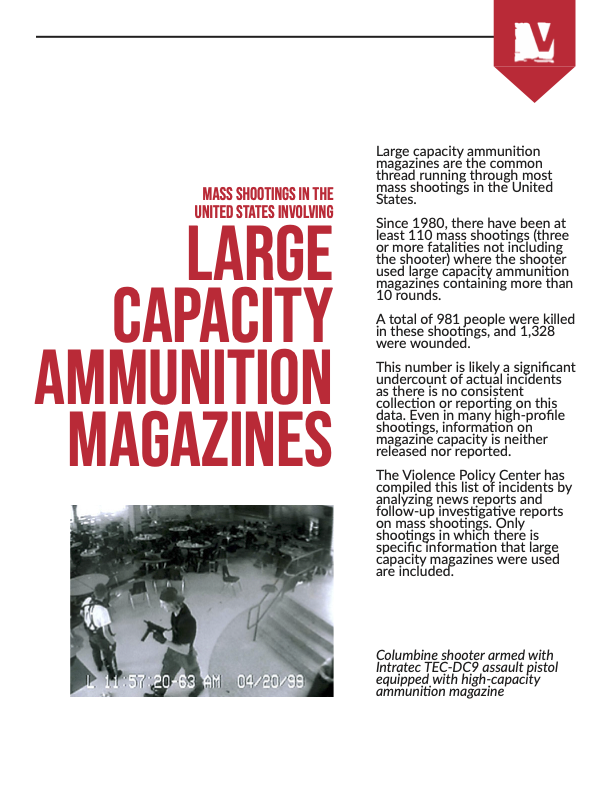
Large capacity ammunition magazines are the common thread running through most mass shootings in the United States. Since 1980, there have been at least 110 mass shootings (three or more fatalities not including the shooter) where the shooter used large capacity ammunition magazines containing more than 10 rounds. A total of 981 people were killed in these shootings, and 1,328 were wounded. This number is likely a significant undercount of actual incidents as there is no consistent collection or reporting on thisdata. Even in many high-profile shootings, information on magazine capacity is neither released nor reported. The Violence Policy Center has compiled this list of incidents by analyzing news reports and follow-up investigative reports on mass shootings. Only shootings in which there is specific information that large capacity magazines were used are included. Columbine shooter armed with Intratec TEC-DC9 assault pistol equipped with high capacity ammunition magazine

Large capacity ammunition magazines are the common thread running through most mass shootings in the United States. Since 1980, there have been at least 110 mass shootings (three or more fatalities not including
the shooter) where the shooter used large capacity ammunition magazines containing more than 10 rounds.
A total of 981 people were killed in these shootings, and 1,328 were wounded. This number is likely a significant undercount of actual incidents as there is no consistent collection or reporting on this data. Even in many high-profile shootings, information on magazine capacity is neither released nor reported. The Violence Policy Center has compiled this list of incidents by analyzing news reports and follow-up investigative reports on mass shootings. Only shootings in which there is specific information that large capacity magazines were used are included.

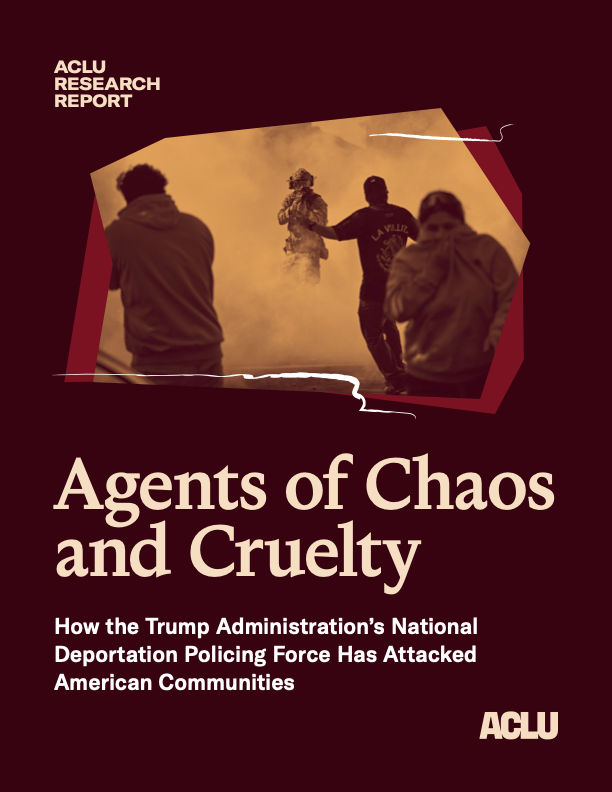
Agents of Chaos and Cruelty: How the Trump Administration’s National Deportation Policing Force Has Attacked American Communities

By American Civil Liberties Union

This ACLU research report, Agents of Chaos and Cruelty, documents widespread civil rights violations carried out by immigration agents during the first year of President Trump’s second term. The report examines immigration enforcement incidents in eight states – representing a cross-section of the country and reflecting varying degrees of federal law enforcement presence and personnel surges – and found that over 400 of the more than 1,200 immigration enforcement incidents examined involved misconduct by immigration agents. The report ends with detailed recommendations urging policymakers to call for transformative change to our immigration system, in recognition that it is broken and dangerous to human rights.

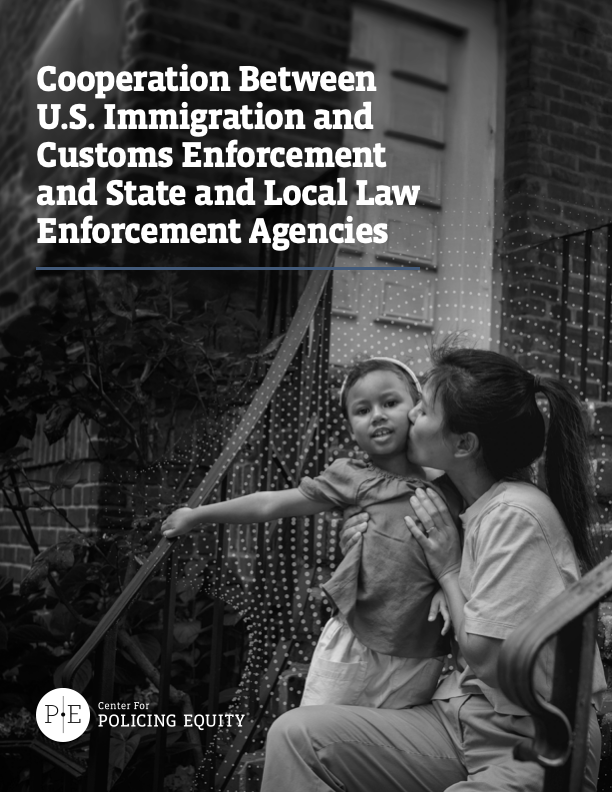
Cooperation Between U.S. Immigration and Customs Enforcement and State and Local Law Enforcement Agencies,

By Rashad James

For community advocates, policymakers, and law enforcement agencies (LEAs) interested in exploring alternatives, this document outlines how federal immigration authorities can—and cannot—compel state and local LEAs to cooperate. It also proposes four strategies that state and local jurisdictions can adopt to resist the growing push for a uniform law enforcement system under executive authority. Specifically, jurisdictions can 1) name the actions currently underway; 2) claim their moral vision through proactive legislation; 3) restrain the use of local funding for immigration enforcement; and 4) reframe these initiatives as measures that strengthen public safety. Community members and elected leaders are encouraged to share this document as a pathway toward a more just and equitable future.