

By United Nations EMLER
In the present report, the International Independent Expert Mechanism to Advance Racial Justice and Equality in Law Enforcement examines how racism is embedded in drug control systems and shapes their impacts on Africans and people of African descent. It begins by exploring the root causes of racial discrimination in drug policy, including the legacies of colonialism, the racialization of drugs, the influence of militarized approaches and the “war on drugs”. The Mechanism then analyses manifestations of racial discrimination across the criminal justice system. Building on this analysis, it examines the intersection of drug policy with other grounds of discrimination, such as gender, highlighting how intersecting forms of discrimination can increase the risk of human rights violations. The Mechanism also identifies factors that exacerbate these harms and concludes by highlighting promising practices and policy approaches aimed at
addressing racial discrimination and advancing more equitable and rights-based drug policies. The present report also includes information on the activities of the Mechanism since its previous report.
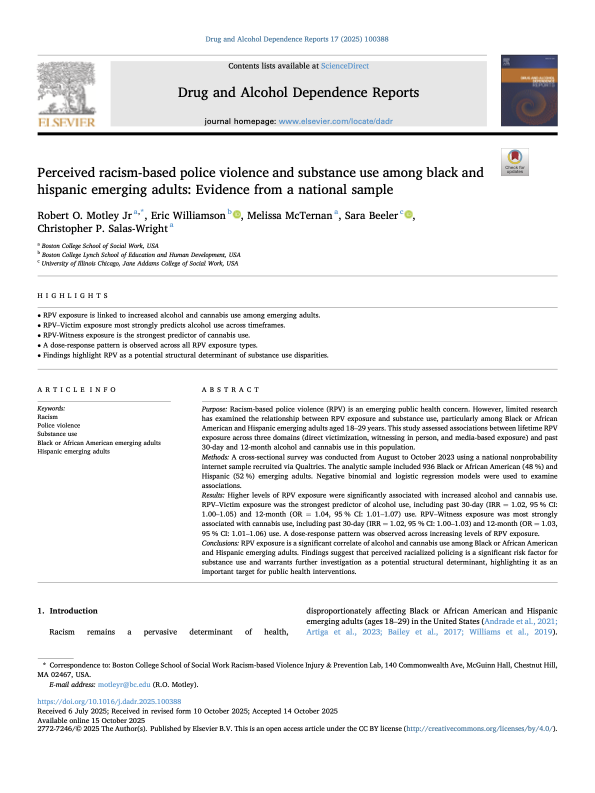
By Robert O. Motley Jr , Eric Williamson , Melissa McTernan , Sara Beeler c, Christopher P. Salas-Wright
Purpose
Racism-based police violence (RPV) is an emerging public health concern. However, limited research has examined the relationship between RPV exposure and substance use, particularly among Black or African American and Hispanic emerging adults aged 18–29 years. This study assessed associations between lifetime RPV exposure across three domains (direct victimization, witnessing in person, and media-based exposure) and past 30-day and 12-month alcohol and cannabis use in this population.
Methods
A cross-sectional survey was conducted from August to October 2023 using a national nonprobability internet sample recruited via Qualtrics. The analytic sample included 936 Black or African American (48 %) and Hispanic (52 %) emerging adults. Negative binomial and logistic regression models were used to examine associations.
Results
Higher levels of RPV exposure were significantly associated with increased alcohol and cannabis use. RPV–Victim exposure was the strongest predictor of alcohol use, including past 30-day (IRR = 1.02, 95 % CI: 1.00–1.05) and 12-month (OR = 1.04, 95 % CI: 1.01–1.07) use. RPV–Witness exposure was most strongly associated with cannabis use, including past 30-day (IRR = 1.02, 95 % CI: 1.00–1.03) and 12-month (OR = 1.03, 95 % CI: 1.01–1.06) use. A dose-response pattern was observed across increasing levels of RPV exposure.
Conclusions
RPV exposure is a significant correlate of alcohol and cannabis use among Black or African American and Hispanic emerging adults. Findings suggest that perceived racialized policing is a significant risk factor for substance use and warrants further investigation as a potential structural determinant, highlighting it as an important target for public health interventions.
By The International Crisis Group
What’s new? Since October 2019, Lebanon’s economic crisis has gutted funding for the country’s security forces, including the army and national police. Overstretched, these agencies have resorted to makeshift solutions for keeping the peace, including initiatives that allow communities to help police themselves.
Why does it matter? With the country’s security institutions struggling for resources, public safety in Lebanon is maintained by a patchwork of ad hoc solutions and quick fixes that cannot hold forever. As formal institutions continue to weaken, security will fray. Violence could follow, particularly in neglected and impoverished areas.
What should be done? Donors should keep pressing Lebanon’s leaders to better address the economic crisis so that the government can reinvest in the security forces’ long-term viability, especially after the latest destabilising Israel-Hizbollah war. In parallel, targeted interventions by donors can help bolster the security forces’ performance and professional integrity.
Brussels, Belgium : International Crisis Group, 2025. 49p.
By Corentin Cohen
This article looks at the discourses regarding Nigerian confraternities’ expansion to Europe. It analyses how networks of individuals working together for solidarity, economic or political objectives became categorized as organised crime or as a mafia. I use original data and police investigations, interviews with members and victims, judges, police officers, and journalists to show how the work of French and Italian institutions led to the emergence and transformation of discourses regarding the “Nigerian mafia” which, in the context of the 2015 migration crisis, came to designate confraternities. The circulation of these categories and frames cannot only be accounted for by the work of state institutions, but needs to be analysed through the sociology of information production and practices, which explains the effects of circular reporting, imposition of frames and narratives coming directly from investigations on criminal issues instead of other approaches to Nigerian migration.
Trends Organ Crim 26, 340–357 (2023
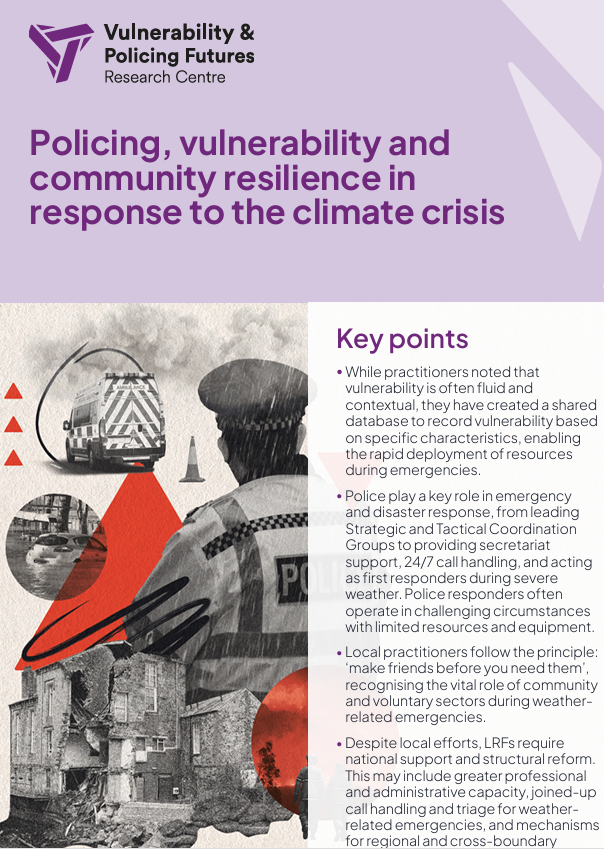
By Ali Malik
The increasing frequency and severity of extreme weather events in the UK, such as storms, flooding, heatwaves, and severe cold spells, recognised as consequences of the climate crisis, have placed significant operational and organisational pressures on police, emergency responders and local authorities. This research adopts an in-depth qualitative case study design and a temporal analogues approach, which draws on past experiences and events to develop an understanding of the present and inform future learning. Doing this provides insights into the role of the police and Local Resilience Forums (LRFs) in preparing for and responding to extreme weather eventsThe findings highlight that LRFs are essential for locally led emergency planning. However, due to resource constraints, these partnerships often rely on relational capital, negotiated agreement and goodwill. Decisive leadership, situational awareness, experience from past events and routine work were also described as key factors for effective emergency response. LRFs cannot mitigate the impacts of the climate crisis without national support. Local preparedness depends on safe homes, green spaces, reliable transport networks and affordable clean energy. The research also points to the need for greater professional, analytical, and specialist support for LRFs, along with targeted funding to resource localised efforts for preparedness, recovery, and long-term climate adaptation.
By William Downs
Police misconduct is behaviour by a police officer that falls below the standards of professional behaviour for the police.
Cases of police misconduct can arise from concerns raised by police officers or staff, or following incidents where members of the public have been harmed by the actions of the police.
What are the laws on police misconduct?
Legislation specifies how allegations of police misconduct should be handled, though the framework is complex. In short, most allegations of police misconduct are handled in line with rules set out in the Police Act 1996 and Police (Conduct) Regulations 2020. This legislation is designed to support the police in maintaining a disciplined force. The Home Office provides statutory guidance on implementing this legislation.
London: UK Parliament, House of Commons Library, 2025. 23p.
By William Downs
Police disciplinary proceedings are brought in cases where it is agreed, following an investigation, that a police officer has a case to answer for: • misconduct (meaning a breach of the standards of professional behaviour that justifies disciplinary action of at least written), or • gross misconduct (meaning a breach of the standards of professional behaviour that is so serious to justify dismissal) A decision on whether there is a case to answer is based on whether there is sufficient evidence upon which a misconduct panel “could make a finding on the balance of probabilities” that an officer’s behaviour amounted to misconduct or gross misconduct. The Commons Library briefings Police standards: Complaints and Police Standards: Conduct explain in more detail how allegations of police wrongdoing are investigated.
London: UK Parliament. House of commons Library.. 2025. 19p.