

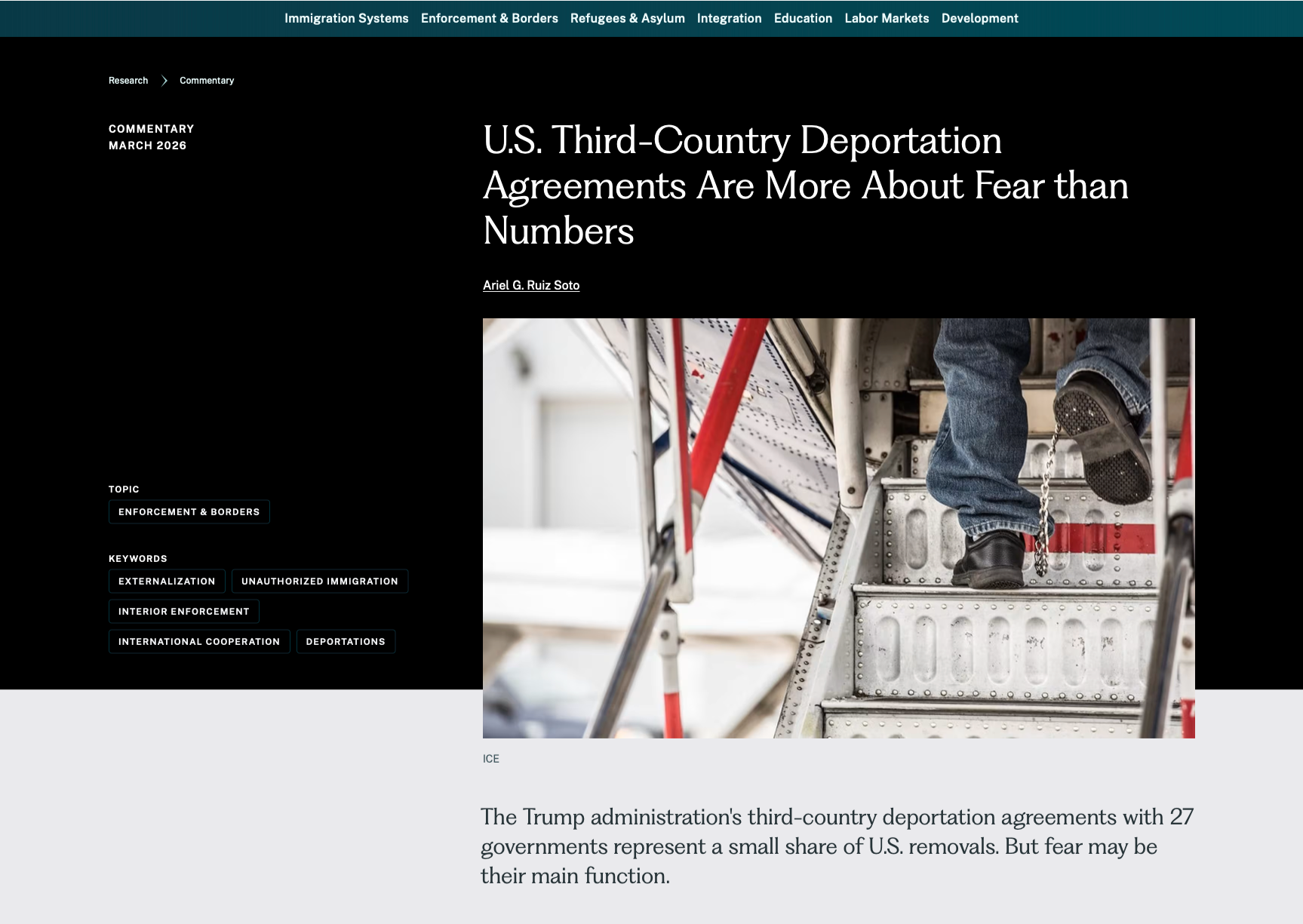
By Ariel G. Ruiz Soto
The Trump administration has entered into third-country deportation agreements with 27 countries to date—from Eswatini and Palau to Uzbekistan—sending people to nations where they have no ties, no
language, and in some cases, little to no legal recourse. Yet despite the high foreign policy priority placed by the U.S. government on reaching these agreements, only about 15,000 deportations in 2025 involved third countries, the Migration Policy Institute (MPI) estimates.
So, what is driving this policy?
The primary purpose appears less about achieving deportation at scale, given the administration’s goal to carry out 1 million deportations yearly, and more about the strategic use of fear, a new MPI short read argues. Signaling that deportation could mean relocation to a far-off, unfamiliar country with no legal status or protection could increase pressure on unauthorized immigrants to “self-deport” or deter future arrivals, the short read notes.
The analysis maps the four distinct types of agreements now in use, from safe third country agreements to incarceration deals. It examines critical gaps, including the lack of transparency around the agreements, the limited infrastructure of receiving countries, and the limbo deportees face. Courts in the United States and abroad are already weighing in, with the issue expected to end up before the Supreme Court
By Steven Blaakman
The European Union increasingly relies on cooperation with non-EU countries to tackle irregular migration, an issue of increasing political importance. However, sending irregular migrants back to their countries of origin or to a transit country depends on the other country agreeing to accept the migrant's readmission. In the 2000s, the EU started concluding readmission agreements with non-EU countries. From 2016, it started to focus on informal readmission deals. These non-legally binding agreements were easier to conclude, but did not lead to higher readmission rates. There was also less transparency about how they were negotiated and carried out, leading to human rights concerns. The European Parliament called for more transparency and scrutiny on several occasions. In 2025, the European Commission proposed a return regulation in a bid to boost migrant returns. Following the 2015 migration crisis, the EU also pursued non-binding agreements with third countries to prevent irregular migrants from arriving in the EU. This involved the EU offering incentives such as funding and visa liberalisation in exchange for non-EU countries doing more to stop migrants from travelling to the EU. As these are not legally binding, there is a lack of transparency and no clear role for the Parliament to check how these are being implemented. This has also led to concerns over human rights.The EU is updating rules on safe countries of origin and safe third countries to facilitate asylum application processing and setting up return hubs in non-EU countries.The Commission has made cooperation with non-EU countries an important part of its strategy for migration management to 2031 and is proposing extra funding to make this possible in the EU's budget for 2028-2034.