


By The American Immigration Council
In the spring and summer of 2018, the first Trump administration sought to deter migrants from coming to the United States through the cruel practice of separating children from their parents. To do this, they implemented the zero-tolerance policy, which aimed to prosecute all adults who crossed the southern border without inspection. If a family was apprehended, the parents were taken into custody by the Department of Homeland Security, while their children were taken into custody by the U.S. Department of Health and Human Services.
In many cases, these kids were sent to shelters thousands of miles away from their parents, without a way to contact them. Later, the government struggled to reunite families, in part because there was no centralized database of where the children had been sent or who their parents were. Years later, some of the nearly 3,000 children taken by the government during the zero-tolerance period had still not been reunited with their parents.
The American Immigration Council and partners filed a request under the Freedom of Information Act for records to better understand how the government implemented these separations. After the Council sued to obtain these records, the government began producing them on a monthly basis. In 2020, the Council published a tranche of documents highlighting the harms and trauma to children caused by the separations. After years of continuing litigation, the Council received tens of thousands of additional pages from government documents about this policy.
This site showcases a new subset of the records obtained. It reveals how journalists, attorneys and members of Congress fought to expose this horrific policy and hold the government accountable for the pain and havoc it created. Visitors to this site can review never-before-published government records, read analysis by the Council, and hear celebrated actors read first-person accounts by the journalists, attorneys and Congressmen who fought family separations on the front lines.
By Ariel G. Ruiz Soto
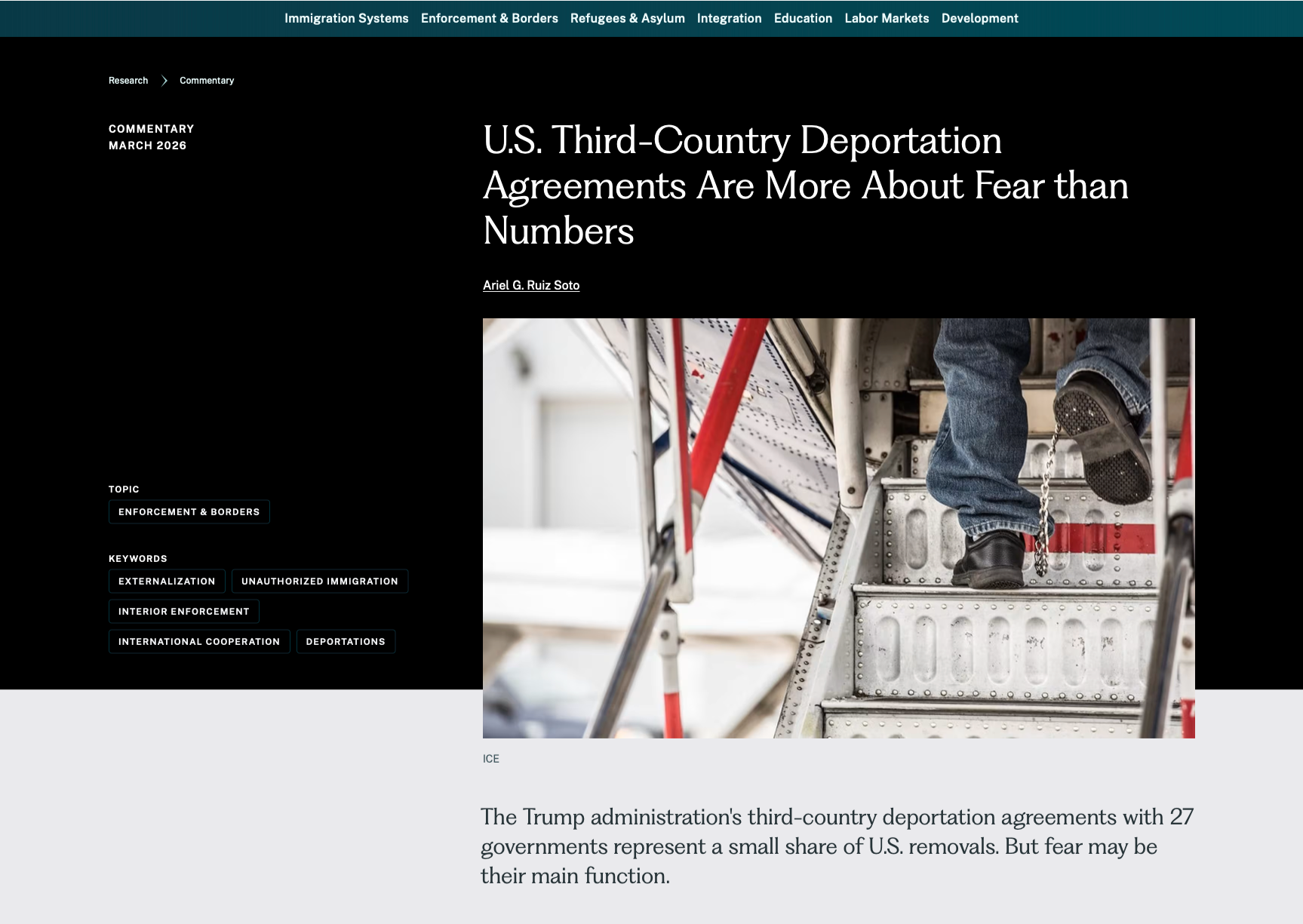
The Trump administration has entered into third-country deportation agreements with 27 countries to date—from Eswatini and Palau to Uzbekistan—sending people to nations where they have no ties, no
language, and in some cases, little to no legal recourse. Yet despite the high foreign policy priority placed by the U.S. government on reaching these agreements, only about 15,000 deportations in 2025 involved third countries, the Migration Policy Institute (MPI) estimates.
So, what is driving this policy?
The primary purpose appears less about achieving deportation at scale, given the administration’s goal to carry out 1 million deportations yearly, and more about the strategic use of fear, a new MPI short read argues. Signaling that deportation could mean relocation to a far-off, unfamiliar country with no legal status or protection could increase pressure on unauthorized immigrants to “self-deport” or deter future arrivals, the short read notes.
The analysis maps the four distinct types of agreements now in use, from safe third country agreements to incarceration deals. It examines critical gaps, including the lack of transparency around the agreements, the limited infrastructure of receiving countries, and the limbo deportees face. Courts in the United States and abroad are already weighing in, with the issue expected to end up before the Supreme Court