

By Ariel G. Ruiz Soto
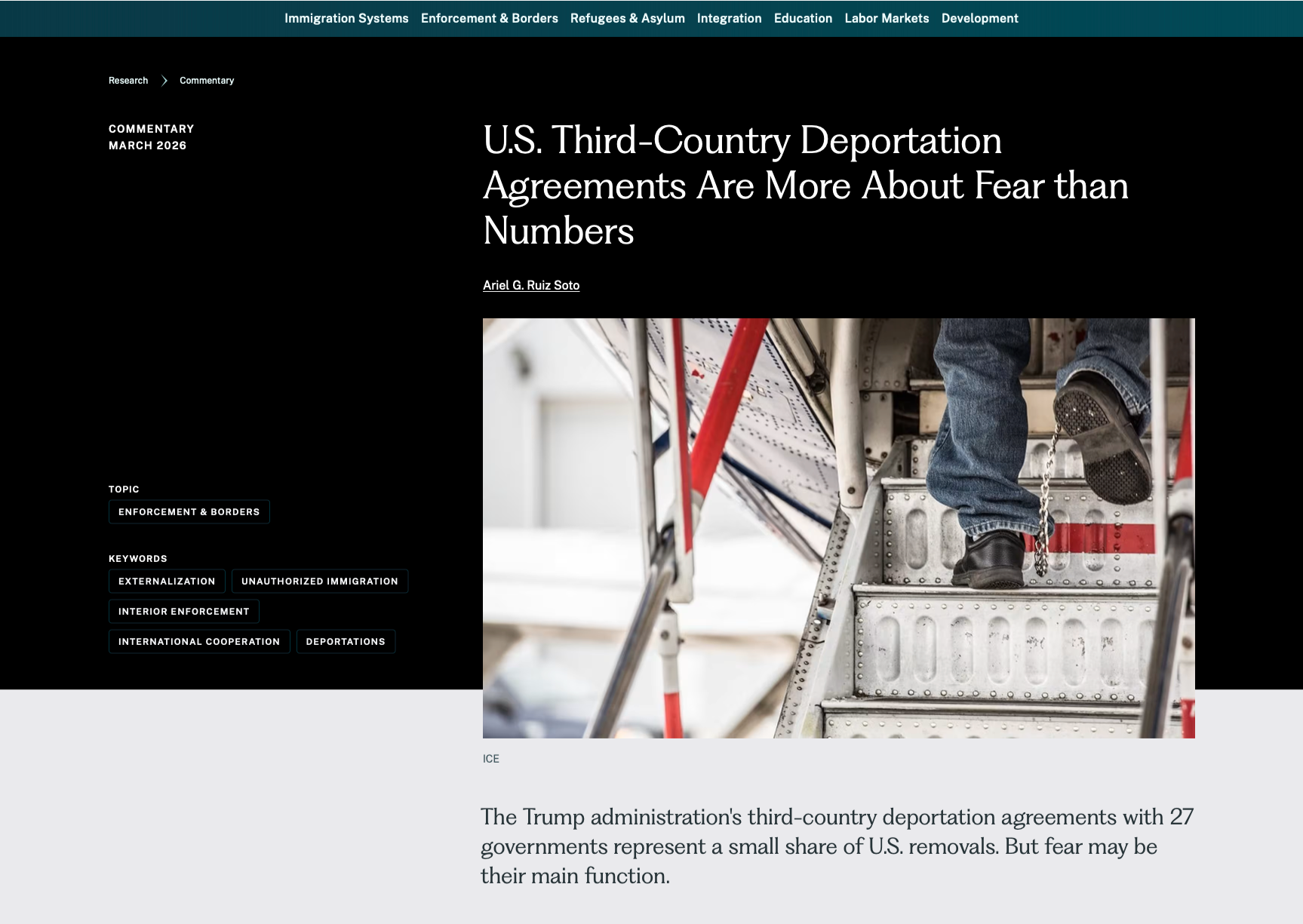
The Trump administration has entered into third-country deportation agreements with 27 countries to date—from Eswatini and Palau to Uzbekistan—sending people to nations where they have no ties, no
language, and in some cases, little to no legal recourse. Yet despite the high foreign policy priority placed by the U.S. government on reaching these agreements, only about 15,000 deportations in 2025 involved third countries, the Migration Policy Institute (MPI) estimates.
So, what is driving this policy?
The primary purpose appears less about achieving deportation at scale, given the administration’s goal to carry out 1 million deportations yearly, and more about the strategic use of fear, a new MPI short read argues. Signaling that deportation could mean relocation to a far-off, unfamiliar country with no legal status or protection could increase pressure on unauthorized immigrants to “self-deport” or deter future arrivals, the short read notes.
The analysis maps the four distinct types of agreements now in use, from safe third country agreements to incarceration deals. It examines critical gaps, including the lack of transparency around the agreements, the limited infrastructure of receiving countries, and the limbo deportees face. Courts in the United States and abroad are already weighing in, with the issue expected to end up before the Supreme Court
By Abigail Weitzman, Julia Behrman, Marta Ascherio
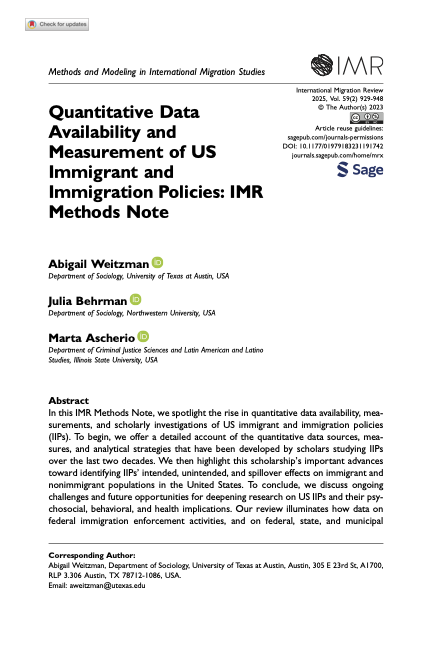
In this IMR Methods Note, we spotlight the rise in quantitative data availability, measurements, and scholarly investigations of US immigrant and immigration policies (IIPs). To begin, we offer a detailed account of the quantitative data sources, measures, and analytical strategies that have been developed by scholars studying IIPs over the last two decades. We then highlight this scholarship’s important advances toward identifying IIPs’ intended, unintended, and spillover effects on immigrant and nonimmigrant populations in the United States. To conclude, we discuss ongoing challenges and future opportunities for deepening research on US IIPs and their psychosocial, behavioral, and health implications. Our review illuminates how data on federal immigration enforcement activities, and on federal, state, and municipal immigrant laws have engendered
increasingly sophisticated quantitative studies of the US IIP climate. At the same time, it highlights several dimensions in which existing work stands to be strengthened, including the need for comparisons of newly developed IIP measures and their estimated effects; greater exploration of IIPs’ potentially heterogeneous effects across distinct subpopulations; and more attention to endogeneity, or in other words, the political and demographic processes that give rise to nonrandom variation in how IIPs take shape across space and time.