

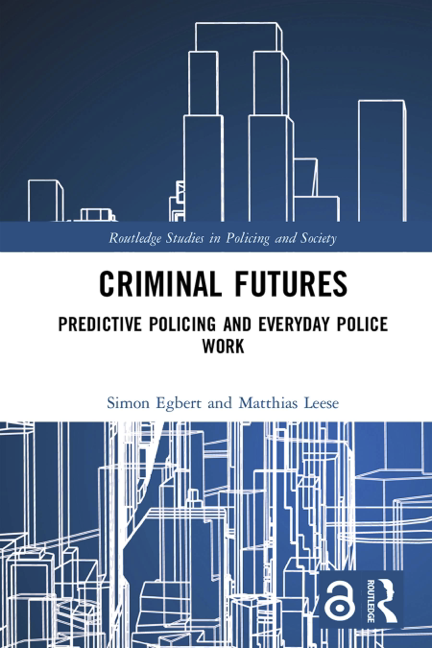
By Simon Egbert, Matthias Leese
This book explores how predictive policing transforms police work. Police departments around the world have started to use data-driven applications to produce crime forecasts and intervene into the future through targeted prevention measures. Based on three years of field research in Germany and Switzerland, this book provides a theoretically sophisticated and empirically detailed account of how the police produce and act upon criminal futures as part of their everyday work practices.
The authors argue that predictive policing must not be analyzed as an isolated technological artifact, but as part of a larger sociotechnical system that is embedded in organizational structures and occupational cultures. The book highlights how, for crime prediction software to come to matter and play a role in more
efficient and targeted police work, several translation processes are needed to align human and nonhuman actors across different divisions of police work.
Police work is a key function for the production and maintenance of public order, but it can also discriminate, exclude, and violate civil liberties and human rights. When criminal futures come into being in the form of algorithmically produced risk estimates, this can have wide-ranging consequences. Building on empirical findings, the book presents a number of practical recommendations for the prudent use of algorithmic analysis tools in police work that will speak to the protection of civil liberties and human rights as much as they will speak to the professional needs of police organizations.
An accessible and compelling read, this book will appeal to students and scholars of criminology, sociology, and cultural studies as well as to police practitioners and civil liberties advocates, in addition to all those who are interested in how to implement reasonable forms of data-driven policing
By Elini Manis, et al.
In this report, S.T.O.P. details how family surveillance apps transfer surveillance used for probation and parole to familial contexts, enabling abusive parents and intimate partners. Courts have even opportunistically used Life360, one family surveillance app, to enforce probation. The report calls on regulators to reign in family surveillance apps based on federal and state wiretap laws, and demands developers prioritize user safety if they refuse to pull the apps entirely.
Key Findings Include:
Family surveillance apps like Life360 repurpose the surveillance typically used to enforce probation and parole. In fact, some courts use Life360 in lieu of apps branded as probation or parole tools.
Family surveillance apps frequently function as stalkerware, enabling abusers to track their targets anywhere they go. These apps can enable abusive parents, intimate partner violence, and other crimes.
Most family surveillance apps track more data than needed to serve their core functions, compounding safety risks for tracked individuals.
Short of pulling family surveillance apps entirely, developers should implement anti-abusability measures recommended by advocates for survivors of domestic abuse.
By Corinne Worthington, et al.
In this report, S.T.O.P. details the NYPD Domain Awareness System’s unparalleled invasion of New Yorkers’ privacy rights. Formed through a public-private partnership with Microsoft, the DAS is an opaque surveillance command center that collects data from tens of thousands of camera feeds, license plate readers, radiological sensors, and other spyware for real-time, warrantless surveillance of New Yorkers across the city. The report uses the NYPD’s own public statements to detail the scope of surveillance systems that monitor New Yorkers every day.
Key Findings Include:
The New York City Police Department’s Domain Awareness System (“DAS”) links citywide camera networks, license plate readers, drone and helicopter feeds, ShotSpotter gunshot alerts, 911 and 311 call records, and countless police records, law enforcement databases, and data streams into a single surveillance network.
Part sensor network, part search engine, the DAS is the backbone of the NYPD’s surveillance program. Every NYPD officer has unfettered access to DAS data on their smartphone, allowing them to use and misuse this information for nearly any purpose.
DAS surveillance drives discriminatory stops and arrests of BIPOC and Muslim New Yorkers by giving officers access to illegal and prejudicial information.
The NYPD has expanded the DAS rapidly without oversight and ignored court-mandated reforms.