Open Access Free Library
CRIME+CRIMINOLOGY.jpeg

CRIME

Violent-Non-Violent-Cyber-Global-Organized-Environmental-Policing-Crime Prevention-Victimization

Posts in Police Practices
Analysis of Maritime Piracy and Armed Robbery in the Gulf of Guinea Maritime Domain

Kenneth U. NNADI, 1 Theophilus C. NWOKEDI, 1 Ignatius A. NWOKORO, 1 Obed C. NDIKOM,

The Gulf of Guinea in the past 14 years witnessed serious challenges of maritime piracy and armed robbery attacks. The paper analyzed maritime piracy and armed robbery in the Gulf of Guinea region from 2002 to 2015. Time series data of 14 years on the reported piracy and armed robbery attacks in the 15 Gulf of Guinea countries and nine coastal zones of Nigeria were obtained from International Maritime Bureau annual reports. Trend analysis model and analysis of variance (ANOVA) were used to analyze the data. It was found that there was significant variation in piracy and armed robbery attacks among the Gulf of Guinea countries, the greatest of attacks occurred in Nigeria. There was also a significant variation in piracy attacks among the coastal zones of Nigeria with attacks in Lagos ports and anchorages being highest within the period. There exists decreasing trend of attacks within the period.

Nnadi et al. / JEMS, 2016; 4(4): 271-287

An Overview of the Impact of Special Anti-Robbery Squad (SARS) in Nigeria

Ogbette, Afamefuna Samuel

This study examined the impact of Special Anti-Robbery Squad (SARS) in Nigeria. It solely depended on the secondary source for information. SARS is one of the Nigeria Police Force units that is saddled with the responsibility of fighting crime in the society; specifically, robbery and kidnapping. The impact was examined in two ways: Positive and Negative impact. From the positive point of view, SARS has been able to reduce robbery and kidnapping to an extent but unfortunately, people now use them as bodyguards to intimidate, suppress, and harass other people. From our findings, SARS tortures people mercilessly, extort, beat, kill and jail people who are not forthcoming with their demands

International Journal of Human Resource Studies ISSN 2162-3058 2018, Vol. 8, No. 4

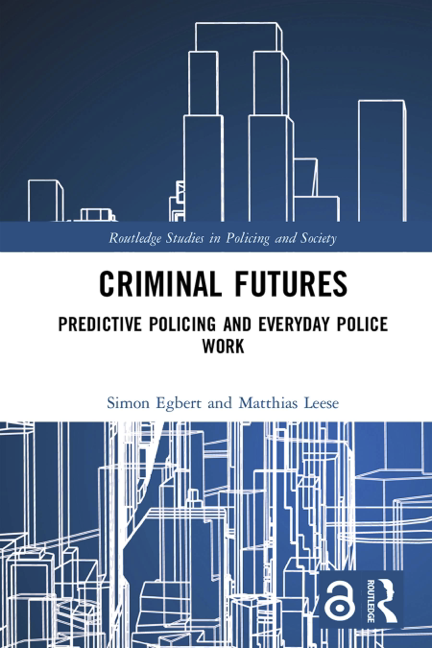
Criminal Futures: Predictive Policing and Everyday Police Work

By Simon Egbert, Matthias Leese

This book explores how predictive policing transforms police work. Police departments around the world have started to use data-driven applications to produce crime forecasts and intervene into the future through targeted prevention measures. Based on three years of field research in Germany and Switzerland, this book provides a theoretically sophisticated and empirically detailed account of how the police produce and act upon criminal futures as part of their everyday work practices.

The authors argue that predictive policing must not be analyzed as an isolated technological artifact, but as part of a larger sociotechnical system that is embedded in organizational structures and occupational cultures. The book highlights how, for crime prediction software to come to matter and play a role in more
efficient and targeted police work, several translation processes are needed to align human and nonhuman actors across different divisions of police work.

Police work is a key function for the production and maintenance of public order, but it can also discriminate, exclude, and violate civil liberties and human rights. When criminal futures come into being in the form of algorithmically produced risk estimates, this can have wide-ranging consequences. Building on empirical findings, the book presents a number of practical recommendations for the prudent use of algorithmic analysis tools in police work that will speak to the protection of civil liberties and human rights as much as they will speak to the professional needs of police organizations.

An accessible and compelling read, this book will appeal to students and scholars of criminology, sociology, and cultural studies as well as to police practitioners and civil liberties advocates, in addition to all those who are interested in how to implement reasonable forms of data-driven policing