Open Access Publisher and Free Library
CRIME+CRIMINOLOGY.jpeg

CRIME

Violent-Non-Violent-Cyber-Global-Organized-Environmental-Policing-Crime Prevention-Victimization

Posts in United States
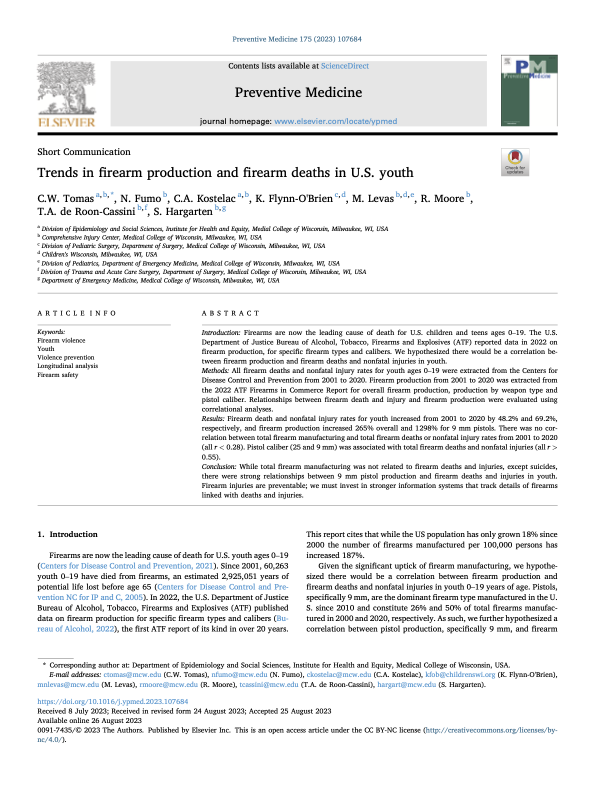
Trends in firearm production and firearm deaths in U.S. youth

By W Tomas, N Fumo, C A Kostelac, K Flynn-O'Brien, M Levas, R Moore, T A de Roon-Cassini, S Hargarten

Introduction: Firearms are now the leading cause of death for U.S. children and teens ages 0-19. The U.S. Department of Justice Bureau of Alcohol, Tobacco, Firearms and Explosives (ATF) reported data in 2022 on firearm production, for specific firearm types and calibers. We hypothesized there would be a correlation between firearm production and firearm deaths and nonfatal injuries in youth.

Methods: All firearm deaths and nonfatal injury rates for youth ages 0-19 were extracted from the Centers for Disease Control and Prevention from 2001 to 2020. Firearm production from 2001 to 2020 was extracted from the 2022 ATF Firearms in Commerce Report for overall firearm production, production by weapon type and pistol caliber. Relationships between firearm death and injury and firearm production were evaluated using correlational analyses.

Results: Firearm death and nonfatal injury rates for youth increased from 2001 to 2020 by 48.2% and 69.2%, respectively, and firearm production increased 265% overall and 1298% for 9 mm pistols. There was no correlation between total firearm manufacturing and total firearm deaths or nonfatal injury rates from 2001 to 2020 (all r < 0.28). Pistol caliber (25 and 9 mm) was associated with total firearm deaths and nonfatal injuries (all r > 0.55).

Conclusion: While total firearm manufacturing was not related to firearm deaths and injuries, except suicides, there were strong relationships between 9 mm pistol production and firearm deaths and injuries in youth. Firearm injuries are preventable; we must invest in stronger information systems that track details of firearms linked with deaths and injuries.

Hispanic Victims of Lethal Firearms Violence in the United States

By Terra Wiens  

  KEY FINDINGS AND RECOMMENDATIONS KEY FINDINGS ■ In 2023, more than 5,700 Hispanics were killed by guns. That year, 3,284 Hispanics died in gun homicides, 2,198 died in gun suicides, 63 died in unintentional shootings, and 202 died in other circumstances (including legal interventiona and undetermined intent). ■ More than 83,000 Hispanics were killed by guns between 2002 and 2023. During this period, 51,780 Hispanics died in gun homicides, 27,160 died in gun suicides, and 1,220 died in unintentional shootings. ■ Most Hispanic murder victims are killed with guns. In 2023, guns were used in more than three-quarters of the homicides where the victims were Hispanic. The latest data show that for homicides where the victim was Hispanic and a gun was used, 53.0 percent of these shootings involved a handgun. ■ The homicide victimization rate for Hispanics in the United States is higher than the homicide victimization rate for whites. The Hispanic homicide victimization rate in 2023 was 6.3 per 100,000. In comparison, the homicide victimization rate for whites was 2.9 per 100,000. ■ As a result of the limitations in current data collection, the total number of Hispanic victims is almost certainly higher than the reported numbers suggest. Government agencies often report data on race but not on ethnic origin. Recognizing the changing demographic landscape in the United States, it is clear that fully documenting such victimization is a crucial step in preventing it. RECOMMENDATIONS Governmental agencies that collect data on death and injury should obtain complete information on the ethnic origin of individuals in addition to their race. This will ensure complete and accurate data collection on Hispanic victims of lethal violence. ■ Individual-level ethnic origin information should be captured by all governmental agencies, regardless of department, and at all levels — local, state, and national — for all pertinent users and subjects of agency services. ■ Individual-level ethnic origin information should be self-reported and not based solely on a person’s surname or other measure. ■ All public access data and published reports issued by governmental agencies should include information on ethnic origin in addition to race. ■ The U.S. Department of Justice should issue periodic or special reports on Hispanic victimization. ■ States with a substantial proportion of Hispanic residents should issue periodic or special reports on Hispanic victimization and deaths due to all causes, including violence. Improved data collection is essential to fully understanding the scope of lethal firearms violence against Hispanics and helping develop effective measures to reduce such violence. At the same time additional efforts, both supporting current programs and activities as well as identifying new violence-reduction opportunities and approaches, should include the following: ■ Support for community-based violence intervention programs that are holistic and encourage participation by all stakeholders. ■ Educational efforts to better inform Hispanics of the risks associated with bringing a firearm into the home as measured by increased risk for homicide, suicide, and unintentional firearm deaths compared to how rarely guns are used in justifiable homicides. This is especially important in the face of current coordinated efforts by the gun industry targeting Hispanics as potential first-time gun buyers.b ■ Improved access to resources for victims and survivors of domestic violence. ■ Identification of anti-trafficking measures that could help interrupt the flow of illegal firearms into impacted communities   

America’s Incarceration Crossroads: Reversing Progress Amid Record-Low Crime Rates

By Nazgol Ghandnoosh and Sabrina Pearce

The U.S. criminal legal system stands at a crossroads. The United States remains a world leader in incarceration, locking up its citizens at a far higher rate than any other industrialized nation.

Between 1972 and 2009, the number of people imprisoned grew nearly 700%, while crime rates declined dramatically after peaking in 1991. Imprisonment levels slowly scaled back, achieving a 25% decline between 2009 and 2021. Then, the prison population has resumed its growth, according to the most recently available data. The prison population grew in 2022 and in 2023, 39 states increased their prison populations.

The COVID-19 pandemic contributed to a seismic increase in the most serious crime, homicide, which has fortunately declined to pre-pandemic levels. By 2024, homicide rates were 49% lower than their peak level in 1991. Violent and property crime rates overall have reached historic lows: 2024’s violent crime rate was 53% lower than its peak-1991 level and the property crime rate was 66% lower.

While crime rates are at historic lows, Americans deserve greater levels of community safety. A growing number of elected officials at the local, state, and federal levels have moved to overturn successful criminal justice reforms and revert to the failed playbook of mass incarceration, while the federal government has cut funding for important crime-prevention programs. Instead, policymakers should respond to crime upticks with evidence-based responses, while correcting the counterproductive, costly, and cruel responses of the past.

Excessive reliance on imprisonment in the United States is ineffective at addressing crime, diverts resources from effective public safety investments, upends family stability, contributes to trauma, and disproportionately harms communities of color. A vast body of research has established that we can advance community safety while reducing prison admissions as well as scaling back sentences for both those entering prisons and those already there