
Open Access Publisher and Free Library
CRIME+CRIMINOLOGY.jpeg

CRIME

Violent-Non-Violent-Cyber-Global-Organized-Environmental-Policing-Crime Prevention-Victimization

Posts tagged Policy Issues
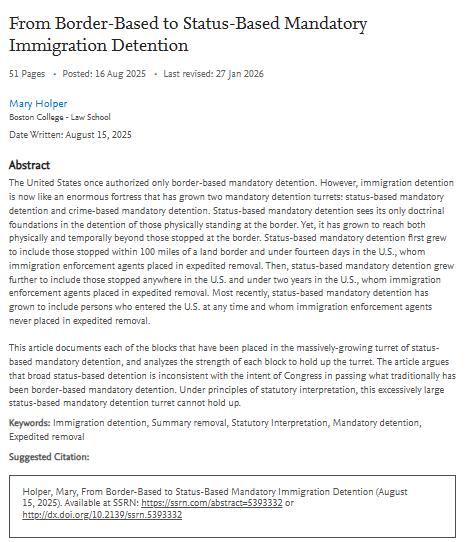
From Border-Based to Status-Based Mandatory Detention

Boston College Law School Legal Studies Research Paper No. 65653 Fordham Urb. L. J. ___ (forthcoming 2026)44 Pages Posted: 16 Aug 2025 Last revised: 9 Sep 2025

By Mary Holper

The United States once authorized only border-based mandatory detention. However, immigration detention is now like an enormous fortress that has grown two mandatory detention turrets: status-based mandatory detention and crime-based mandatory detention. Status-based mandatory detention sees its only doctrinal foundations in the detention of those physically standing at the border. Yet, it has grown to reach both physically and temporally beyond those stopped at the border. Status-based mandatory detention first grew to include those stopped within 100 miles of a land border and under fourteen days in the U.S., whom immigration enforcement agents placed in expedited removal. Then, status-based mandatory detention grew further to include those stopped anywhere in the U.S. and under two years in the U.S., whom immigration enforcement agents placed in expedited removal. Most recently, status-based mandatory detention has grown to include persons who entered the U.S. at any time and whom immigration enforcement agents never placed in expedited removal. 
This article documents each of the blocks that have been placed in the massively-growing turret of status-based mandatory detention, and analyzes the strength of each block to hold up the turret. The article argues that broad status-based detention is inconsistent with the intent of Congress in passing what traditionally has been border-based mandatory detention. Under principles of statutory interpretation, this excessively large status-based mandatory detention turret cannot hold up.

Boston College Law School Legal Studies Research Paper No. 656, 53, 2025 Fordham Urb. L. J. ___ (forthcoming 2026)

Bringing Made-in-Canada Democratic Accountability to Autonomous Policing

By Joseph Quesnel

Elected Representatives and the media are confused about what police independence means in Canada. Media accuse politicians who address policy issues with police of interfering in police operations. Ongoing pro-Palestinian protests in Canada have led to Canadians questioning police willingness to enforce the law in the face of troubled protest behaviour that has crossed into criminality. Canadians want police to enforce the law unbiasedly and believe police are accountable to the public. In examining the origins and evolution of Canada’s police independence doctrine, this study will show that Canadians have a point as our police are responsible to government ministers, meaning they are accountable to the Canadian public. However, Canadians know that the police must be insulated from political pressures. Canadian history contains examples of elected representatives inappropriately interfering in police operations. Perhaps the term ‘independence’ is inappropriate, given police are subject to laws, policies, and ministerial oversight. Police are autonomous, not independent. The study proposes a model of made-in-Canada democratic policing, allowing politicians to properly converse with police on policy directions while avoiding a form of “governmental policing” where elected representatives too easily influence police operations with partisan politics. Finally, the study’s policy recommendations set Canada toward “apolitical and autonomous” policing.

Winnipeg: Frontier Centre for Public Policy. 2024. 26p.