Open Access Publisher and Free Library
CRIME+CRIMINOLOGY.jpeg

CRIME

Violent-Non-Violent-Cyber-Global-Organized-Environmental-Policing-Crime Prevention-Victimization

Posts tagged immigration policy
Bridging the Immigration Detention Justice Gap

By Jaclyn Kelley-Widmer and  Alisa Whitfield

Immigrants held in United States detention centers experience a de facto denial of their right to access to counsel. The 38,000 immigrants detained each day are largely held in remote facilities, where they experience extremely poor—often abusive—conditions; the inability to contact counsel or prepare their cases; and a legal framework that is stacked against them. Many scholars have studied the overlapping challenges detained immigrants face in a hostile regime and have proposed solutions ranging from ending immigration prison to providing universal representation for all those detained to revising legal rationales for detention. These ideas are good ones. However, as we work towards such goals, tens of thousands remain detained with little recourse. As a partial way to bridge that gap, we argue for a transformative, collaborative model of access to justice that focuses on community empowerment and combines the work of organizers, attorneys, and law students in clinics.

 This article uniquely blends both theory and practical perspectives to advance a theory of abolition-minded provision of legal services in detention. First, we explore the legal right of access to counsel for detained immigrants, with an overview of Constitutional and international human rights models. We then examine the severe barriers to this counsel that immigration detention creates. We then use theories of abolition and legal pedagogy to explore an innovative and critical model for expanding justice in immigration detention. We propose primary goals of increasing access to counsel, empowering communities, and supporting organizing to work towards the end of immigration detention.

 This article was inspired by our experiences representing detained immigrants in a clinical setting, with law students, and in coalition with agencies and organizers working on the ground. Through examples, stories, and even photographs, we weave in insights from this ongoing collaborative project to advance a framework for bridging the immigration detention justice gap.

Cornell Legal Studies Research Paper 25-18, 2024

From Border-Based to Status-Based Mandatory Detention

By Mary Holper

The United States once authorized only border-based mandatory detention. However, immigration detention is now like an enormous fortress that has grown two mandatory detention turrets: status-based mandatory detention and crime-based mandatory detention. Status-based mandatory detention sees its only doctrinal foundations in the detention of those physically standing at the border. Yet, it has grown to reach both physically and temporally beyond those stopped at the border. Status-based mandatory detention first grew to include those stopped within 100 miles of a land border and under fourteen days in the U.S., whom immigration enforcement agents placed in expedited removal. Then, status-based mandatory detention grew further to include those stopped anywhere in the U.S. and under two years in the U.S., whom immigration enforcement agents placed in expedited removal. Most recently, status-based mandatory detention has grown to include persons who entered the U.S. at any time and whom immigration enforcement agents never placed in expedited removal. 
This article documents each of the blocks that have been placed in the massively-growing turret of status-based mandatory detention, and analyzes the strength of each block to hold up the turret. The article argues that broad status-based detention is inconsistent with the intent of Congress in passing what traditionally has been border-based mandatory detention. Under principles of statutory interpretation, this excessively large status-based mandatory detention turret cannot hold up.

Boston College Law School Legal Studies Research Paper No. 65653 Fordham Urb. L. J. ___ (forthcoming 2026)44 Pages Posted: 16 Aug 2025 Last revised: 9 Sep 2025

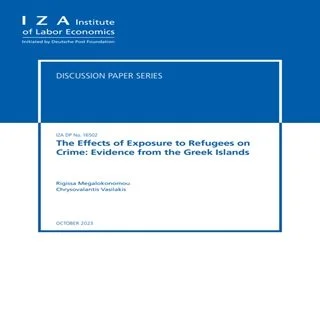
The Effects of Exposure to Refugees on Crime

By Rigissa Megalokonomou and Chrysovalantis Vasilakis

Recent political instability in the Middle East has triggered one of the largest influxes of refugees into Europe. The different departure points along the Turkish coast generate exogenous variation in refugee arrivals across Greek islands. We construct a new dataset on the number and nature of crime incidents and arrested offenders at island level using official police records and newspaper reports. Instrumental variables and difference-in-differences are employed to study the causal relationship between immigration and crime. We find that a 1-percentage-point increase in the share of refugees on destination islands increases crime incidents by 1.7-2.5 percentage points compared with neighboring unexposed islands. This is driven by crime incidents committed by refugees; there is no change in crimes committed by natives on those islands. We find a significant rise in property crime, knife attacks, and rape, but no increase in drug crimes. Results based on reported crimes exhibit a similar pattern. Our findings highlight the need for government provision in terms of infrastructure, social benefits, quicker evaluation for asylum, and social security.


IZA DP No. 16502

Bonn:  IZA – Institute of Labor Economics, 2023. 66p.

Taking Back the Streets: ICE and Local Enforcement Target immigrant Gangs

By Jessica M. Vaughan and Jon D. Feere

A new Center for Immigration Studies Backgrounder finds that immigration law enforcement has been highly effective in fighting gang activity around the country. Local law enforcement agencies that shun involvement with immigration law enforcement are missing an opportunity to protect their communities, according to the authors. Since 2005, ICE has arrested more than 8,000 immigrant gangsters from more than 700 different gangs under an initiative known as Operation Community Shield.

The Backgrounder, “Taking Back the Streets: ICE and Local Law Enforcement Target Immigrant Gangs,” by Jessica M. Vaughan and Jon D. Feere, was funded by the Department of Justice and describes the unique public safety problems posed by immigrant gangs. The authors present previously unpublished statistics on gang arrests by Immigration and Customs Enforcement (ICE), describe how immigration law enforcement authorities are used to combat gang activity, and offer policy recommendations to improve federal-local cooperation, and without damaging relations with immigrant communities.

Washington, DC: Center for Immigration Studies, 2008. 32p.