
Open Access Publisher and Free Library
CRIME+CRIMINOLOGY.jpeg

CRIME

Violent-Non-Violent-Cyber-Global-Organized-Environmental-Policing-Crime Prevention-Victimization

Posts tagged Youth Studies
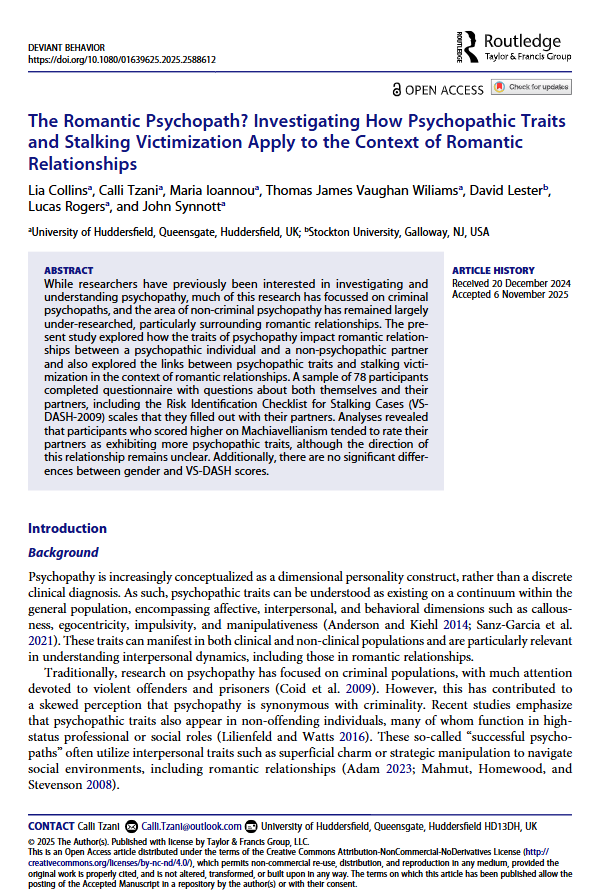
The Romantic Psychopath? Investigating How Psychopathic Traits and Stalking Victimization Apply to the Context of Romantic Relationships

By Lia Collins,Calli Tzani,Maria Ioannou,Thomas James Vaughan Wiliams,David Lester,Lucas Rogers


While researchers have previously been interested in investigating and understanding psychopathy, much of this research has focussed on criminal psychopaths, and the area of non-criminal psychopathy has remained largely under-researched, particularly surrounding romantic relationships. The present study explored how the traits of psychopathy impact romantic relationships between a psychopathic individual and a non-psychopathic partner and also explored the links between psychopathic traits and stalking victimization in the context of romantic relationships. A sample of 78 participants completed questionnaire with questions about both themselves and their partners, including the Risk Identification Checklist for Stalking Cases (VS-DASH-2009) scales that they filled out with their partners. Analyses revealed that participants who scored higher on Machiavellianism tended to rate their partners as exhibiting more psychopathic traits, although the direction of this relationship remains unclear. Additionally, there are no significant differences between gender and VS-DASH scores.


Nashville Longitudinal Study of Youth Safety and Wellbeing

By Maury Nation

The author reports on the motivation for developing and performing the Nashville Longitudinal Study of Youth Safety and Wellbeing (NLSYSW) as well as the project’s activities and outcomes, and resulting artifacts. The work of the NLSYSW was organized into working groups corresponding to the principal required tasks to develop the multi-sectoral dataset. The four data collection working groups focused on the following: Metropolitan Nashville Public Schools (MNPS) administrative data; MNPS survey data; contextual data; and youth mapping data. Two data management working groups focused on data anonymization and data archiving. The report describes the major tasks of each working group, the impact of the Covid-19 pandemic disruptions, and NLSYSW outputs and artifacts. The major output of the study was a compilation of multiple data sources with over two million observations and 450 variables; the report provides a list of data sources with the years of data included and a short description of each data set, and directs readers to the user guide and codebook sections for complete details.

Nashville, TN: Vanderbilt University, 2023. 167p.

Embracing Virtual Reality Technology with Black Adolescents to Redress Police Encounters

By Danielle M. Olson, Tyler Musgrave, Divya Gumudavelly, Chardee Galan, Sarita Schoenebeck, D. Fox Harrell, and Riana E. Anderson

Police brutality—including the incidents that mobilized collective outrage and action across the world during the summer of 2020—has negatively impacted the psychological health of Black youth for generations. Police harassment is a persistent form of racial discrimination that Black youth frequently navigate (Brunson, 2007), and particularly as a consequence of vicarious trauma via social media, it has been associated with depressive and anxious sequelae (e.g., Tynes et al., 2019). While Black youth are faced with policing experiences in vivo and in vitro, many studies of the psychological impact of policing are contained within traditional retrospective surveys, which limits our understanding of youth’s in-the-moment perceptions and desired concurrent actions. To expand the efforts to assess and redress youth’s experiences with police encounters, this manuscript details the development of an afterschool program that supports adolescents in the creation of a series of video game and virtual reality (VR) narratives. A participatory design method was utilized to co-create the perception of policing experiences with Detroit high school students enrolled in a computer science course, allowing them to actualize their experiences “on screen” and work towards redressing these experiences through co-construction and virtual activism.

United States, Journal of Youth Development Vol 18 Issue 3. 2023, 18pg