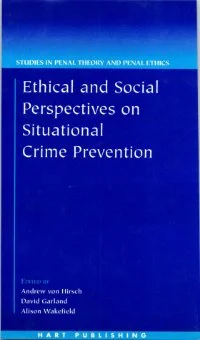
Edited By Andrew von Hirsch, David Garland, and Alison Wakefield
Ethical and Social Perspectives on Situational Crime Prevention is a penetrating examination of the ethical, social, and political questions raised by contemporary crime prevention strategies. Rather than debating whether situational crime prevention is effective, this volume explores the broader consequences of preventing crime by altering environments, regulating opportunities, and managing risk. [
Edited by leading criminologists Andrew von Hirsch, David Garland, and Alison Wakefield, the book brings together influential scholars to assess the impact of surveillance, target hardening, environmental design, access control, and other preventive measures on civil liberties, public space, community life, and social justice.
The contributors examine fundamental questions about the balance between security and freedom, the role of government and private organizations in crime control, and the ethical limits of increasingly preventive approaches to social regulation. Through rigorous analysis, the essays challenge readers to consider how crime prevention policies shape not only criminal behavior but also the character of modern society.
Combining criminological insight with philosophical and sociological inquiry, this collection is an essential resource for students, researchers, policymakers, and practitioners interested in the moral foundations and societal implications of crime prevention. It remains a significant contribution to debates about governance, security, citizenship, and the responsible pursuit of safer communities.
Oxford. Hart Publishing. Series: Studies in Penal Theory and Penal Ethics. 2000. 239p.