Open Access Publisher and Free Library
CRIME+CRIMINOLOGY.jpeg

CRIME

Violent-Non-Violent-Cyber-Global-Organized-Environmental-Policing-Crime Prevention-Victimization

Posts in crime prevention
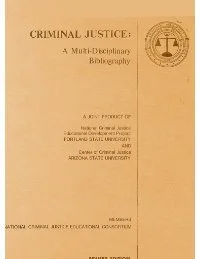
Criminal Justice: A Multidisciplinary Bibliography

By Florence Yosne. National Criminal Justice Educational Development Project Portland State University And Center Of Criminal Justice Arizona State University.

From the Introduction: This bibliography is the result of a cooperative effort between Portland State University and Arizona State University. It was developed in response to a need for a comprehensive and detailed multi-disciplinary compilation of available books and government documents that relate to the emerging field of Criminal Justice. Professional journals and magazine sources were not included due to person power constraints and the recognition that many of the more significant articles and statements relating to Criminal Justice can be found contained in recently-published books.

The bibliography is broken down into four general substantive areas: (1) criminal justice; (2) law enforcement; (3) corrections;  and (4) courts. The majority of the works are included under the heading "Criminal Justice." In this area, titles are included from such diverse fields as anthropology, economics, education, history, law, political science, psychology, the physical sciences, public administration, and sociology. The other three areas--"Law, Enforcement, " "Corrections, " and "Courts"--while more specific in nature, also reflect the use of information and research from many related and diverse sources.

Clearly, the specific subjects appearing within these four broad rubrics are varied and numerous. In order to facilitate the use of this bibliography, the four broad areas were further broken down into specific subjects such as "civil liberties, " "victimless crimes, " etc., with bibliography entries relating to those topics being identified. The detailed classification of bibliography entries appears at the end of this "Introduction."

It will be readily apparent to the user that the bibliography is multi-disciplinary in nature. This reflects the editor's view that Criminal Justice is a multi-disciplinary, problem-oriented field of scholarship, research, and teaching, embracing those aspects of the social, behavioral, natural, and medical sciences relating to understanding crime and social deviance and entailing a critical examination of the system which has evolved for the handling of attendant problems. The selection of authors, titles, and subjects reflects the need of Criminal Justice, as an emerging field of study, to be sensitive to the ideas and philosophies of a wide range of scholar sand researchers. A bibliography with a narrow focus is of organization and functioning of an entire society.

The sources for the bibliography were legion, and they also reflect the multi-disciplinary approach. Bibliographies from the faculty at Portland State University, Florida Slate University, Michigan State University, San Jose State University, and the University of California at Berkeley, in addition to the Index of Books in Print, catalogs from the National Criminal Justice Reference Service, lists from publishers, and reviews from the New York Review of Books, Psychology Today, and the Atlantic Monthly, provided the editor with the reference material necessary for so vast an undertaking.

 MEMBERS NATIONAL CRIMINAL JUSTICE EDUCATIONAL CONSORTIUM. 1975. 418p.

download
The Unknown Citizen

May Contain Markup

By Tony Parker

Study of Recidivism: The book explores the life of 'Charlie Smith,' habitual criminal, to understand the broader issue of recidivism and the challenges faced by repeat offenders.

Humanizing Criminals: It emphasizes treating criminals as human beings with complex backgrounds and not just as statistics or typical representatives of criminal behavior.

Systemic Failures: The narrative highlights the systemic failures in addressing the root causes of criminal behavior and the ineffectiveness of punishment alone.

Personal Struggles: Charlie's story reveals his personal struggles, lack of support, and the societal challenges that contribute to his repeated offenses.

Faber & Faber, Jul 16, 2013, 176 pages

READ
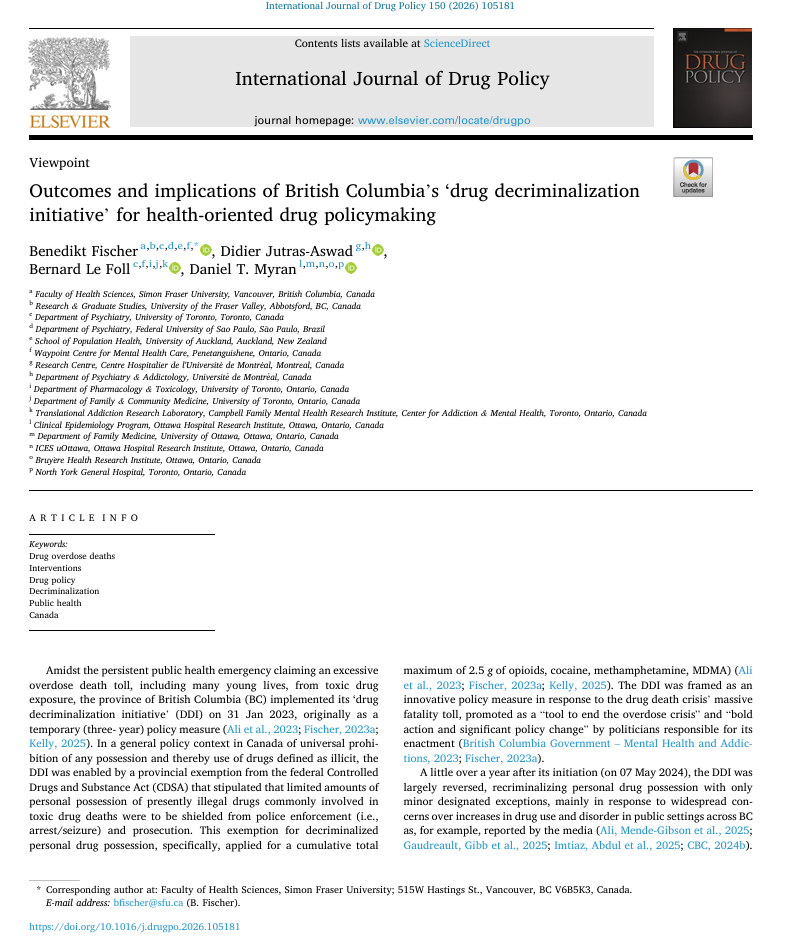
Urgent and long overdue: legal reform and drug decriminalisation in Canada

By Matthew Bonn, Chelsea Cox, Marilou Gagnon. et al.

The International Guidelines on Human Rights and Drug Policy recommend that States commit to adopting a balanced, integrated, and human rights-based approach to drug policy through a set of foundational human rights principles, obligations arising from human rights standards, and obligations arising from the human rights of particular groups. Following two years of consultation with stakeholders, including people who use drugs, NGOs, legal and human rights experts, UN technical agencies and Member States, the Guidelines “do not invent new rights. Rather, they apply existing human rights law to the legal and policy context of drug control to maximise human rights protections, including in the interpretation and implementation of the drug control conventions.” In respect of the Guidelines and its obligations under UN human rights treaties, Canada must adopt stronger and more specific commitments for a human rights-based, people centered and public health approach.3 This approach must commit to the removal of criminal penalties for simple possession and a comprehensive health-based approach to drug regulation.

Ottawa, ONT: Royal Society of Canada, 2024. 52p.

download
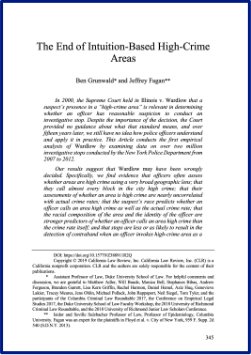
The End of Intuition-Based High-Crime Areas

By Ben Grunwald and Jeffrey Fagan

In 2000, the Supreme Court held in Illinois v. Wardlow that a suspect’s presence in a “high-crime area” is relevant in determining whether an officer has reasonable suspicion to conduct an investigative stop. Despite the importance of the decision, the Court provided no guidance about what that standard means, and over fifteen years later, we still have no idea how police officers understand and apply it in practice. This Article conducts the first empirical analysis of Wardlow by examining data on over two million investigative stops conducted by the New York Police Department from 2007 to 2012. Our results suggest that Wardlow may have been wrongly decided. Specifically, we find evidence that officers often assess whether areas are high crime using a very broad geographic lens; that they call almost every block in the city high crime; that their assessments of whether an area is high crime are nearly uncorrelated with actual crime rates; that the suspect’s race predicts whether an officer calls an area high crime as well as the actual crime rate; that the racial composition of the area and the identity of the officer are stronger predictors of whether an officer calls an area high crime than the crime rate itself; and that stops are less or as likely to result in the detection of contraband when an officer invokes high-crime area as a basis of a stop. We conclude with several policy proposals for courts, police departments, and scholars to help address these problems in the doctrine.

California Law Review 345-404 (2019

download
Community Criminology: Fundamentals of Spatial and Temporal Scaling, Ecological Indicators, and Selectivity Bias

By Ralph B. Taylor

For close to a century, the field of community criminology has examined the causes and consequences of community crime and delinquency rates. Nevertheless, there is still a lot we do not know about the dynamics behind these connections. In this book, Ralph Taylor argues that obstacles to deepening our understanding of community/crime links arise in part because most scholars have overlooked four fundamental concerns: how conceptual frames depend on the geographic units and/or temporal units used; how to establish the meaning of theoretically central ecological empirical indicators; and how to think about the causes and consequences of non-random selection dynamics. The volume organizes these four conceptual challenges using a common meta-analytic framework. The framework pinpoints critical features of and gaps in current theories about communities and crime, connects these concerns to current debates in both criminology and the philosophy of social science, and sketches the types of theory testing needed in the future if we are to grow our understanding of the causes and consequences of community crime rates. Taylor explains that a common meta-theoretical frame provides a grammar for thinking critically about current theories and simultaneously allows presenting these four topics and their connections in a unified manner. The volume provides an orientation to current and past scholarship in this area by describing three distinct but related community crime sequences involving delinquents, adult offenders, and victims. These sequences highlight community justice dynamics thereby raising questions about frequently used crime indicators in this area of research. A groundbreaking work melding past scholarly practices in criminology with the field’s current needs, Community Criminology is an essential work for criminologists.

New York; London: New York University Press, 2015. 336p.

download