by Graeme R. Newman with the assistance of Claude.
Can you stop crime before it starts, without fully knowing what causes it? A reader's guide to the 1936 symposium that gathered twenty-four programs trying to find out.
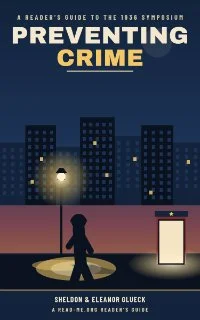
Preventing Crime: A Symposium, edited by Sheldon and Eleanor Glueck, brought together the directors of coordinated community councils, school bureaus, police prevention units, residential homes, child guidance clinics, a parent school, and boys' clubs, and asked each the same questions: what evidence shows the need for your program, how does it work, and how do you know whether it succeeds? The editors were candid from the start. Their title, they admitted in the preface, was optimistic, and a more accurate one would have been "Promising Efforts to Prevent Delinquency and Criminality." Only time and real evaluation, they wrote, could say whether these programs actually prevented anything.
The book is a portrait of what serious people believed about crime prevention in the depths of the Depression, and a case study in the gap between good intentions and good evidence. This Reader's Guide makes it accessible without replacing it. It explains what each program did, sets out the twelve principles the Gluecks drew from the contributions, and shows exactly what counted as proof of success in 1936, and how little of it would count today.
INSIDE THIS GUIDE
A reading plan and a chapter-by-chapter map of the original, with all twenty-five contributors
The Gluecks' opening argument: can crime be prevented without knowing its causes?
Twelve principles distilled from the programs, from starting early to using trained personnel
Community councils, school programs, police prevention bureaus, residential homes, clinics, and boys' clubs, program by program
A close look at "the audit problem": what each contributor offered as evidence, and what it actually showed
A worked example that tests one program's before-and-after numbers against six hard questions
What has changed since 1936, including the Cambridge-Somerville Youth Study's sobering results and decades of research on what works, what doesn't, and what's promising
Five common misreadings, a primer of evaluation terms, a glossary, an annotated reading list, an FAQ, 26 discussion questions and classroom activities
WHO IT'S FOR: Students of criminology, social work, education, public policy and program evaluation; practitioners designing youth programs; teachers and reading groups; and general readers curious about where crime prevention came from and why proving it works is so hard.
PLEASE NOTE: This is an independent guide, not an abridgment or edition of the original symposium. It does not reproduce the original's text and is not endorsed by the editors', or contributors', heirs. It is meant to be read alongside the original, which is in the public domain in the United States.
Written by Graeme R. Newman with the assistance of Claude, an AI model made by Anthropic. The AI-generated content is disclosed in accordance with Read-Me.Org policy.
Download the original book here.
Read-Me.Org Inc. New York-Philadelphia-Australia. 2026. p.54p.